
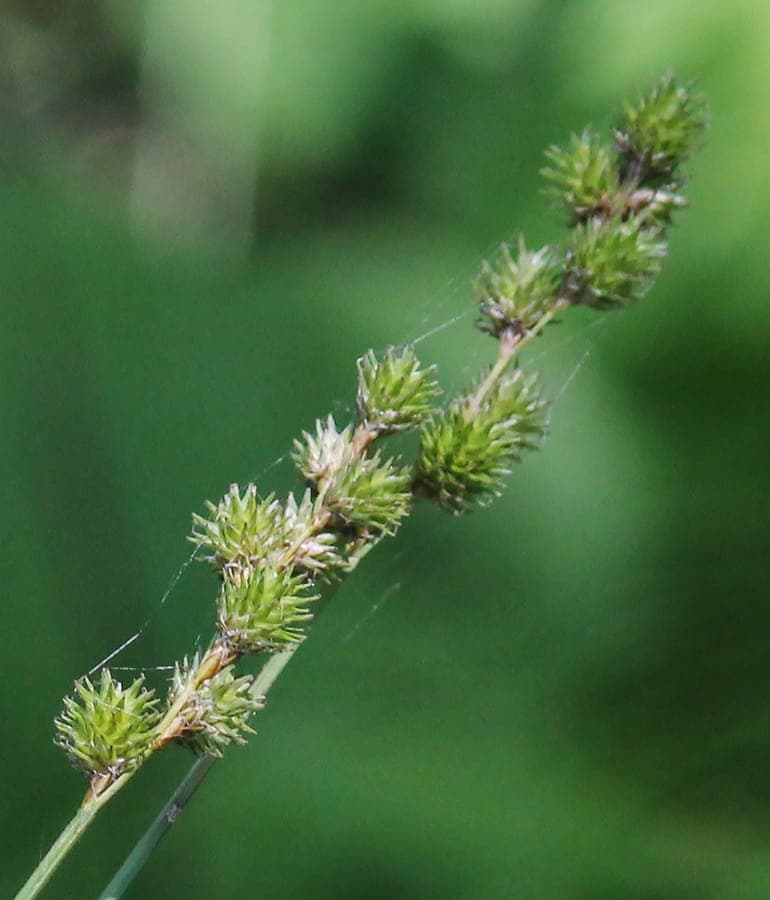
cassi saari / CC BY-SA 4.0, via Wikimedia Commons
Greater Straw Sedge: complete guide
Carex normalis
Want to see Greater Straw Sedge: complete guide in your garden?
1 minute, no credit card
Overview
Greater Straw Sedge (Carex normalis) is a remarkable grass-like plant from the Cyperaceae family, native to eastern North America. This semi-evergreen species specializes in moist soils and is widely used in naturalistic garden designs, water edges, and wetland areas. With its fine, rigid leaves, it forms dense ornamental tufts that remain attractive from early spring through deep autumn.
Appearance and Bloom
Carex normalis grows in compact, upright clumps with leaves reaching approximately 20-35 cm in height. The leaves are exceptionally fine-textured with a silky quality in bright to pale green. The plant develops small, inconspicuous green flowers in May-June, followed by brown seed heads that remain ornamental through autumn. The structure is graceful and airy, making it suitable for modern garden compositions.
Ideal Location
Greater Straw Sedge is extremely flexible regarding light conditions. It thrives better in dappled to deep shade, where it can establish itself without drying out. In full sun, plants require regular moisture. Perfect for pond edges, beneath trees, or in wet depressions. Protect from strong winds that may damage the delicate structure.
Soil
The plant is highly tolerant of various soil types as long as they retain adequate moisture. Ideal are clay to loam soils with pH 4.7-6.7. Add extra peat or compost when planting for improved water retention. In heavier soils, growth is slower initially, but once established, it grows reliably. Waterlogging is less critical than for other plants, though extended standing water causes rot.
Watering
Water generously during the growing season from March through October, especially in dry periods. Ensure the soil remains lightly moist - not waterlogged, but not bone-dry. In full sun, the plant dries out faster and needs daily watering. Winter watering is minimal; water only in very dry winters. In wet locations (wetlands), supplemental watering is unnecessary.
Free design
Want to see Greater Straw Sedge: complete guide in your garden? Make a free design now.
Pruning
Carex normalis requires minimal maintenance. Remove dead foliage from the previous season in March before new growth emerges. This can be done with a stiff comb or by gently cutting back. Do not remove spent flowers - the seed structures remain decorative through October. Divide large plants every 3-4 years in spring by gently pulling apart established clumps.
Maintenance Calendar
March: Remove dead litter, divide established plants; April-May: Active growth period, water regularly; June-July: Blooming period, enjoy wildlife visits; August-September: Seed set, maintain moisture; October-November: Enjoy brown seed heads, keep soil moister; December-February: Minimal maintenance, water only during dry spells.
Winter Hardiness
Carex normalis is absolutely hardy to USDA zone 3b (-35 to -40 C), easily suitable for all of Europe including the UK and Scandinavia. The plant remains largely evergreen and provides structure in grey winter landscapes. Snow and ice damage do not permanently harm the plant.
Companion Plants
Combine Greater Straw Sedge with other moisture-loving plants: Astilbe (fine red plumes), Iris pseudacorus (yellow wild iris), Darmera peltata (large heart-shaped leaves), Hostas (foliage variety), Filipendula (queen-of-the-meadow with red flowers). In drier corners: Geranium macrorrhizum, Bergenia, and other Carex species.
Closing
Greater Straw Sedge is a reliable, elegantly structured sedge for every garden space. Its unfailing growth habits, winter presence, and minimal maintenance requirements make it ideal for effortless gardens. For online ordering, visit major garden centres like RHS Plant Shop or local specialists. Gardenworld.app helps you integrate this beautiful plant into your garden design with detailed plant positioning and care tips.
Want to see Greater Straw Sedge: complete guide in your garden? Make a free design now.
Upload a photo, pick a style, and get a photorealistic design with plant list in under a minute.
No credit card required


Similar plants
Flat-stemmed club-rush: complete guide
Bolboschoenus planiculmis
Everything about Bolboschoenus planiculmis: growing conditions, watering, care, and use as a pond margin or wetland plant in garden design.
Great Plains flatsedge: complete guide
Cyperus lupulinus
Everything about Great Plains flatsedge (Cyperus lupulinus): growing conditions, care, garden uses, and ecological value. Tips for pond margins and dry sandy soils.
Golden beak sedge: complete guide
Rhynchospora corymbosa
Everything about golden beak sedge (Rhynchospora corymbosa): a dramatic tropical marginal for pond edges, bog gardens, and wet habitats.