
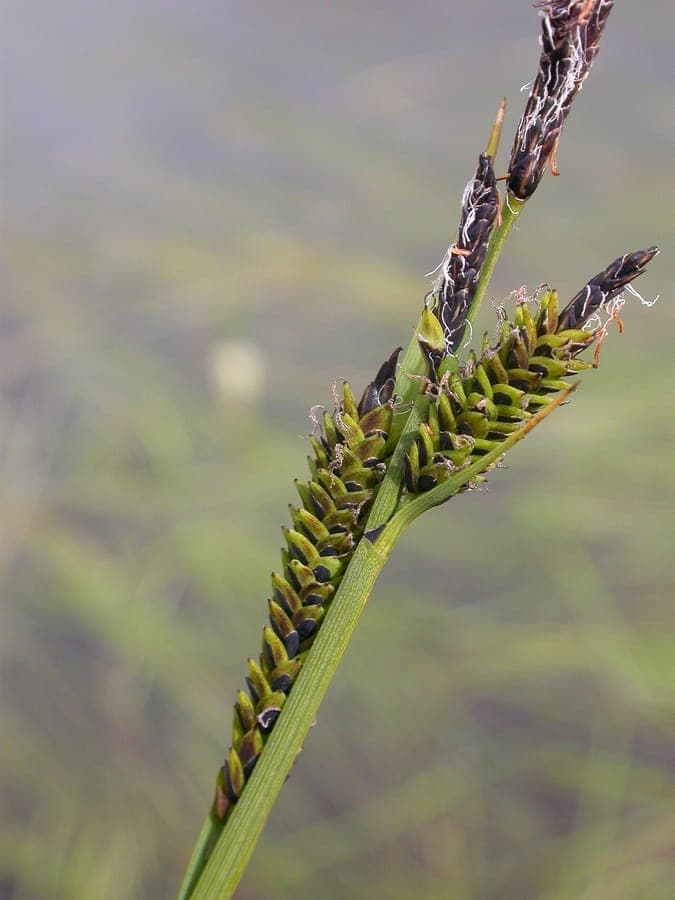
No machine-readable author provided. Thommybe assumed (based on copyright claims). / CC BY-SA 3.0, via Wikimedia Commons
Black sedge: complete guide
Carex nigra
Want to see Black sedge: complete guide in your garden?
1 minute, no credit card
Overview
Carex nigra, commonly known as Black sedge, is a resilient and understated ornamental grass that thrives in wet, challenging garden spots. Native across much of Europe and parts of northern Asia, it's a natural fit for damp lawns, bog gardens, and waterside plantings. If you've got a soggy patch where nothing else seems to grow, this sedge is your go-to solution.
It forms neat, dense clumps of dark green to almost blackish foliage, staying evergreen in milder climates. Its low-maintenance nature and adaptability make it a favourite among gardeners looking to add structure without fuss. On gardenworld.app, you can design a planting scheme that integrates Black sedge into wetland areas, rain gardens, or shaded borders with ease.
Appearance & bloom cycle
Black sedge features narrow, arching leaves that range from 20 to 50 cm in length, with a fine, grass-like texture. The foliage is deep green, taking on a darker, almost charcoal hue in full sun - hence the name. From June to July, triangular flower spikes emerge, standing 5 to 15 cm above the foliage. These are brownish-black and not particularly showy, but they add subtle texture and interest.
The plant doesn't flower dramatically, but its consistent presence across seasons is its strength. In autumn and winter, the leaves may fade to a bronze or golden brown, but they rarely collapse completely, offering year-round form. This makes it ideal for structural planting in naturalistic designs.
Ideal location
Black sedge prefers moist to wet conditions and does best in full sun to partial shade. In full sun, it needs consistent moisture to prevent leaf scorch. In dappled shade - say, under deciduous trees or along a stream bank - it flourishes with minimal care. Avoid hot, dry, south-facing borders unless you can provide supplemental watering.
It's perfect for rain gardens, pond margins, or low-lying areas prone to seasonal flooding. It handles temporary inundation up to 10 cm deep without issue. Plant in groups of 5–7 for a natural drift effect, or use it as a soft edging along paths in damp areas.
Soil requirements
This sedge thrives in humus-rich, moisture-retentive soils. It tolerates clay, loam, and sandy-loam as long as the ground doesn't dry out. The ideal pH is between 5.0 and 7.0 - slightly acidic to neutral. It can survive in peaty soils but may grow more slowly in nutrient-poor conditions.
If your soil is sandy or fast-draining, amend it with compost or well-rotted manure before planting. A layer of organic mulch - like leaf mould or straw - helps retain moisture and suppress weeds. Black sedge doesn't demand fertility, so avoid rich fertilisers that could encourage leggy growth.
Free design
Want to see Black sedge: complete guide in your garden? Make a free design now.
Watering
Once established, Black sedge is surprisingly tough, but it never likes to dry out. During the first growing season, water weekly if rainfall is below 25 mm. In prolonged dry spells, especially in summer, provide deep watering every 7–10 days.
It's one of the few ornamental grasses that actually benefits from standing water. For gardeners dealing with poor drainage, this is a gift. Use it in bioswales or near downspouts where water collects. On gardenworld.app, you can visualise how to redirect runoff to areas planted with moisture-loving species like Carex nigra.
Pruning
Pruning isn't essential, but a light cutback in late winter or early spring improves appearance. In February or March, trim old foliage to about 10 cm above ground level using sharp shears. This clears space for fresh growth and prevents the centre from becoming too dense and matted.
Avoid cutting too close to the crown - you don't want to damage the growing point. Never prune in autumn; leaving the foliage through winter adds texture and protects the crown from frost.
Maintenance calendar
- January: Check for frost damage. No action needed.
- February: Begin light pruning of old leaves.
- March: Complete cutback. New growth emerges.
- April: Monitor soil moisture. Water if dry.
- May: Active growth phase. No feeding required.
- June: Flower spikes appear. Watch for slugs.
- July: Peak bloom. Keep soil moist.
- August: Water during droughts.
- September: Growth slows. Stop pruning.
- October: Leave foliage intact for winter protection.
- November: Apply mulch in exposed areas.
- December: Dormant. Plant retains structure.
Winter hardiness
Black sedge is fully hardy in USDA zones 4 to 8, tolerating winter lows down to -30°C. It remains semi-evergreen in milder regions, with foliage persisting well into spring. In colder zones, leaves may turn brown but the plant rebounds strongly in spring.
No winter protection is usually needed, though a thin layer of mulch can help in exposed, windy sites or for young plants in their first winter.
Companion plants
Pair Black sedge with other moisture-loving plants for best effect. Consider pairing it with Carex elata 'Aurea' for contrast, or with Iris pseudacorus, Lythrum salicaria, or Molinia caerulea. It also works well under willows (Salix spp.) or alongside ferns like Matteuccia struthiopteris.
For a wilder look, plant in drifts with Deschampsia cespitosa or Eriophorum angustifolium. Its dark foliage contrasts beautifully with lighter greens and golden tones.
Closing
Black sedge is a quiet achiever - not flashy, but dependable. It solves wet soil problems, adds texture, and asks for little in return. Whether you're restoring a boggy corner or designing a naturalistic planting, it's a valuable addition.
You can find Carex nigra at garden centres across the UK and Europe. In the UK, try independent nurseries or larger chains. Look for 9 cm pots for quick establishment. With the right conditions and a smart layout - perhaps planned on gardenworld.app - Black sedge will form a lush, self-sustaining ground cover in just one season.
Want to see Black sedge: complete guide in your garden? Make a free design now.
Upload a photo, pick a style, and get a photorealistic design with plant list in under a minute.
No credit card required


Similar plants
Flat-stemmed club-rush: complete guide
Bolboschoenus planiculmis
Everything about Bolboschoenus planiculmis: growing conditions, watering, care, and use as a pond margin or wetland plant in garden design.
Great Plains flatsedge: complete guide
Cyperus lupulinus
Everything about Great Plains flatsedge (Cyperus lupulinus): growing conditions, care, garden uses, and ecological value. Tips for pond margins and dry sandy soils.
Golden beak sedge: complete guide
Rhynchospora corymbosa
Everything about golden beak sedge (Rhynchospora corymbosa): a dramatic tropical marginal for pond edges, bog gardens, and wet habitats.