
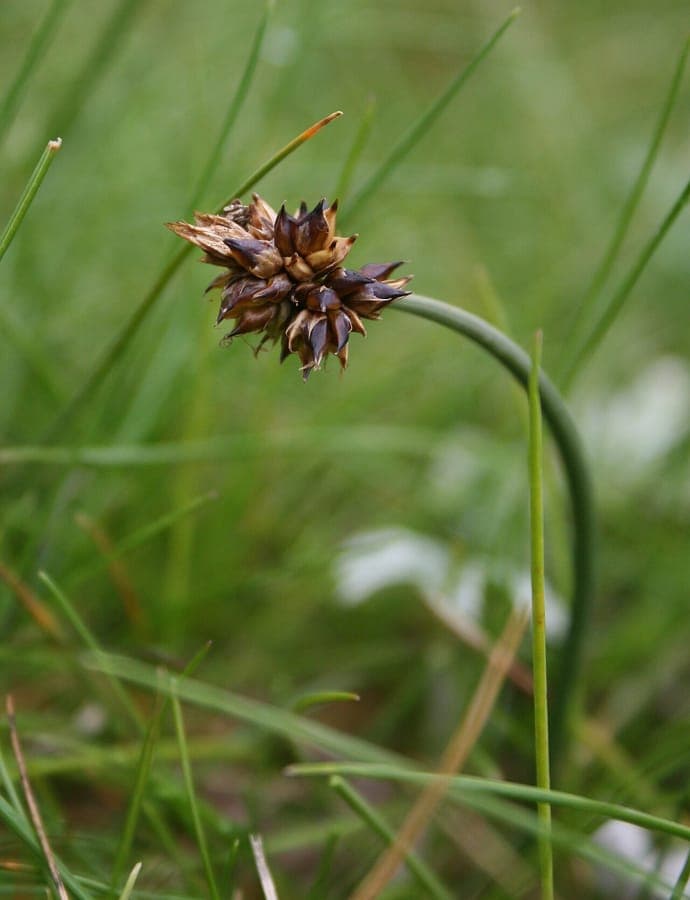
E Wusk / CC BY-SA 4.0, via Wikimedia Commons
Curved sedge: complete guide
Carex maritima
Want to see Curved sedge: complete guide in your garden?
1 minute, no credit card
Overview
Carex maritima, commonly known as curved sedge, is a tough, creeping perennial that thrives in wet, exposed, and often salty conditions. Native to coastal regions from Greenland to northern France, it's a natural fit for British and Irish gardens, especially in areas with poor drainage or sea spray. At 20–30 cm in height, it forms dense, soft green mats that hold the soil and add subtle texture to low-level planting schemes. It won't grab attention like a rose, but it's a silent workhorse in the garden.
This sedge is evergreen in mild winters, making it useful for year-round ground cover. It spreads slowly via shallow rhizomes, filling gaps without becoming invasive. If you're planning a coastal or bog garden, consider using gardenworld.app to lay out your design - you can map moisture zones and sunlight exposure to find the perfect spot for curved sedge.
Appearance & bloom cycle
The foliage is narrow (2–3 mm wide), arching gracefully, giving the plant its common name. Leaves reach 15–30 cm long and remain bright green through most of the year. In late spring, small brownish spikes appear - not flashy, but they add structure. These emerge in May and June, sitting just above the foliage. After pollination, seeds form and disperse by wind, supporting small insects and seed-eating birds.
By late summer, the spikes fade, but the plant maintains its form. In colder zones, the tips may bleach or flatten under snow, but new growth in March quickly replaces it. No flowers, no fragrance - just steady presence.
Ideal location
Full sun to light shade is ideal. In full sun, the plant stays compact and dense. In heavy shade, it tends to sprawl and thin out. It's exceptionally tolerant of coastal conditions - salt spray, wind, and sandy soil don't faze it. That makes it perfect for seaside gardens, dune edges, or damp meadows.
It also works well in rain gardens, bog borders, or areas with seasonal flooding. Avoid dry, chalky soils - this sedge won't survive there. If you're unsure about your garden's conditions, gardenworld.app lets you simulate microclimates and test plant suitability before you buy.
Soil requirements
Moist to wet, acidic to neutral soil (pH 4.5–7.0) is best. It tolerates clay if drainage isn't completely blocked, but prefers sandy loam or peaty soils. Don't enrich the soil with compost - curved sedge hates rich, fertile ground. Too much nutrients lead to weak, floppy growth and fungal issues.
When planting, use native soil. If you're amending, mix in some leaf mould or peat-free substitute to retain moisture without adding fertility. Avoid lime at all costs - this plant won't tolerate alkaline conditions.
Free design
Want to see Curved sedge: complete guide in your garden? Make a free design now.
Watering
Keep consistently moist during the first growing season (May to September). Water once a week during dry spells. After establishment, it usually survives on rainfall alone, unless you have a prolonged drought (14+ days without rain). Then, a deep soak helps.
Use rainwater when possible - tap water with high lime content can harm the plant over time. In coastal areas, humidity helps, but rinse salt deposits off the leaves during dry periods to prevent burn.
Pruning
Prune once a year in March. Cut back old foliage to 5–7 cm using shears or a lawn mower on the highest setting. This removes dead or discoloured leaves and encourages fresh growth. Don't cut in winter - the old foliage protects the crown from frost and gives shelter to overwintering insects.
If clumps start thinning, divide them in early spring. Lift the plant, split into 10x10 cm sections, and replant 15–20 cm apart. Water well until established.
Maintenance calendar
- Jan: observe, no action
- Feb: prepare for pruning
- Mar: cut back old growth, check for weeds
- Apr: monitor new shoots
- May: light growth, watch for dry spells
- Jun: flowering period (spikes visible)
- Jul: no action needed
- Aug: check soil moisture in drought
- Sep: final watering if dry
- Oct: leave as is
- Nov: let foliage stand for winter
- Dec: no pruning
Winter hardiness
Hardy to USDA zone 4 (-25°C). In the UK and Ireland, it survives all but the harshest winters without protection. Foliage remains green in mild areas. In colder zones, tips may die back slightly but regrow fast in spring. Avoid waterlogged soil in winter - it can cause root rot, though this is rare.
Companion plants
Pair with moisture-loving plants like tussock grass (Deschampsia cespitosa), bog pimpernel (Anagallis tenella), or Carex elata 'Aurea'. For colour, add purple moor grass (Molinia caerulea) or meadow cranesbill (Geranium pratense). In coastal gardens, combine with sea thrift (Armeria maritima) and sea campion (Silene uniflora).
Avoid drought-tolerant plants like lavender or sedum - they'll struggle in the same wet conditions and won't complement the sedge's growth habit.
Closing
Curved sedge isn't flashy, but it's dependable. It handles wet feet, salt, wind, and cold without complaint. Perfect for tough spots where other plants fail. Buy it from garden centres across the UK, especially those specialising in native or bog plants. When planning your layout, use gardenworld.app to visualise spacing, sunlight, and soil type - it's a smart way to avoid trial and error. With the right spot, Carex maritima becomes a quiet backbone in your garden for years to come.
Want to see Curved sedge: complete guide in your garden? Make a free design now.
Upload a photo, pick a style, and get a photorealistic design with plant list in under a minute.
No credit card required


Similar plants
Flat-stemmed club-rush: complete guide
Bolboschoenus planiculmis
Everything about Bolboschoenus planiculmis: growing conditions, watering, care, and use as a pond margin or wetland plant in garden design.
Great Plains flatsedge: complete guide
Cyperus lupulinus
Everything about Great Plains flatsedge (Cyperus lupulinus): growing conditions, care, garden uses, and ecological value. Tips for pond margins and dry sandy soils.
Golden beak sedge: complete guide
Rhynchospora corymbosa
Everything about golden beak sedge (Rhynchospora corymbosa): a dramatic tropical marginal for pond edges, bog gardens, and wet habitats.