
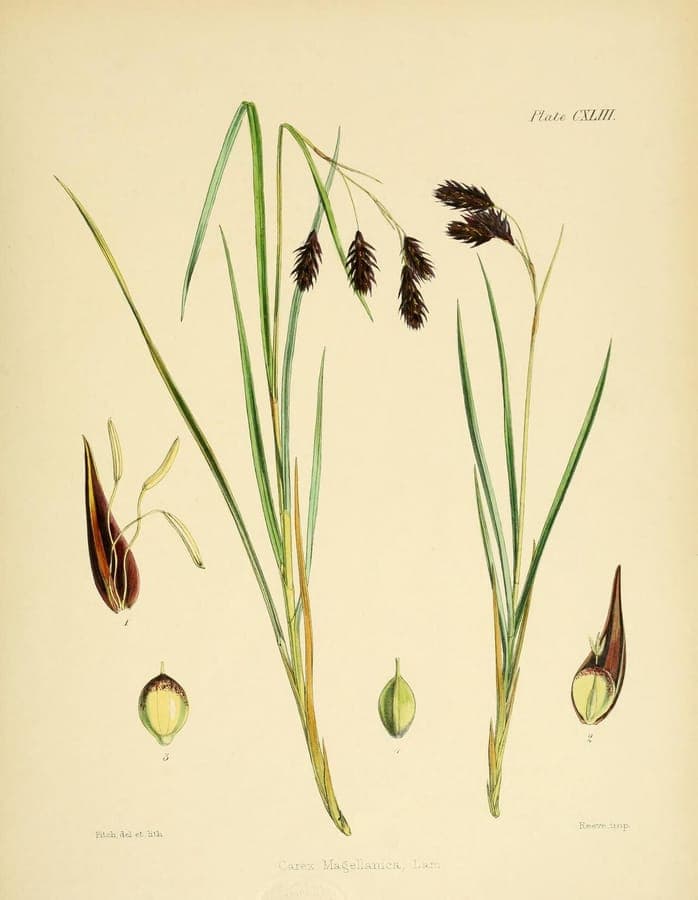
Walter Hood Fitch / Public domain, via Wikimedia Commons
Tall bog sedge: complete guide
Carex magellanica
Want to see Tall bog sedge: complete guide in your garden?
1 minute, no credit card
Overview
Carex magellanica, commonly known as tall bog sedge, is a hardy, clump-forming sedge native to cool, moist regions across North and South America, as well as parts of Europe like the Baltic States and Austria. It's a member of the Cyperaceae family and thrives in environments where many ornamental plants struggle. While not commonly found in mainstream garden centres, it's gaining attention among eco-conscious gardeners designing naturalistic, moisture-rich landscapes.
What makes tall bog sedge special is its resilience in wet soils and its subtle, textural presence. It doesn't scream for attention, but once established, it offers year-round structure and supports local wildlife. On gardenworld.app, you can design a custom garden layout that integrates tall bog sedge into damp zones, ensuring it's paired with suitable companions and placed in optimal light.
Appearance & bloom cycle
Tall bog sedge grows 20–40 cm tall with a spread of up to 30 cm. The narrow, arching leaves are dark green, sometimes with a slight sheen, and emerge in early spring (March–April). They remain evergreen in milder climates but may turn brown in harsh winters.
Flowering occurs in May, with unassuming greenish-brown spikes rising just above the foliage. The blooms are wind-pollinated and not showy, but they develop into small nutlets by June, persisting into autumn. There's no flashy floral display, but the plant's strength lies in its consistent form and seasonal reliability.
Ideal location
This sedge loves damp, cool conditions. It performs best in partial to full shade, making it ideal for woodland gardens, shaded pond margins, or under deciduous trees. In full sun, it requires constantly moist soil – otherwise, it will scorch or dry out, especially in southern exposures.
Avoid hot, exposed sites. Instead, use it in shady, boggy corners where few other plants survive. It's perfect for rain gardens or areas with poor drainage. On gardenworld.app, you can simulate how water flows through your garden and pinpoint exactly where to plant tall bog sedge for maximum success.
Soil requirements
Tall bog sedge prefers acidic to neutral, humus-rich soils with a pH between 5.0 and 6.5. It does well in peaty or loamy soils that retain moisture without becoming waterlogged. Heavy clay is acceptable if it drains slowly but doesn't pond for days.
Avoid alkaline, sandy, or fast-draining soils. If your soil is too dry or chalky, amend it with leaf mould or pine compost. No need for fertiliser – excess nutrients lead to floppy growth and reduced hardiness.
Free design
Want to see Tall bog sedge: complete guide in your garden? Make a free design now.
Watering
Keep the soil consistently moist, especially during the growing season (April–September). Young plants need weekly deep watering in dry spells. Mature clumps are more resilient but still depend on reliable moisture.
Never let the root zone dry out completely. Use a soaker hose or water by hand at the base. Overhead watering isn't necessary and can encourage fungal issues in dense foliage.
Pruning
Pruning is minimal. In late winter or early spring (February–March), cut back any damaged or dead foliage to just above the crown. Use sharp, clean shears to avoid tearing. Leave healthy leaves intact – they protect new growth.
No autumn clean-up is needed. If leaves turn brown in winter, tidy them in early spring before new shoots emerge.
Maintenance calendar
- Jan: Check for frost damage, no action needed
- Feb: Trim old foliage
- Mar: New growth appears, optional light mulch
- Apr: Monitor moisture, especially in young plants
- May: Flower spikes emerge, no care required
- Jun: Nutlets form, check for fungal spots if overly wet
- Jul: Maintain moisture during dry periods
- Aug: Water deeply if no rain for 7+ days
- Sep: Stop feeding, prepare for dormancy
- Oct: Leave plant debris for insulation
- Nov: Add leaf litter or bark mulch
- Dec: Ensure snow cover or mulch for root protection
Winter hardiness
Tall bog sedge is hardy in USDA zones 4–8, tolerating temperatures down to -25°C. In the UK and most of the US, it survives winters without protection. In zone 4, a thick mulch helps. The foliage may brown but the crown usually survives.
Avoid disturbing the plant in winter. Potted specimens should be kept in the ground or heavily insulated.
Companion plants
Pair tall bog sedge with plants that share its preference for shade and moisture:
- Ferns (e.g., Dryopteris spp.) – for texture and height contrast
- Marsh marigold (Caltha palustris) – early spring colour
- Creeping jenny (Lysimachia nummularia) – ground cover
- Blue flag iris (Iris versicolor) – vertical interest
- Mosses – natural understory layer
Avoid aggressive spreaders like bamboo or mint. This sedge is modest in growth and needs space to breathe.
Closing
Tall bog sedge isn't a showstopper, but it's a reliable performer in challenging, wet areas. It asks for little and gives back with stability, texture, and habitat value. You won't find it at every garden centre, but specialist nurseries or plant fairs often carry it. Try OBI or Hornbach in Europe, Truffaut or Jardiland in France, or ask at local native plant suppliers. Once you've got it placed right, you'll wonder how you ever gardened without it. And when you're planning your next damp-corner redesign, remember: gardenworld.app helps you visualise the perfect spot for tall bog sedge, alongside compatible plants and moisture zones.
Want to see Tall bog sedge: complete guide in your garden? Make a free design now.
Upload a photo, pick a style, and get a photorealistic design with plant list in under a minute.
No credit card required


Similar plants
Flat-stemmed club-rush: complete guide
Bolboschoenus planiculmis
Everything about Bolboschoenus planiculmis: growing conditions, watering, care, and use as a pond margin or wetland plant in garden design.
Great Plains flatsedge: complete guide
Cyperus lupulinus
Everything about Great Plains flatsedge (Cyperus lupulinus): growing conditions, care, garden uses, and ecological value. Tips for pond margins and dry sandy soils.
Golden beak sedge: complete guide
Rhynchospora corymbosa
Everything about golden beak sedge (Rhynchospora corymbosa): a dramatic tropical marginal for pond edges, bog gardens, and wet habitats.