
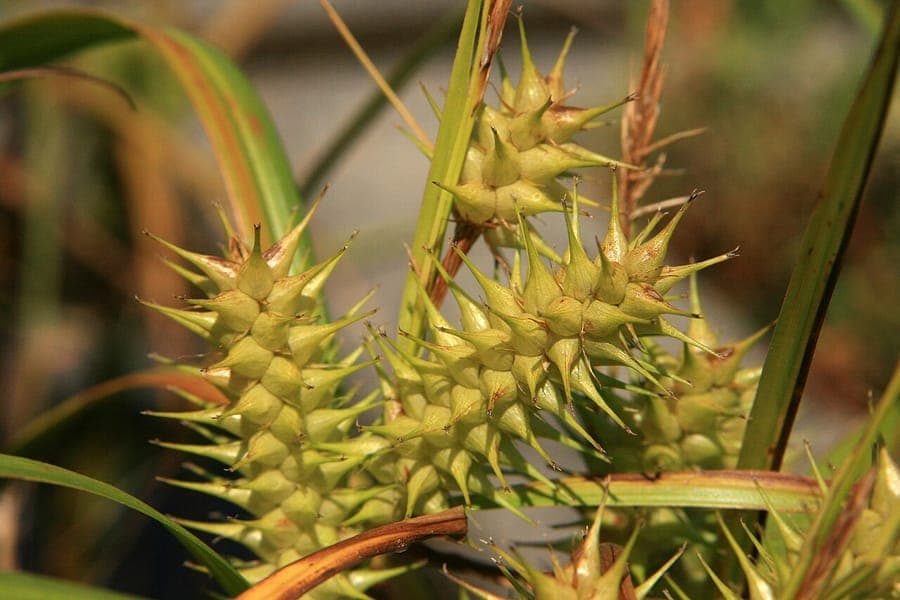
Quinn Dombrowski from Berkeley, USA / CC BY-SA 2.0, via Wikimedia Commons
False hop sedge: complete guide
Carex lupuliformis
Want to see False hop sedge: complete guide in your garden?
1 minute, no credit card
Overview
Carex lupuliformis, commonly called False hop sedge, Hop-like sedge, or Knobbed hop sedge, is an attractive native North American sedge from the Cyperaceae family. This species naturally inhabits southeastern Canada and eastern United States, ranging southward into Mexico's Chihuahua region, thriving in moist, shaded habitats including wetland margins, forest edges and moist grasslands. Though less recognized than many common garden plants, this sedge offers remarkable ornamental possibilities for property owners seeking to transform wet, marshy terrain into functional, beautiful landscapes. The characteristic hop-like fruit clusters grant the plant unique, almost sculptural qualities that distinguish it from most competing Carex species. Throughout North America and Europe, gardener enthusiasm for this species is growing, particularly among specialists valuing wetland restoration and moisture-rich garden integration.
Appearance and Bloom
Carex lupuliformis develops as a coarse-textured, upright tuft with broad, dark-green leaves that typically reach 40-60 cm height. The leaves are deeply ribbed, linear and flex gracefully outward, creating full, vase-shaped silhouettes. The plant exhibits complete dioecy, meaning male and female plants develop separately. Female plants produce the characteristic, hop-like fruit clusters defining this species - densely packed clusters approximately 1-2 cm long with dark-brown to olive-green coloration. These distinctive clusters form in June and July and remain highly ornamental throughout late season months. The blooming period extends from April through June, making this plant strongly featured in spring and summer garden compositions. The fruit structures, combined with dark-green foliage, create exceptionally appealing visual interest throughout the growing season.
Ideal Location
Carex lupuliformis thrives optimally in part-shade to full-shade positions, making it ideal for marshy, moisture-rich areas beneath tree canopies or in partially enclosed garden niches. The plant tolerates full sun positions provided soil moisture remains adequate throughout the growing season. This species is inherently moisture-dependent and performs optimally along waterside zones, in wetland borders, marshy restoration areas and other water-oriented garden features. In western North American gardens, some protection from intense afternoon sun proves beneficial. The plant performs excellently beneath large trees, where it provides ground-level vegetation in shadowed areas others plants struggle to colonize. In persistently windy locations, tall plants may suffer wind damage; supplementary shelter proves beneficial for windy-site gardens.
Soil
Carex lupuliformis performs optimally in moist to wet soils with pH ranging approximately 5.5 to 7.5, though this species remains reasonably flexible regarding soil chemistry. The soil should possess organic matter richness and strong water-holding capacity. The plant accepts clay-heavy soils and actually performs best in moisture-retentive, clay-rich conditions. Adding compost or leaf-mould improves less-ideal soils. The essential aspect is consistent moisture: this species tolerates water saturation far better than dryness. In wetland gardens, fertilization is usually unnecessary since such habitats are naturally nutrient-rich. In moderately-dry gardens, organic mulch around the plant base helps improve moisture retention.
Free design
Want to see False hop sedge: complete guide in your garden? Make a free design now.
Watering
Carex lupuliformis demands consistent moisture and actually thrives in marshy or regularly flooded conditions. This represents one of few Carex species genuinely tolerating water saturation. Once established, this plant requires minimal supplemental irrigation in wetland situations where natural water levels remain high. In normally moist gardens, soil should remain consistently wet during the April-October growing period. Even winter moisture levels remain elevated. Only during exceptionally dry periods or prolonged droughts may supplementary watering become necessary - and even then, the plant will suffer significantly. Container-grown specimens require very regular watering since pots dry faster than garden soil. Mulch around the plant base helps improve moisture retention substantially.
Pruning
Carex lupuliformis demands minimal pruning, though the plant benefits from routine maintenance cutting. The plant can be cut to 15-20 cm above ground level in early spring (March), stimulating vigorous new growth. This remains optional; many gardeners prefer leaving this plant completely uncut for more naturalistic appearance. Dead foliage can be removed throughout the season. The characteristic fruit clusters should be retained for ornamental value. In very dry situations, leaf-tip browning may occur; regular moisture supply prevents this condition.
Maintenance Calendar
March: Remove any winter-damaged foliage; execute optional maintenance cutting to 15 cm. Check soil moisture levels. April-June: Water regularly, especially during dry periods. Appreciate developing flower clusters. June-August: Enjoy hop-like fruit displays. Minimal watering needed given regular rainfall. August-October: Maximum ornamental interest. October-March: Minimal maintenance required.
Winter Hardiness
Carex lupuliformis shows winter hardiness to USDA Zone 4 (temperatures to approximately -34 degrees Celsius), making it an exceptionally cold-hardy species. The plant thrives in all temperate North American and European climates. In very warm-winter landscapes (zones 9-10), the plant may struggle with summer heat unless water saturation remains adequate. In colder climates (zones 3-4), plants perform excellently; no winter protection is necessary. In regions experiencing extremely harsh winters, a protective mulch layer ensures plant base survival through severe frost.
Companion Planting
Carex lupuliformis combines beautifully with other moisture-loving plants, particularly Iris sibirica (Siberian iris), Astilbe species and Rodgersia. For waterside composition, group three to five plants spaced 30-40 cm apart. Associate with Primula japonica, Hosta varieties and Matteucia struthiopteris (ostrich fern) for layered textural interest. For naturalistic marsh effects, combine with Lychnis coronaria, Scrophularia nodosa and low-growing Carex companions. In container culture, this plant performs excellently with consistent moisture maintenance.
Conclusion
Carex lupuliformis is a distinctive moisture-loving sedge whose unique hop-like fruit structures appeal to gardeners seeking distinctive foliage and seasonal interest. This plant offers valuable solutions for wetland gardens, marshy restoration projects and water-edge plantings where traditional landscape plants struggle to thrive. With winter hardiness extending to Zone 4 and demonstrated ability to flourish in consistently wet conditions, this sedge is ideal for North American and European gardeners. Source this distinctive species from specialized water-plant nurseries or gardenworld.app for your next wetland garden project.
Want to see False hop sedge: complete guide in your garden? Make a free design now.
Upload a photo, pick a style, and get a photorealistic design with plant list in under a minute.
No credit card required


Similar plants
Flat-stemmed club-rush: complete guide
Bolboschoenus planiculmis
Everything about Bolboschoenus planiculmis: growing conditions, watering, care, and use as a pond margin or wetland plant in garden design.
Great Plains flatsedge: complete guide
Cyperus lupulinus
Everything about Great Plains flatsedge (Cyperus lupulinus): growing conditions, care, garden uses, and ecological value. Tips for pond margins and dry sandy soils.
Golden beak sedge: complete guide
Rhynchospora corymbosa
Everything about golden beak sedge (Rhynchospora corymbosa): a dramatic tropical marginal for pond edges, bog gardens, and wet habitats.