
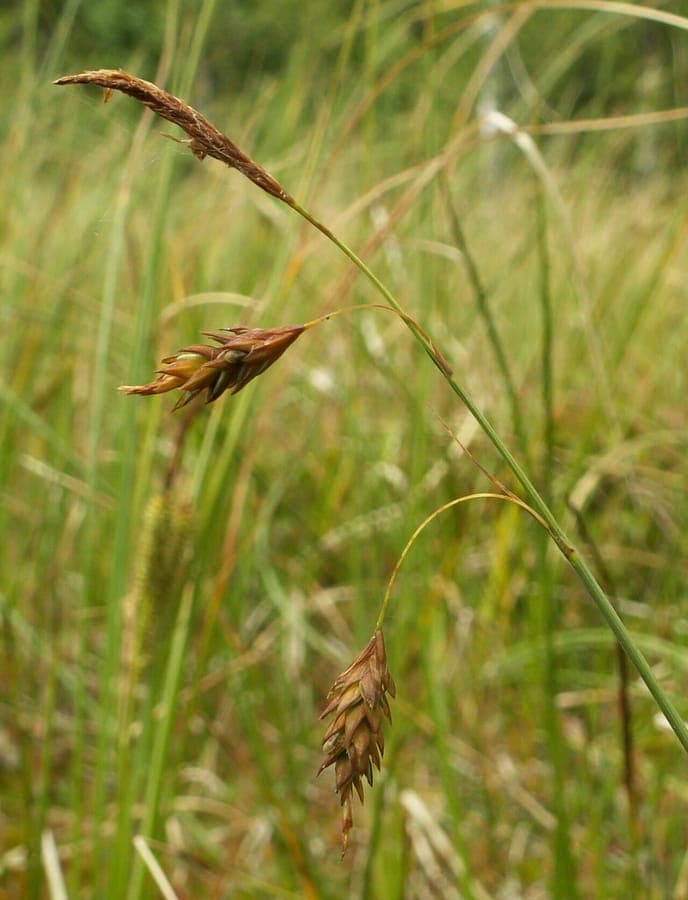
Krzysztof Ziarnek / CC BY-SA 3.0, via Wikimedia Commons
Bog sedge: complete guide
Carex limosa
Want to see Bog sedge: complete guide in your garden?
1 minute, no credit card
Overview
Bog sedge (Carex limosa) is a low-growing, creeping sedge that thrives in wet, acidic peat soils. Native to cold temperate regions across North America and Northern Europe, it's often found in bogs, fens, and swampy forest edges. While it won't grab attention with flashy flowers, it plays a vital role in stabilizing fragile wetland ecosystems and adds subtle texture to naturalistic planting schemes.
For gardeners working with challenging damp corners, bog sedge is a quiet hero. On gardenworld.app, you can design a planting plan that integrates bog sedge into moisture-rich zones, making the most of otherwise difficult areas. It's perfect for bog gardens, rain gardens, or the shallow edges of wildlife ponds.
Appearance & bloom cycle
Bog sedge forms a dense, moss-like mat of narrow, dark green to olive-brown leaves, rarely exceeding 15–20 cm in height. In late spring (May to June), delicate flower spikes emerge-thin, greenish-brown inflorescences that rise just above the foliage. These aren't showy, but they add structure and interest during the blooming season.
The plant spreads slowly via long rhizomes, gradually forming colonies. Seed heads mature by August and persist into autumn, providing food for insects and small birds. Unlike more aggressive sedges, bog sedge is well-behaved and won't take over your garden.
Ideal location
This sedge prefers partial to full shade. While it can tolerate light sun, only if the soil remains constantly wet. The best spots are along pond margins, in shaded wetland borders, or in sunken containers filled with peat-rich soil.
Avoid hot, south-facing areas unless you can guarantee consistent moisture. If you're unsure whether your garden has the right microclimate, use gardenworld.app to map sunlight patterns and soil moisture levels over time. It's a practical tool for planning moisture-loving plantings.
Soil requirements
Bog sedge demands acidic, low-nutrient soil with a pH between 4.0 and 5.5. Ideal substrates include pure peat, decomposed pine litter, or a mix of peat moss and coarse sand. Avoid compost, manure, or lime-these raise pH and nutrient levels, which can encourage weeds and harm the sedge.
Heavy clay soils should be amended with generous amounts of peat and perlite to improve drainage and acidity. The root zone must stay moist but not waterlogged-think of the spongy texture of a healthy bog.
Watering
Consistent moisture is non-negotiable. The soil should never dry out, especially during summer. If grown in containers, check daily and water with rainwater or distilled water-tap water with high lime content can alter pH over time.
Mulch with pine needles or reed to help retain moisture and keep roots cool. During droughts, bog sedge may brown off, but it usually recovers once rain returns. Never let it sit in standing water for extended periods-it's not fully aquatic.
Free design
Want to see Bog sedge: complete guide in your garden? Make a free design now.
Pruning
Minimal pruning is needed. In late winter or early spring (February–March), gently remove dead or damaged foliage by hand. Avoid cutting into live rhizomes. Don't prune in autumn-the old growth insulates the plant and adds winter texture.
If the plant spreads beyond its intended area, dig and divide clumps in early spring. Replant divisions 15–20 cm apart to allow room for growth.
Maintenance calendar
- January: Check for frost damage. Leave dead foliage in place.
- February: Remove old leaves. Prepare soil for spring.
- March: Add fresh peat mulch. Divide and replant if needed.
- April: Keep soil moist. Watch for invasive weeds.
- May: Bloom period begins. No feeding required.
- June: Flowers at peak. Minimal care.
- July: Water regularly during dry spells.
- August: Seeds mature. Monitor moisture.
- September: Leave seed heads for winter interest.
- October: Apply pine needle mulch.
- November: Check for fungal issues in damp conditions.
- December: Dormancy. No action needed.
Winter hardiness
Bog sedge is hardy in USDA zones 4–7 (down to -30°F / -34°C). Foliage often remains semi-evergreen, turning bronze or brown in winter. In harsh winters, top growth may die back, but rhizomes survive under snow or mulch.
Avoid fertilizing in fall-this can trigger tender new growth vulnerable to frost. A protective layer of reed or pine needles helps maintain stable soil temperature and moisture.
Companion plants
Pair bog sedge with other moisture-loving, acid-tolerant plants like cotton grass (Eriophorum angustifolium), bog rosemary (Andromeda polifolia), marsh marigold (Caltha palustris), or small sedges like Carex vulpinoidea. It also works well under dwarf conifers or in shaded bog gardens with pitcher plants (Sarracenia).
Avoid competitive species like reed canary grass or purple loosestrife, which can overwhelm slower-growing natives. Stick to plants with similar cultural needs for a balanced, low-maintenance planting.
Closing
Bog sedge isn't a standout in the traditional garden sense, but it's invaluable in the right setting. With steady moisture, acidic soil, and some shade, it thrives with little intervention. It's a great choice for eco-conscious gardeners aiming to support native biodiversity.
You can find bog sedge at garden centres, especially those specializing in native or wetland plants. Look for reputable suppliers-sometimes it's mislabeled as Carex nigra or Carex rostrata. With patience and the right conditions, this unassuming sedge will quietly enrich your damp garden corners for years.
Want to see Bog sedge: complete guide in your garden? Make a free design now.
Upload a photo, pick a style, and get a photorealistic design with plant list in under a minute.
No credit card required


Similar plants
Flat-stemmed club-rush: complete guide
Bolboschoenus planiculmis
Everything about Bolboschoenus planiculmis: growing conditions, watering, care, and use as a pond margin or wetland plant in garden design.
Great Plains flatsedge: complete guide
Cyperus lupulinus
Everything about Great Plains flatsedge (Cyperus lupulinus): growing conditions, care, garden uses, and ecological value. Tips for pond margins and dry sandy soils.
Golden beak sedge: complete guide
Rhynchospora corymbosa
Everything about golden beak sedge (Rhynchospora corymbosa): a dramatic tropical marginal for pond edges, bog gardens, and wet habitats.