
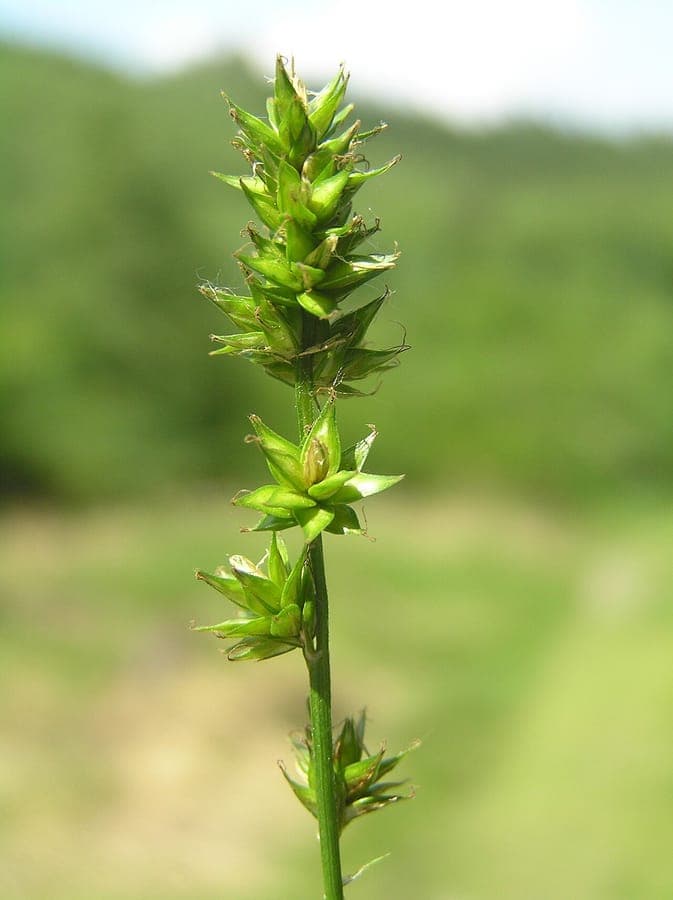
Petr Filippov / CC BY-SA 3.0, via Wikimedia Commons
Grassland sedge: complete guide
Carex leersii
Want to see Grassland sedge: complete guide in your garden?
1 minute, no credit card
Overview
Carex leersii, commonly known as Grassland sedge, is a quietly elegant perennial that brings structure and year-round presence to shaded garden areas. Native to parts of Central and Southern Europe, this member of the Cyperaceae family naturally grows in moist woodlands, forest margins, and damp grasslands. While not commonly found in the wild across the UK, it's increasingly popular in cultivated gardens, especially among gardeners who value understated beauty and ecological function.
This sedge forms neat, arching clumps reaching 30–40 cm in height and about 35 cm in spread. It grows slowly via short rhizomes, so it won't take over your borders. The foliage is fine-textured, narrow (around 3 mm), and soft green, creating a delicate, fountain-like effect. It's not a showy plant, but its reliability and subtle charm make it a staple in thoughtful garden design.
On gardenworld.app, you can explore planting schemes where Grassland sedge serves as a quiet backbone in shade-loving combinations.
Appearance & bloom cycle
In late spring, from May to June, Carex leersii produces slender, star-shaped inflorescences that rise just above the foliage. These golden-brown flower spikes are held upright and have a spiky, almost bristly appearance - earning it the French name 'Laîche-hérisson' (hedgehog sedge). The blooms are wind-pollinated and don't attract many insects, but they add texture and movement to the garden.
After flowering, the seed heads persist into autumn, gradually turning darker. The plant remains evergreen in mild winters, with leaves fading to a pale, bleached green - hence its Dutch name 'Bleke zegge'. Even in winter, it provides visual interest and shelter for small ground-dwelling creatures.
Ideal location
Plant Grassland sedge in partial to full shade. It thrives under light tree canopies, on north-facing slopes, or along woodland edges. Avoid hot, south-facing spots, especially in dry soils. It's perfect for planting beneath deciduous trees like birch or hazel, where it benefits from spring moisture and summer dappled light.
Use it in groups of 3–5 for a soft, natural look, or as a groundcover under shrubs. It works particularly well in rain gardens or near stream banks where moisture is consistent. For design ideas, check gardenworld.app to visualize how this sedge can enhance your shade garden layout.
Soil requirements
This sedge prefers moist, humus-rich, well-drained soil with a pH between 5.5 and 7.0. It does well in clay-loam or silt-based soils but struggles in sandy, fast-draining substrates. If your soil is too dry, amend it with leaf mould or composted bark to improve water retention.
Avoid compacted or waterlogged soils. While it likes moisture, stagnant water will rot the roots. A 5 cm mulch layer in spring helps maintain soil moisture and suppresses weeds.
Free design
Want to see Grassland sedge: complete guide in your garden? Make a free design now.
Watering
During the first growing season, water weekly with about 10 litres per square metre if rainfall is scarce. Once established, Carex leersii is moderately drought-tolerant but performs best when soil remains consistently moist. In summer droughts, give a deep soak every 10–14 days.
Rainwater is ideal. Tap water, especially if hard, can leave mineral deposits that affect long-term health. In containers, ensure pots have drainage holes and consider self-watering systems for consistency.
Pruning
Minimal pruning is needed. In late winter or early spring (February to March), cut back old, tattered foliage to about 5 cm above the crown. Use clean, sharp shears to prevent disease. Leave the spent flower spikes over winter - they add winter texture and provide habitat.
Do not cut into the crown. This can damage new growth and expose the plant to rot. Compost the trimmed material unless it shows signs of disease.
Maintenance calendar
- January: Check for frost heave. Keep soil lightly moist.
- February: Begin cutting back old foliage. Refresh mulch if needed.
- March: Finish pruning. Apply a thin layer of compost.
- April: Monitor for slugs. Water during dry spells.
- May: Flowers emerge. Maintain consistent moisture.
- June: Peak bloom. Avoid disturbing the plant.
- July: Reduce watering if rainy. Watch for dry edges.
- August: Inspect for aphids. Keep mulch in place.
- September: Leave seed heads. No maintenance needed.
- October: Clear only dead material. Protect roots with leaf litter.
- November: Add organic mulch for winter insulation.
- December: Let plant rest. Minimal intervention.
Winter hardiness
Grassland sedge is hardy to USDA zone 5 (-20°C). Foliage may yellow or brown in harsh winters but typically recovers in spring. No winter protection is needed in the ground. Potted plants should be elevated on feet and insulated with hessian or bubble wrap to prevent root freeze.
Companion plants
Pair with ferns like Dryopteris filix-mas, wood anemones (Anemone nemorosa), or shade-tolerant geraniums such as Geranium macrorrhizum. For contrast, plant alongside silver-leaved Lunaria or dark-leafed Asarum europaeum.
Avoid aggressive spreaders like bamboo or mint. Also steer clear of plants that dry out the soil, such as Lavandula or Sedum.
Closing
Carex leersii is a quiet achiever in the shade garden. It won't dazzle with colour, but it delivers reliability, texture, and year-round structure. Its soft form and persistent presence make it ideal for naturalistic planting schemes.
You can find Grassland sedge at garden centres across the UK, often in 1-litre pots priced between £5 and £8. Look for healthy, green clumps with no signs of drying or browning at the base.
When planning your shade border, use gardenworld.app to preview how this sedge integrates with companion plants and hardscape elements for a cohesive design.
Want to see Grassland sedge: complete guide in your garden? Make a free design now.
Upload a photo, pick a style, and get a photorealistic design with plant list in under a minute.
No credit card required


Similar plants
Flat-stemmed club-rush: complete guide
Bolboschoenus planiculmis
Everything about Bolboschoenus planiculmis: growing conditions, watering, care, and use as a pond margin or wetland plant in garden design.
Great Plains flatsedge: complete guide
Cyperus lupulinus
Everything about Great Plains flatsedge (Cyperus lupulinus): growing conditions, care, garden uses, and ecological value. Tips for pond margins and dry sandy soils.
Golden beak sedge: complete guide
Rhynchospora corymbosa
Everything about golden beak sedge (Rhynchospora corymbosa): a dramatic tropical marginal for pond edges, bog gardens, and wet habitats.