
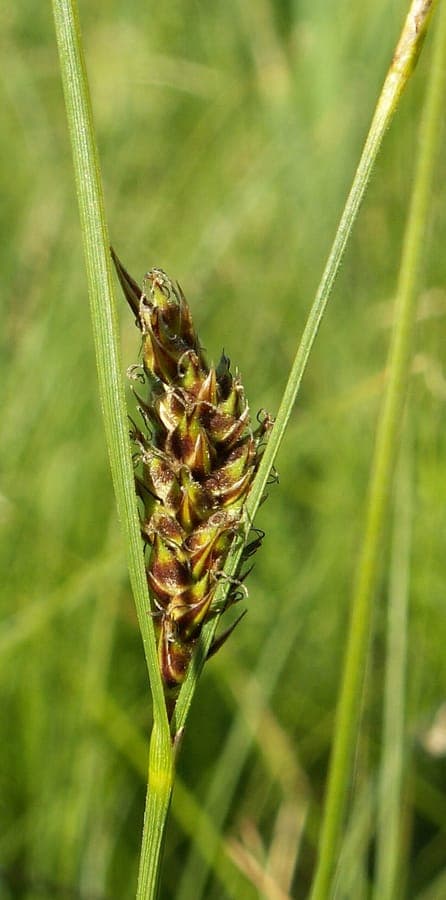
Krzysztof Ziarnek / CC BY-SA 3.0, via Wikimedia Commons
Slender sedge: complete guide
Carex lasiocarpa
Want to see Slender sedge: complete guide in your garden?
1 minute, no credit card
Overview
Carex lasiocarpa, commonly known as slender sedge, is a graceful, clump-forming perennial that thrives in consistently wet conditions. Native to wetlands across northern Europe, Canada, and parts of Asia, this grass-like sedge from the Cyperaceae family brings quiet elegance to bog gardens, pond margins, and rain gardens. It's not flashy, but its fine texture and reliable growth make it a staple for ecological landscaping.
What many gardeners overlook is how well this plant supports biodiversity. Its dense root system stabilises damp soil, while the foliage shelters insects and provides cover for amphibians. If you're planning a wetland-style garden, you can use gardenworld.app to design a layout that integrates Carex lasiocarpa with complementary species and proper water retention zones.
Appearance & bloom cycle
Slender sedge forms narrow, thread-like leaves that reach 40–60 cm in height, with an arching, fountain-like habit. The foliage is light green to blue-green, giving a soft, airy appearance. From May through July, slender brown flower spikes rise just above the foliage. These aren't showy, but they add subtle vertical interest and persist into autumn, gradually fading to tan.
The plant spreads slowly via creeping rhizomes, forming loose colonies over time. It's not invasive, making it manageable in mixed borders or naturalistic plantings. The growth habit remains low and tidy, rarely needing division unless you want to propagate or thin it out.
Ideal location
This sedge needs plenty of light - a solid 8 out of 10. That means full sun to partial shade. In full sun, it develops denser foliage and stronger stems. In heavy shade, it tends to flop and lose its shape. The best spot is along pond edges, in shallow water up to 5 cm deep, or in consistently moist soil.
Avoid dry areas completely. Slender sedge will not survive prolonged drought. For gardeners designing a water feature or bog bed, gardenworld.app offers visual planning tools to place moisture-loving plants like this one in optimal zones, ensuring long-term success.
Soil requirements
The ideal soil is moist to wet, rich in organic matter, and slightly acidic (pH 5.5–6.5). It prefers peaty, loamy, or silty substrates that hold water without becoming compacted. Sandy soils can work if irrigated regularly. Avoid alkaline or chalky soils - this plant is sensitive to high pH and may show signs of chlorosis.
When planting, mix in plenty of well-rotted compost or bog-specific soil. Never use lime or chalk-based amendments. A top dressing of leaf mould in spring helps retain moisture and feeds the plant naturally.
Free design
Want to see Slender sedge: complete guide in your garden? Make a free design now.
Watering
Constant moisture is non-negotiable. From April to September, the soil should never dry out. In containers or raised bog beds, you may need to water daily during dry spells. If planted in a pond margin or rain garden, natural runoff may be sufficient.
Use rainwater when possible - tap water, especially if hard, can raise soil pH over time and harm the plant's long-term health.
Pruning
Minimal pruning is required. In late winter or early spring (February to March), cut back old, ragged foliage to about 10 cm above ground level. This encourages fresh, upright growth and prevents debris buildup. Use sharp, clean shears to avoid damaging the crown.
Divide clumps every 4–5 years if they become too dense or start to die out in the centre. Replant divisions immediately in moist soil.
Maintenance calendar
- Jan: Check for winter damage; leave old growth for insulation.
- Feb: Begin light cleanup; cut back dead foliage.
- Mar: Final pruning; apply thin compost layer if needed.
- Apr: Growth resumes; monitor soil moisture.
- May: Flowers emerge; no feeding required.
- Jun: Peak bloom; watch for dry spells.
- Jul: Seed heads mature; continue watering.
- Aug: No major tasks; keep soil damp.
- Sep: Growth slows; avoid fertilising.
- Oct: Leave foliage for winter protection.
- Nov: Plant dormant; inspect for pests.
- Dec: Protect container plants from hard freezes with mulch or bubble wrap.
Winter hardiness
Carex lasiocarpa is hardy in USDA zones 4–8 (-34°C to -12°C). In most temperate climates, it remains evergreen or semi-evergreen, with foliage turning light brown but staying intact. Established plants survive harsh winters without protection.
In containers, where roots are more exposed, it's wise to wrap pots or move them to a sheltered spot. No additional winter mulch is needed in-ground.
Companion plants
Pair slender sedge with other moisture-loving plants like Eriophorum angustifolium, Iris versicolor, Molinia caerulea, or Filipendula ulmaria. For contrast, use taller plants like Lythrum salicaria or Caltha palustris in spring.
Avoid pairing with drought-tolerant perennials like Echinacea or Sedum. Stick to species that share the same water needs for a harmonious, low-maintenance planting scheme.
Closing
Slender sedge isn't a headline plant, but it's a workhorse in wet gardens. With its fine texture, quiet beauty, and ecological benefits, it earns its place in any sustainable landscape. Plant in groups of 5–7 for a natural drift effect. Available at most garden centres, especially those specialising in water plants.
For inspiration and precise placement in your garden design, visit gardenworld.app - where you can build a custom plan that matches your soil, light, and water conditions perfectly.
Want to see Slender sedge: complete guide in your garden? Make a free design now.
Upload a photo, pick a style, and get a photorealistic design with plant list in under a minute.
No credit card required


Similar plants
Flat-stemmed club-rush: complete guide
Bolboschoenus planiculmis
Everything about Bolboschoenus planiculmis: growing conditions, watering, care, and use as a pond margin or wetland plant in garden design.
Great Plains flatsedge: complete guide
Cyperus lupulinus
Everything about Great Plains flatsedge (Cyperus lupulinus): growing conditions, care, garden uses, and ecological value. Tips for pond margins and dry sandy soils.
Golden beak sedge: complete guide
Rhynchospora corymbosa
Everything about golden beak sedge (Rhynchospora corymbosa): a dramatic tropical marginal for pond edges, bog gardens, and wet habitats.