
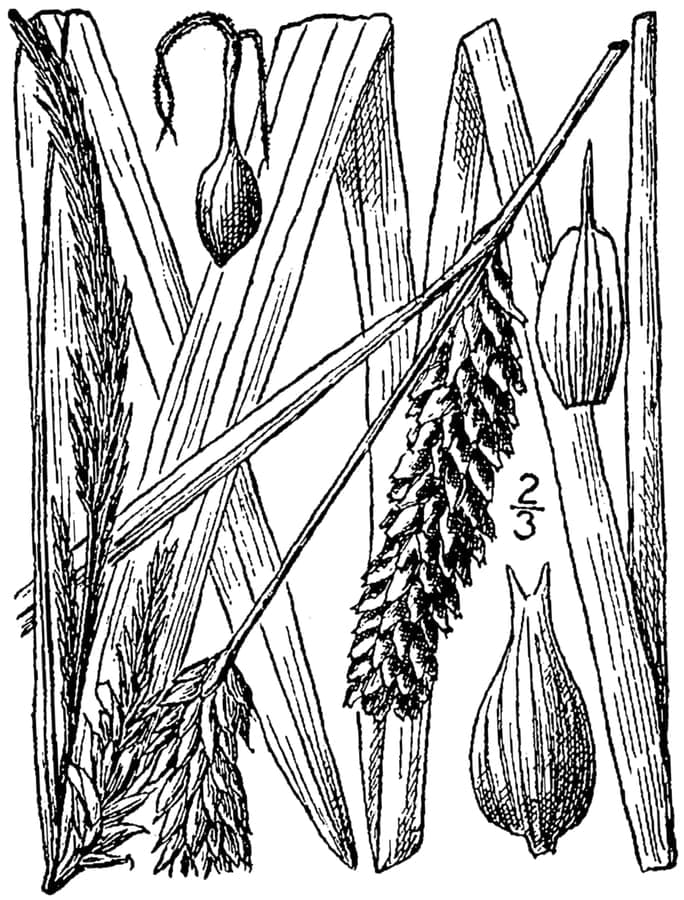
Britton, N.L., and A. Brown. 1913. An illustrated flora of the northern United States, Canada and the British Possessions. 3 vols. Charles Scribner's Sons, New York. Vol. 1: 426. Courtesy of Kentucky Native Plant Society. Scanned by Omnitek Inc. / Public domain, via Wikimedia Commons
Shoreline sedge: complete guide
Carex hyalinolepis
Want to see Shoreline sedge: complete guide in your garden?
1 minute, no credit card
Overview
Carex hyalinolepis, commonly called shoreline sedge or hyaline-scaled sedge, is a water-loving ornamental grass from the Cyperaceae family. This species thrives naturally in wet, low-lying areas of North America and is the perfect choice for garden designs with water features. On GardenWorld, we use shoreline sedge regularly for shoreline planting and water-edge environments that require erosion-resistant, natural banks.
Appearance and bloom
Shoreline sedge grows in upright patterns with medium-green, slightly undulating foliage. The plant forms elegant clumps of 30-60 cm height. In spring to early summer, it produces subtle greenish-brown sedge flowers. The medium-textured foliage offers interesting visual depth along waterfront margins. Although the flowers are not spectacular, the plant's form significantly contributes to waterfront designs.
Ideal location
Shoreline sedge thrives optimally in full sun to half-light. Plant this species directly at waterside, in marshes, and low-lying wet zones. The plant accepts periodic waterlogging and even short inundation. Avoid deep, permanent water - shoreline sedge grows in the so-called 'splash zone' where periodic water occurs. This plant is perfect for bank protection in GardenWorld designs.
Soil
Shoreline sedge demands wet, moisture-rich soils. This plant thrives best in heavy clay or silt soils that retain water. Unlike drought-tolerant sedges, shoreline sedge gladly accepts waterlogged earth. Add organic matter to poor soils to increase water-holding capacity. pH 5.6-7.9 is suitable; the plant adapts to diverse pH levels.
Free design
Want to see Shoreline sedge: complete guide in your garden? Make a free design now.
Watering
Watering is not needed for shoreline sedge in natural wet conditions. If you cultivate this plant in gardens with normal drainage, water regularly and ensure soil remains moist. Once established, it tolerates short dry periods but prefers consistently moist conditions. Stagnation is no problem - even underwater planting accepts this species to certain depths.
Pruning
Shoreline sedge requires minimal pruning. Remove dead or damaged foliage in early spring. Regular pruning helps maintain compact form, but many gardeners leave this plant to grow untouched. The natural form is attractive and organic.
Maintenance calendar
Spring: Remove dead overwintered foliage. Add compost around root base. Summer: Monitor water level at shoreline, ensure plant does not dry out. Fall: Leave dead foliage for winter protection. Winter: In cold regions, foliage can freeze, but plants survive winters without damage.
Winter hardiness
Carex hyalinolepis is hardy in temperate zones and undergoes winters without issue in the Netherlands and Belgium. Foliage may die in severe winters, but rhizomes survive. Fresh leaves appear quickly in the new growing season.
Companion plants
Shoreline sedge combines beautifully with other water-lovers: Pontederia, Iris laevigata, Mentha aquatica, and Lythrum salicaria. Plant with Filipendula and other wet-zone perennials. In GardenWorld waterfront designs, we create transition zones with lower Carex hyalinolepis clumps grading into deeper water-lovers.
Closing
Carex hyalinolepis is an indispensable plant for wet zones and waterfront landscaping. With its elegant green form, moisture affinity, and ecological importance, it offers practical and beautiful bank protection. On GardenWorld, shoreline sedge is essential in modern water gardens and ecological garden designs.
Want to see Shoreline sedge: complete guide in your garden? Make a free design now.
Upload a photo, pick a style, and get a photorealistic design with plant list in under a minute.
No credit card required


Similar plants
Flat-stemmed club-rush: complete guide
Bolboschoenus planiculmis
Everything about Bolboschoenus planiculmis: growing conditions, watering, care, and use as a pond margin or wetland plant in garden design.
Great Plains flatsedge: complete guide
Cyperus lupulinus
Everything about Great Plains flatsedge (Cyperus lupulinus): growing conditions, care, garden uses, and ecological value. Tips for pond margins and dry sandy soils.
Golden beak sedge: complete guide
Rhynchospora corymbosa
Everything about golden beak sedge (Rhynchospora corymbosa): a dramatic tropical marginal for pond edges, bog gardens, and wet habitats.