
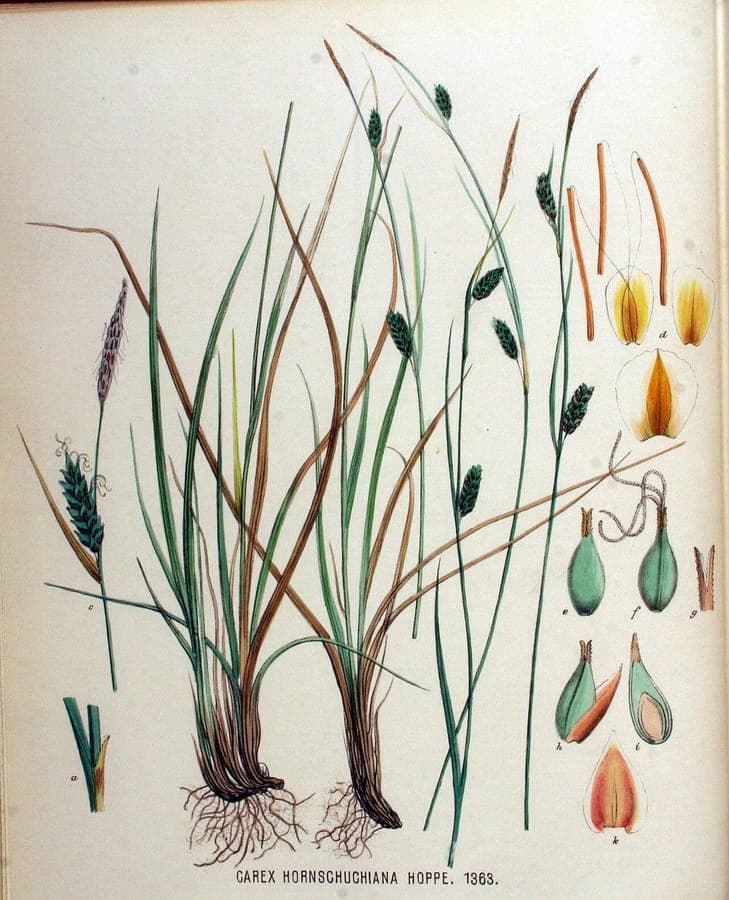
Jan Kops / Public domain, via Wikimedia Commons
Host sedge: complete guide
Carex hostiana
Want to see Host sedge: complete guide in your garden?
1 minute, no credit card
Overview
Carex hostiana, commonly known as Host sedge, is a graceful, grass-like perennial that thrives in moist to wet garden conditions. Native to regions across Central and Northern Europe-including Austria, the Baltic States, Finland, and the Faroe Islands-this sedge from the Cyperaceae family naturally occurs in damp meadows, woodland edges, and acidic peat soils. For gardeners struggling with soggy corners or looking for a reliable, texture-rich plant, Host sedge is a top contender.
It's not a flashy bloomer, but its subtle charm and year-round structure make it ideal for naturalistic gardens, wetland borders, or modern rain gardens. The plant maintains form through winter, with foliage turning a soft golden-brown, adding warmth to the dormant garden. On gardenworld.app, you can generate a custom planting plan that integrates Host sedge seamlessly, especially when paired with other moisture-loving perennials and groundcovers.
Appearance & bloom cycle
Host sedge grows to a height of 30–50 cm, with a spread of 25–40 cm. It forms dense, tufted clumps of narrow, bright green leaves that remain evergreen to semi-evergreen depending on winter severity. The bloom period runs from May through July, producing upright, green flower spikes that rise just above the foliage. These aren't showy like traditional flowers, but they add fine texture and movement in the summer breeze.
By late summer, the flower spikes fade to a warm, straw-like brown, persisting into winter and offering visual interest and shelter for small insects. Though not a dramatic plant, its consistency and quiet elegance make it a gardener's favourite for structural planting.
Ideal location
Host sedge performs best in full sun to partial shade, with a light preference of around 8 out of 10 (where 10 is full sun). In the UK, Ireland, and northern US zones, this translates to a spot with at least 5–6 hours of direct sunlight, preferably morning sun with afternoon shade in hotter regions. It's perfect for damp borders, rain gardens, or the margins of ponds and streams.
Avoid deep shade-this leads to floppy growth and reduced clump density. Likewise, full sun on dry soil will scorch the leaf tips. If you're unsure whether your garden has the right microclimate, gardenworld.app can help map moisture levels and suggest optimal planting zones for sedge varieties.
Soil requirements
This sedge prefers moist, well-drained soil with a pH between 6.5 and 7.0. It tolerates a range of soil types-from sandy loams to heavier clays-as long as moisture is consistently available. It struggles in drought-prone or fast-draining soils. Young plants are especially sensitive to drying out and require reliable water in their first growing season.
Amend the soil at planting with compost or well-rotted manure to improve moisture retention. Avoid compacted or waterlogged clay without organic matter, as this can lead to root rot. A light mulch of leaf mould or compost in spring helps retain moisture and suppress weeds.
Free design
Want to see Host sedge: complete guide in your garden? Make a free design now.
Watering
Consistent moisture is key. During dry spells, especially in summer, water deeply once or twice a week. Established plants are reasonably resilient, but prolonged drought will cause leaf browning and stunted growth. In naturally wet areas or near water features, Host sedge often survives with minimal supplemental watering.
Use rainwater when possible, as Carex hostiana is sensitive to high calcium levels in tap water. If using tap water, let it sit for 24 hours to dissipate chlorine.
Pruning
Pruning isn't essential, but a light trim in late winter or early spring (February to March) keeps the plant looking fresh. Cut back old foliage to about 10 cm above ground level to make way for new growth. This also prevents the clump from becoming too dense and improves air circulation.
Leave the flower spikes over winter for visual texture and to support overwintering insects. Avoid cutting too early, as the old growth provides some insulation.
Maintenance calendar
- Jan: Check clumps; leave old foliage for winter protection.
- Feb: Begin light cleanup of dead leaves.
- Mar: Cut back old growth; apply light compost.
- Apr: New shoots emerge; ensure consistent moisture.
- May: Flower spikes appear; monitor soil dampness.
- Jun: Peak bloom; protect from drought.
- Jul: Bloom fades; no further care needed.
- Aug: Let plant rest; avoid fertilising.
- Sep: No action unless drought occurs.
- Oct: Leave foliage intact for winter.
- Nov: Check drainage; protect young plants if needed.
- Dec: Minimal care; ensure snow cover in extreme cold.
Winter hardiness
Host sedge is hardy to USDA zone 5 (-20°C to -29°C). It survives cold winters across most of the UK, northern US, and Canada without issue. The root system remains active and sends up new shoots each spring. Foliage may brown in harsh winters, but this doesn't affect vitality. No winter protection is needed for mature plants, though mulching young clumps with straw can help in exposed sites.
Companion plants
Pair Host sedge with other moisture-loving plants like Carex vulpinoidea, Molinia caerulea, Eriophorum angustifolium, or Iris versicolor. For colour contrast, try Astilbe, Trollius, or Ligularia. In bog gardens or damp woodland edges, it combines beautifully with ferns, sedges, and rushes.
Avoid drought-tolerant plants like Lavandula, Sedum, or Nepeta, as their cultural needs clash with Host sedge's moisture requirements.
Closing
Carex hostiana is a quiet achiever-unshowy but indispensable in the right setting. It brings texture, resilience, and ecological value to wet areas. Easy to grow and low-maintenance, it's perfect for gardeners embracing naturalistic design. Find Host sedge at garden centres across the UK and US, or order from specialist nurseries. With gardenworld.app, you can design a planting scheme that maximises its potential and keeps your damp areas thriving year-round.
Want to see Host sedge: complete guide in your garden? Make a free design now.
Upload a photo, pick a style, and get a photorealistic design with plant list in under a minute.
No credit card required


Similar plants
Flat-stemmed club-rush: complete guide
Bolboschoenus planiculmis
Everything about Bolboschoenus planiculmis: growing conditions, watering, care, and use as a pond margin or wetland plant in garden design.
Great Plains flatsedge: complete guide
Cyperus lupulinus
Everything about Great Plains flatsedge (Cyperus lupulinus): growing conditions, care, garden uses, and ecological value. Tips for pond margins and dry sandy soils.
Golden beak sedge: complete guide
Rhynchospora corymbosa
Everything about golden beak sedge (Rhynchospora corymbosa): a dramatic tropical marginal for pond edges, bog gardens, and wet habitats.