
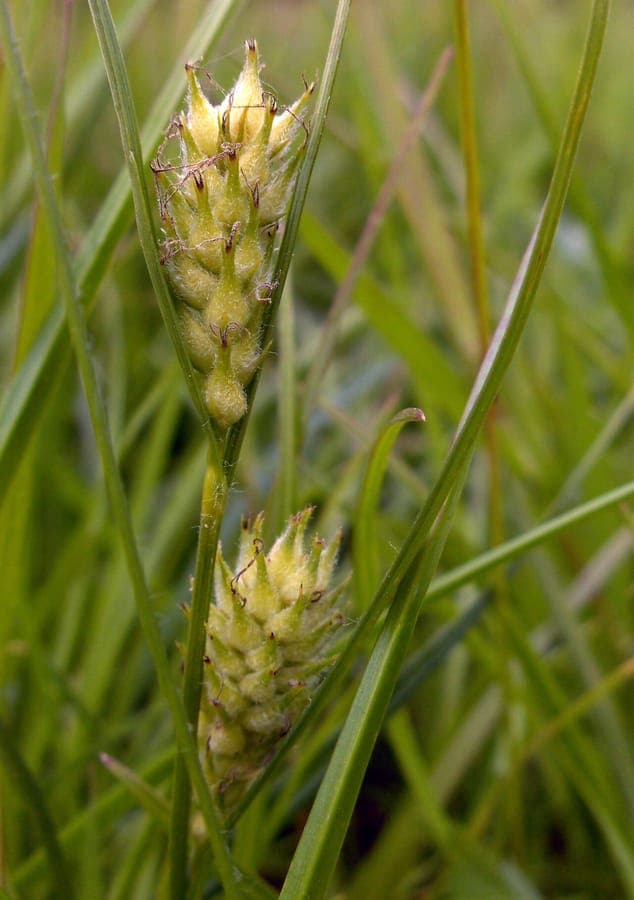
Stemonitis / CC BY-SA 3.0, via Wikimedia Commons
Hairy sedge: complete guide
Carex hirta
Want to see Hairy sedge: complete guide in your garden?
1 minute, no credit card
Overview
Carex hirta, commonly known as hairy sedge, is a quiet achiever in the world of ornamental grasses. It won't stop traffic with flashy blooms, but that's not its job. Instead, it excels as a structural, low-maintenance plant for damp, shady corners where many others struggle. Native to woodlands, hedgerows and damp meadows across central and northern Europe, this graminoid brings a soft, textured presence to the garden all year round.
On gardenworld.app you can design a naturalistic planting scheme where hairy sedge forms the backbone of your shade garden, pairing beautifully with ferns, wildflowers and mosses. Its evergreen habit means it holds visual interest through winter, providing subtle movement and structure when other plants have died back.
Appearance & bloom cycle
Hairy sedge forms dense, mounding clumps of narrow, dark green leaves that arch gently outward. The foliage typically reaches 30–40 cm in height with blades about 3–5 mm wide. What sets it apart is the fine pubescence - tiny hairs - on the leaf sheaths and lower stems, giving it a slightly fuzzy, 'hairy' texture (hence the name).
From May through July, triangular flower spikes emerge, standing just above the foliage. The flowers are green, inconspicuous, and consist of both male and female parts on the same spike. While they don't offer showy colour or fragrance, they contribute to the plant's natural, wild appearance. No need to deadhead - let them fade naturally.
Ideal location
This sedge thrives in partial to full shade, rated at light level 7 - meaning 4 to 6 hours of indirect or dappled sunlight daily. Full sun is acceptable only if the soil remains consistently moist. In hot, dry summers, plants in full sun will scorch and weaken.
Best spots include under light-canopy trees, along shaded pond edges, or in woodland borders. It's ideal for naturalistic gardens, rain gardens, or areas with poor drainage. Avoid exposed, windy sites, as they dry out the foliage too quickly.
Soil requirements
Carex hirta prefers moist, well-drained soils with a pH between 7.0 and 7.5 - neutral to slightly alkaline. It tolerates clay and loamy soils well, as long as they don't stay waterlogged for weeks. Sandy soils can work if enriched with organic matter like compost or leaf mould to improve moisture retention.
Avoid dry, chalky, or compacted soils. If your garden has poor conditions, consider amending the planting hole generously with compost. A 5–10 cm layer of mulch helps lock in moisture and suppress weeds.
Watering
Consistent moisture is key. During establishment (first 1–2 growing seasons), water weekly if rainfall is below 2.5 cm. Once established, it's more resilient but still benefits from supplemental watering in prolonged dry spells.
Signs of underwatering: leaves turning pale, curling, or developing brown tips. Water deeply in the morning or evening to avoid evaporation. Rainwater is ideal - set up a barrel if possible.
Free design
Want to see Hairy sedge: complete guide in your garden? Make a free design now.
Pruning
Minimal pruning required. In early spring (March–April), cut back old, damaged, or tatty foliage to about 10 cm above ground level. Use sharp, clean shears to prevent disease. This encourages fresh, upright growth for the season.
Leave the plant intact over winter. The evergreen leaves provide shelter for overwintering insects and add texture to the dormant garden. Only remove severely damaged parts if needed.
Maintenance calendar
- Jan: Check for frost damage; leave foliage in place
- Feb: Monitor for new growth; no action needed
- Mar: Cut back old leaves; apply light compost top-dressing
- Apr: Ensure consistent moisture; watch for slug damage
- May: Flower spikes emerge; monitor soil moisture
- Jun: Peak growing period; maintain damp soil
- Jul: Flowers persist; no feeding required
- Aug: Watch for drought stress; water if needed
- Sep: Growth slows; reduce watering gradually
- Oct: Prepare for dormancy; no pruning
- Nov: Leave plant standing; mulch if soil is sandy
- Dec: Winter check; look for fungal issues in wet areas
Winter hardiness
Hairy sedge is hardy to USDA zones 5–9, making it perfectly suited to most temperate climates. It remains evergreen in milder winters, though tips may bronze in harsh cold. No winter protection is needed, but in areas with dry winters on sandy soil, a light mulch helps prevent desiccation.
Avoid heavy foot traffic on frozen foliage - it can crush the crowns.
Companion plants
Pair Carex hirta with other moisture-loving, shade-tolerant plants. Try it with ferns like Dryopteris filix-mas, wild ginger (Asarum europaeum), or bluebells (Hyacinthoides non-scripta). It also works well with other sedges such as Carex remota or Carex elata 'Aurea'.
For contrast, use golden-leaved plants like Hakonechloa macra 'Aureola' or silver-foliage brunnera. Avoid aggressive spreaders like goldenrod or mint, which can overwhelm the sedge.
On gardenworld.app, you can build a shade planting plan with ideal spacing and growth timelines, ensuring your hairy sedge and companions thrive together without overcrowding.
Closing
Hairy sedge isn't flashy, and that's exactly why it's valuable. It's a workhorse plant - reliable, subtle, and ecologically beneficial. Once settled, it asks for little and gives back texture, year-round presence, and habitat.
Available at garden centres across the UK and North America, look for it under its botanical name to avoid mix-ups with similar sedges. With the right spot and a little patience, Carex hirta becomes a quiet foundation in any natural garden.
Want to see Hairy sedge: complete guide in your garden? Make a free design now.
Upload a photo, pick a style, and get a photorealistic design with plant list in under a minute.
No credit card required


Similar plants
Flat-stemmed club-rush: complete guide
Bolboschoenus planiculmis
Everything about Bolboschoenus planiculmis: growing conditions, watering, care, and use as a pond margin or wetland plant in garden design.
Great Plains flatsedge: complete guide
Cyperus lupulinus
Everything about Great Plains flatsedge (Cyperus lupulinus): growing conditions, care, garden uses, and ecological value. Tips for pond margins and dry sandy soils.
Golden beak sedge: complete guide
Rhynchospora corymbosa
Everything about golden beak sedge (Rhynchospora corymbosa): a dramatic tropical marginal for pond edges, bog gardens, and wet habitats.