
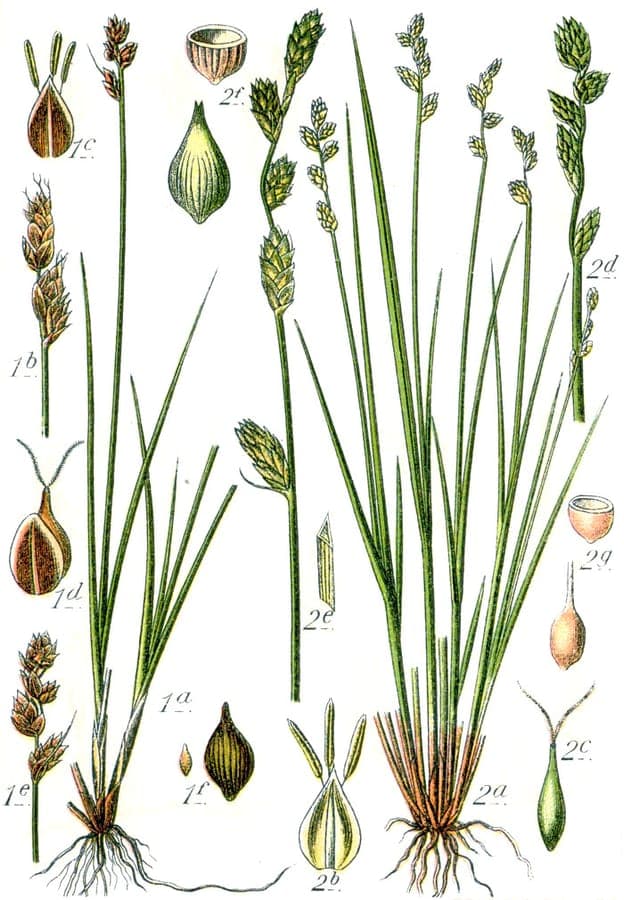
Johann Georg Sturm (Painter: Jacob Sturm) / Public domain, via Wikimedia Commons
Hudson bay sedge: complete guide
Carex heleonastes
Want to see Hudson bay sedge: complete guide in your garden?
1 minute, no credit card
Overview
Carex heleonastes, commonly known as Hudson bay sedge, is a resilient, clump-forming perennial sedge native to cold, wet regions across northern North America and Eurasia. It thrives in bogs, fens, and moist forest margins where few other plants can survive. In the garden, it's an excellent choice for damp, shady areas that tend to collect water after heavy rain. Its fine-textured foliage and low-maintenance nature make it a favourite among gardeners aiming for naturalistic planting schemes.
If you're planning a wetland-inspired garden, gardenworld.app offers design tools that help integrate Carex heleonastes into your layout based on soil moisture and light levels.
Appearance & bloom cycle
This sedge grows to a height of 30–50 cm with a spread of about 40 cm. The leaves are narrow, arching, and deep green, forming a graceful, fountain-like mound. It remains semi-evergreen in milder climates, providing year-round structure. In late spring (May to June), small, inconspicuous flower spikes appear-brownish and arranged in 3 to 5 short, lateral clusters. The seed heads mature in July and persist into autumn, though they are more functional than ornamental.
While not showy, its consistent foliage and subtle seasonal changes add quiet elegance to shaded corners, especially when paired with mosses, ferns, or other moisture-loving groundcovers.
Ideal location
Hudson bay sedge performs best in partial to full shade. It can tolerate morning sun if the soil stays consistently moist, but afternoon sun will stress the plant unless water is abundant. Ideal spots include the edge of woodlands, under deciduous trees, or along the margins of ponds and streams. It's perfect for low-lying areas where water naturally pools.
Avoid planting in dry, sandy, or fast-draining soils without irrigation. Use it in rain gardens, shaded bog gardens, or as an understory plant beneath shrubs like Viburnum or Cornus.
Soil requirements
It prefers acidic to slightly acidic, humus-rich soils with a pH between 4.5 and 6.5. The soil should be high in organic matter-think leaf litter, compost, or peat. While it likes moisture retention, the soil must not be compacted; good aeration is essential to prevent root rot.
Heavy clay soils can be improved with the addition of peat moss or composted pine bark. Avoid calcareous or alkaline soils, which can lead to chlorosis. A 5–7 cm mulch layer of pine needles or shredded bark helps retain moisture and keeps roots cool.
Free design
Want to see Hudson bay sedge: complete guide in your garden? Make a free design now.
Watering
Consistent moisture is non-negotiable. This sedge tolerates temporary waterlogging but will not survive prolonged dry spells. During the growing season (April to September), keep the soil evenly moist. In dry summers, water deeply twice a week-daily if in containers or newly planted.
Mature clumps are slightly more resilient but still depend on reliable moisture. For busy gardeners, setting up a drip irrigation system ensures consistent hydration. gardenworld.app allows you to create a custom watering schedule tailored to moisture-loving plants like this sedge.
Pruning
Pruning is minimal. In late winter or early spring (February–March), remove any dead, damaged, or tattered foliage with clean, sharp shears. Do not cut more than one-third of the plant to avoid stressing it. Use the trimmings as mulch or compost, unless disease is suspected.
Leave flower and seed heads intact through winter-they add texture and provide habitat for overwintering insects. Cut them back only when new growth emerges in spring.
Maintenance calendar
- Jan: Check for frost damage; maintain mulch layer
- Feb: Remove old foliage; prepare for spring growth
- Mar: Light pruning; monitor soil moisture
- Apr: Watch for new shoots; begin regular watering
- May: Flower spikes appear; keep soil moist
- Jun: Continue watering; watch for slugs
- Jul: Prevent drying out; water deeply during heat
- Aug: Maintain moisture; avoid drought stress
- Sep: Reduce watering gradually; remove diseased leaves
- Oct: Apply fresh mulch; let plant enter dormancy
- Nov: Leave standing; no pruning needed
- Dec: Protect from freeze-thaw cycles; ensure drainage
Winter hardiness
Hardy in USDA zones 4–8 (down to −30°C). In the UK and similar climates, it survives winter without protection, especially when mulched. In harsh winters, an extra layer of pine boughs or straw can insulate the crown. Avoid plastic covers-they trap moisture and encourage rot.
Companion plants
Pair with other moisture- and shade-tolerant species:
- Carex vulpinoidea
- Athyrium filix-femina (lady fern)
- Eutrochium maculatum (spotted joe-pye weed)
- Menyanthes trifoliata (bogbean)
- Osmunda regalis (royal fern)
These combinations create layered, ecologically rich plantings that support biodiversity and visual interest year-round.
Closing
Carex heleonastes may not grab attention like a blooming perennial, but it's a dependable workhorse for wet, shady corners. Its evergreen presence, minimal care needs, and natural elegance make it a top choice for sustainable, low-maintenance gardens. Whether you're designing a bog garden or reviving a soggy patch, this sedge delivers.
Plant in groups of at least five for a natural drift effect. Look for it at local garden centres, especially those specialising in native or water plants.
Want to see Hudson bay sedge: complete guide in your garden? Make a free design now.
Upload a photo, pick a style, and get a photorealistic design with plant list in under a minute.
10,000+ gardens designed already
No credit card required


Similar plants
Flat-stemmed club-rush: complete guide
Bolboschoenus planiculmis
Everything about Bolboschoenus planiculmis: growing conditions, watering, care, and use as a pond margin or wetland plant in garden design.
Great Plains flatsedge: complete guide
Cyperus lupulinus
Everything about Great Plains flatsedge (Cyperus lupulinus): growing conditions, care, garden uses, and ecological value. Tips for pond margins and dry sandy soils.
Golden beak sedge: complete guide
Rhynchospora corymbosa
Everything about golden beak sedge (Rhynchospora corymbosa): a dramatic tropical marginal for pond edges, bog gardens, and wet habitats.