
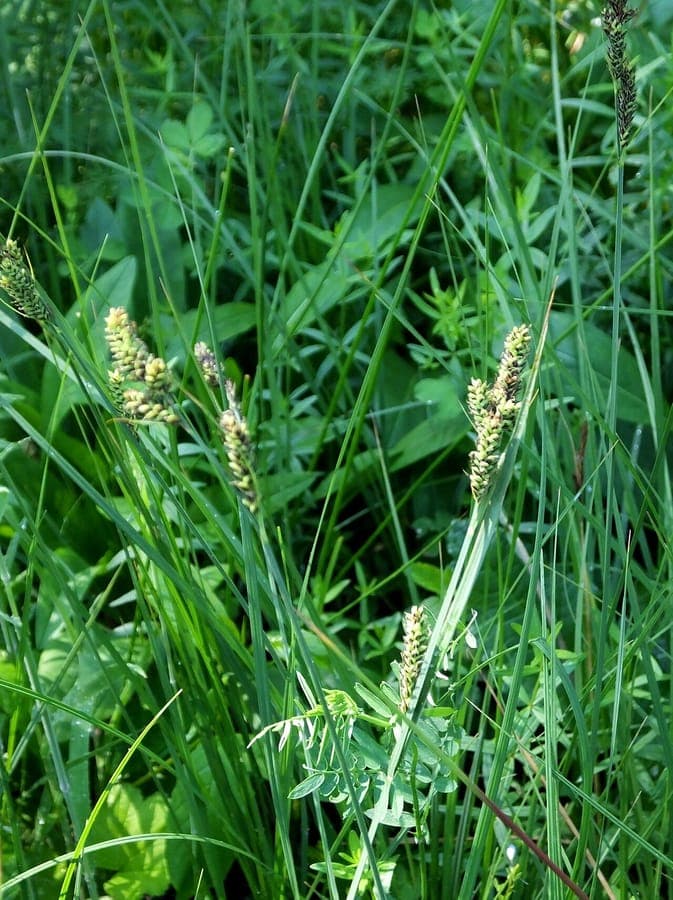
Panek / CC BY-SA 3.0 pl, via Wikimedia Commons
Carex hartmaniorum: complete guide
Carex hartmaniorum
Want to see Carex hartmaniorum: complete guide in your garden?
1 minute, no credit card
Overview
Carex hartmaniorum, better known as "kleine knotszegge" in Dutch and "hartmann's sedge" in English, is an elegant European sedge originating from Central Europe to Central Asia. This plant thrives on wet mountain locations and moisture-rich soils.
It is a refined plant for moisture-rich mountain gardens and natural gardens where wet environment is dominant. Carex hartmaniorum brings elegance and ecological value to the wetter corners of your garden.
Appearance & Bloom
Carex hartmaniorum forms dense, compact tufts of long foliage. The plant reaches 20-40 cm height with elegant, slender appearance. The foliage is dark green and very refined.
Blooming occurs from May to July with brown, compact flower spikes. Characteristic perigynia are densely clustered and feature interesting details. This makes the plant botanically fascinating.
Ideal Location
Carex hartmaniorum thrives best in full to partial sun on moist, nutrient-rich mountain soil. This plant prefers wet environment with good nutrient value. It is ideal for wet mountain gardens, waterside planting, and moisture-rich woodland edges.
Plant this sedge in groups on wet mountain locations. It spreads slowly under optimal conditions.
Soil Composition
Carex hartmaniorum thrives on moist, nutrient-rich mountain soil with both mineral and organic material. Ensure stable moisture content - consistent involvement in feeding and moisture management is essential.
In mountainous gardens with permanent moisture supply, this sedge blooms optimally. Add organic material for nutrient value.
Free design
Want to see Carex hartmaniorum: complete guide in your garden? Make a free design now.
Watering
Carex hartmaniorum prefers constantly moist to wet environment. Water regularly so soil never dries out. This sedge thrives better with water excess than deficit.
In permanent mountain gardens with moist microclimate, supplemental watering is minimal. Natural moisture usually suffices.
Pruning
Carex hartmaniorum requires minimal pruning. Remove only dead foliage in spring.
The plant maintains its natural form. Old leaves can be gently removed in March.
Maintenance Calendar
March: Clean dead material. May: Growth and blooming begin. June-July: Bloom continues. August: Seeds ripen. September: Seed dispersal. October-February: Winter rest.
Winter Hardiness
Carex hartmaniorum is fully hardy. This European mountain resident tolerates frost to very low temperatures without damage. No winter protection required.
In wet winters, normal drainage suffices - this sedge even enjoys water-covered periods.
Companion Plants
Carex hartmaniorum combines beautifully with other water-loving mountain plants. Suitable partners include Carex elata, Caltha palustris, Trollius europaeus, Veratrum album, and Petasites hybridus. In wet mountain margins, it fits with sedums and other moisture-tolerant dwarfs.
Avoid drought-loving partners. Carex hartmaniorum thrives in moist environment and needs water to feel at home.
Closing Remarks
Anyone wishing to beautify wet mountain corners should consider Carex hartmaniorum. This elegant European sedge brings refinement and ecological value. On gardenworld.app, find more suggestions for moisture-rich mountain gardens.
Once established on wet mountain soil with optimal nutrient value, Carex hartmaniorum is a grateful, long-term neighbor. The plant enjoys stable moisture and grows elegantly for years.
Available from specialized mountain garden growers in Europe. Check gardenworld.app for suppliers.
Want to see Carex hartmaniorum: complete guide in your garden? Make a free design now.
Upload a photo, pick a style, and get a photorealistic design with plant list in under a minute.
No credit card required


Similar plants
Carex arctogena: complete guide
Carex arctogena
Meet Carex arctogena, a hardy subarctic sedge perfect for cold mountain gardens. Learn about care, location, and winter hardiness in this guide.
Carex depressa: complete guide
Carex depressa
Learn about Carex depressa, a refined Alpine sedge from Europe. Ideal for acidic, nutrient-poor soil. Complete care guide and growing tips.
Carex glareosa: complete guide
Carex glareosa
Meet Carex glareosa, the gravel sedge from Arctic regions. Perfect for arctic and alpine gardens. Care guide and growing tips.