
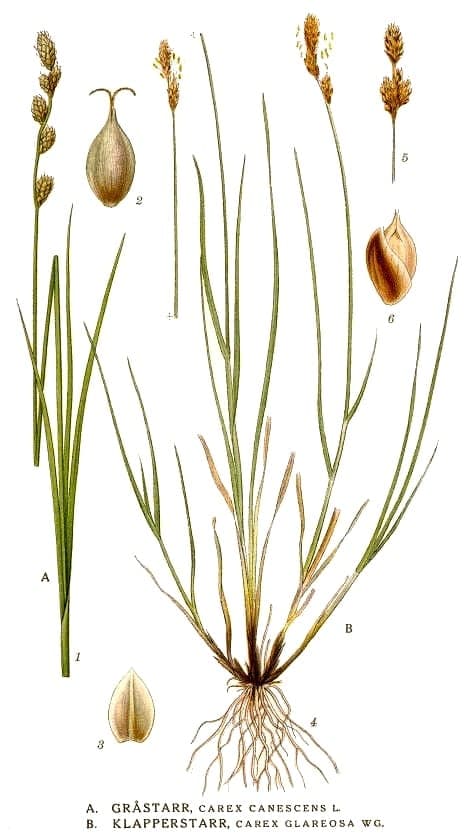
Carl Axel Magnus Lindman / Public domain, via Wikimedia Commons
Carex glareosa: complete guide
Carex glareosa
Want to see Carex glareosa: complete guide in your garden?
1 minute, no credit card
Overview
Carex glareosa, better known as "gravel sedge" or "lesser saltmarsh sedge," is an arctic sedge originating from Northern Europe, Russia, Siberia, Alaska, and Canada. This plant grows naturally in arctic tundras, gravel areas, and coastal cliffs.
It is an exceptional plant for specialists wishing to create authentic arctic gardens. Carex glareosa brings rarity and botanical interest to the most advanced gardens.
Appearance & Bloom
Carex glareosa forms compact, dense tufts of narrow, pale green foliage. The plant reaches only 5-15 cm height and forms subtle, elegant mats. The foliage is very fine and soft-green.
Blooming occurs from May to July with brown, inconspicuous flowers. The plant grows appropriately slowly - this provides structure without invasiveness. For patient gardeners, this plant brings eternal value.
Ideal Location
Carex glareosa thrives best in full sun on extremely well-draining, gravelly soil. This plant prefers arctic environments with fluctuating moisture. It is ideal for gravel gardens, alpine gardens, and coastal habitats.
Plant this sedge in display groups on pure gravel. It thrives in arctic, subarctic environment where normal gardens do not exist.
Soil Composition
Carex glareosa makes extremely high demands on soil. The plant requires extremely well-draining, sandy gravel soil with minimal humus. Use pure gravel mixture - no compost or feeding.
This sedge attaches to rocks and gravel - it grows this way in the arctic. Provide shallow, dry soil with plenty of mineral material.
Free design
Want to see Carex glareosa: complete guide in your garden? Make a free design now.
Watering
Carex glareosa prefers moist, but not wet environment. Water sparingly - this plant tolerates drought well. In arctic climates, rainwater usually suffices.
Overwatering is greater problem than underwatering. Always ensure excellent drainage. In mountainous rock gardens, water only during extreme drought.
Pruning
Carex glareosa requires no pruning. Remove only dead material if severely damaged.
The plant grows slowly and shapes itself. Let it grow at its own pace.
Maintenance Calendar
May: Growth begins, monitor moisture. June: Bloom arrives. July: Bloom continues. August-April: Winter rest with minimal activity.
Winter Hardiness
Carex glareosa is extremely hardy - it grows in arctic tundra. This plant tolerates temperatures of -40°C and lower without damage. No winter protection required.
In arctic winters, snow cover is beneficial. This sedge is designed for extreme environment.
Companion Plants
Carex glareosa combines with little plant material - it grows in arctic tundra where vegetation is sparse. Possible partners are Carex subspathacea, Plantago maritima, Silene acaulis, and other arctic dwarfs.
Let this plant grow in arctic purity - it belongs without many neighbors.
Closing Remarks
Anyone wishing to create arctic, tundra-like gardens should consider cultivating Carex glareosa. This rare sedge brings authentic polar atmosphere. On gardenworld.app, find more arctic plant suggestions.
Once established on correct, arctic soil, Carex glareosa is a grateful, age-old resident. This plant requires patience and insight, but rewards with unique botanical splendor.
Rarely available - seek specialized arctic plant growers. Check gardenworld.app for suppliers.
Want to see Carex glareosa: complete guide in your garden? Make a free design now.
Upload a photo, pick a style, and get a photorealistic design with plant list in under a minute.
No credit card required


Similar plants
Carex arctogena: complete guide
Carex arctogena
Meet Carex arctogena, a hardy subarctic sedge perfect for cold mountain gardens. Learn about care, location, and winter hardiness in this guide.
Carex careyana: complete guide
Carex careyana
Meet Carex careyana, also known as Carey's sedge. A frost-hardy woodland plant for shaded gardens. Learn about care, growth, and planting.
Carex depressa: complete guide
Carex depressa
Learn about Carex depressa, a refined Alpine sedge from Europe. Ideal for acidic, nutrient-poor soil. Complete care guide and growing tips.