
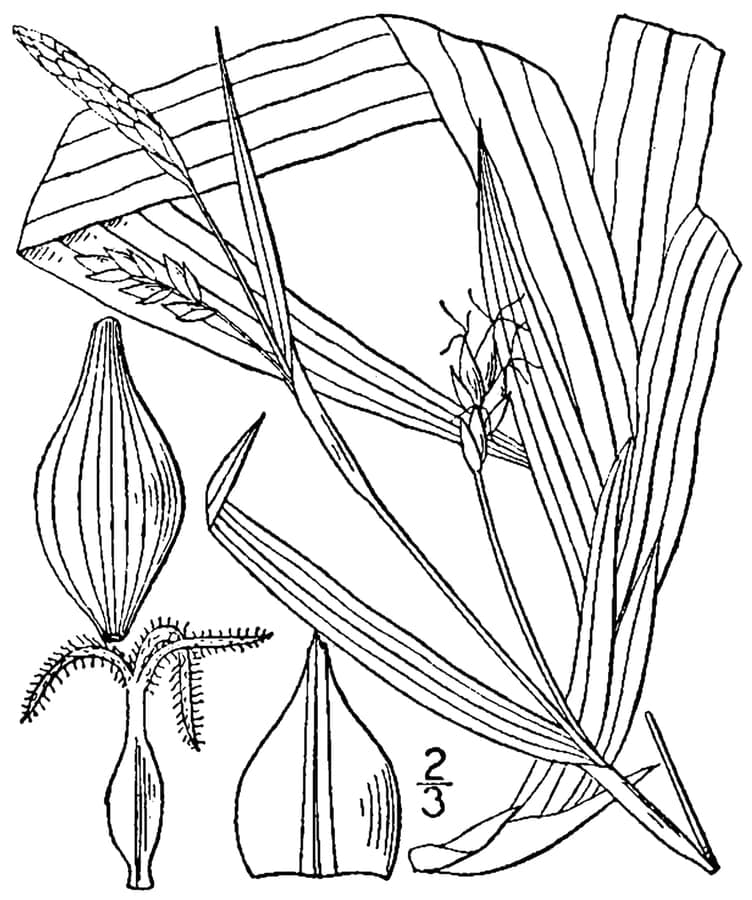
Britton, N.L., and A. Brown. 1913. An illustrated flora of the northern United States, Canada and the British Possessions. 3 vols. Charles Scribner's Sons, New York. Vol. 1: 400. Courtesy of Kentucky Native Plant Society. Scanned by Omnitek Inc. / Public domain, via Wikimedia Commons
Carex careyana: complete guide
Carex careyana
Want to see Carex careyana: complete guide in your garden?
1 minute, no credit card
Overview
Carex careyana, known as "Carey's sedge" or "Carey's wood sedge," is a native North American sedge that naturally occurs from Southeast Canada to eastern and central United States. This frost-hardy woodland plant thrives in shaded, nutrient-rich environments.
It is an ideal plant for naturally designed gardens, woodland border plantings, and shady corners where traditional catalog choices fail. Carex careyana brings subtle elegance and ecological value to any garden.
Appearance & Bloom
Carex careyana forms broad, dense mats of long foliage. The plant reaches 30-50 cm height and creates compact, attractive clusters. The foliage is glossy green with subtle texture.
Blooming occurs in April to May with inconspicuous, greenish-brown flowers. Characteristic perigynia follow later in the season. Together, these elements provide botanical interest year-round.
Ideal Location
Carey's sedge thrives excellently in full to partial shade. This plant is ideal at tree bases and under shrubs. It feels at home on moist, nutrient-rich soil. Avoid full sun - this leads to weakening.
Plant this sedge in groups for maximum effect. It is perfect for wild gardens, woodland edges, and shady borders where it spreads elegantly.
Soil Composition
Carex careyana thrives on moist, nutrient-rich woodland and humus-rich soil. Unlike many sedges, it prefers neutral to slightly acidic environment. Add compost or leaf mold for better soil structure.
Place this plant under trees where it benefits from fallen leaves. Organic material increases soil life and nutrient supply.
Free design
Want to see Carex careyana: complete guide in your garden? Make a free design now.
Watering
Carey's sedge loves constantly moist soil without stagnation. Water regularly, especially during growing period (April-September). In wild gardens with woodland soil, supplemental water is usually not needed.
The plant is relatively drought-tolerant thanks to deep roots. However, optimal growth is achieved with consistently moist environment.
Pruning
Carex careyana requires minimal pruning. Remove dead foliage in March. The plant maintains its natural form.
Old leaves can be gently removed. The plant shapes itself into an attractive form naturally.
Maintenance Calendar
March: Clean dead material. April: Blooming begins. May: Bloom continues. June: Perigynia ripen. July-August: Seed development. September: Seed dispersal. October-February: Resting period.
Winter Hardiness
Carex careyana is fully hardy to zone 3. This plant tolerates severe frost without issues. No winter protection required.
On woodland soils with humus layer, excessive moisture is not problematic. Natural winter protection from fallen leaves helps.
Companion Plants
Carey's sedge combines beautifully with other woodland plants. Suitable partners include Carex pensylvanica, Carex platyphylla, Helleborus niger, Epimedium, and Pulmonaria. In woodland-edge gardens, it pairs well with early-blooming bulbs.
Avoid nutrient-demanding neighbors. Carex careyana spreads slowly and likes to share space.
Closing Remarks
Anyone wanting to soften shady woodland corners in their garden should consider Carex careyana. This American native brings elegance and ecological value. On gardenworld.app, find more shade garden suggestions.
Once established, Carex careyana is a grateful, long-term neighbor. The plant enjoys nutrient-rich woodland soil and spreads gradually. Plant in groups for maximum effect.
Available from woodland plant growers in North America and Europe. Check gardenworld.app for suppliers in your region.
Want to see Carex careyana: complete guide in your garden? Make a free design now.
Upload a photo, pick a style, and get a photorealistic design with plant list in under a minute.
No credit card required


Similar plants
Carex arctogena: complete guide
Carex arctogena
Meet Carex arctogena, a hardy subarctic sedge perfect for cold mountain gardens. Learn about care, location, and winter hardiness in this guide.
Carex depressa: complete guide
Carex depressa
Learn about Carex depressa, a refined Alpine sedge from Europe. Ideal for acidic, nutrient-poor soil. Complete care guide and growing tips.
Carex hartmaniorum: complete guide
Carex hartmaniorum
Meet Carex hartmaniorum, the small clubsedge from Central Europe. A hardy sedge for wet mountain locations. Complete care and growing guide.