
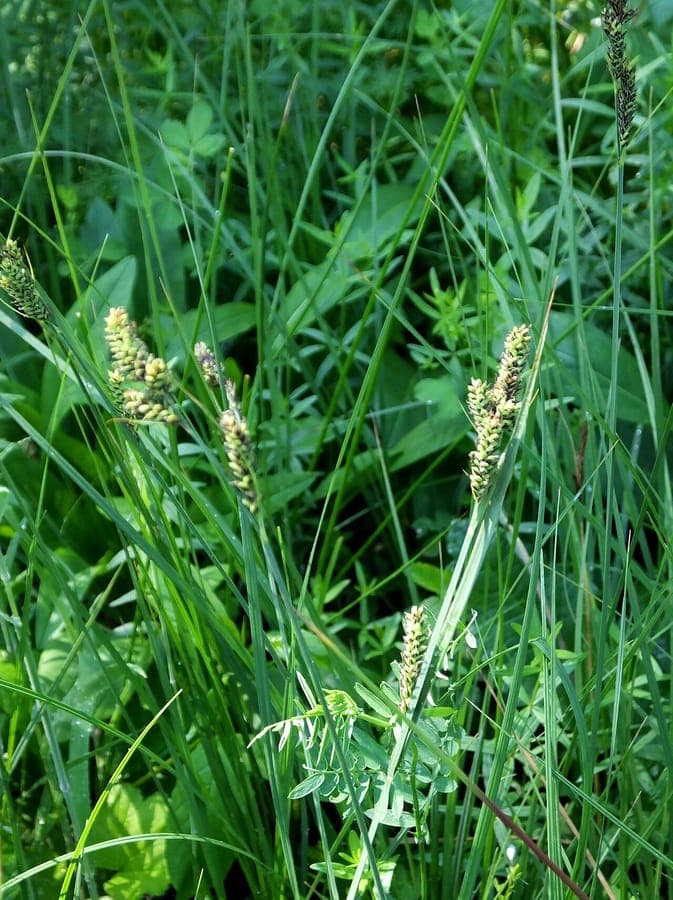
Panek / CC BY-SA 3.0 pl, via Wikimedia Commons
Carex hartmanii: complete guide
Carex hartmanii
Want to see Carex hartmanii: complete guide in your garden?
1 minute, no credit card
Overview
Carex hartmanii, commonly known as Hartman's sedge, is a quietly elegant perennial grass-like plant from the Cyperaceae family. Native to moist woodlands across northern and central Europe, it thrives where many traditional groundcovers struggle - in deep shade and consistently damp soil. This evergreen sedge forms neat, compact clumps and brings year-round structure to the garden, a rare quality in late winter when most plants are dormant.
It's not flashy, but it's dependable. Gardeners who value texture, subtlety, and resilience will find a true ally in this plant. On gardenworld.app, you can design a garden layout that highlights Carex hartmanii in shaded corners, under tree canopies, or along naturalistic stream beds.
Appearance & bloom cycle
This sedge reaches 25–40 cm in height with a spread of around 30 cm. The foliage is fine-textured, narrow, and gracefully arching, with a soft, light green hue that brightens shady spots. The leaves are evergreen, turning slightly bronzed in harsh winters but rebounding strongly in spring.
Flowering occurs from April to May. The blooms are modest - small, brownish spikelets rise just above the foliage, adding quiet interest rather than drama. While not showy, they attract small pollinators and contribute to ecological balance. After flowering, the seed heads persist into autumn, maintaining visual appeal.
The plant grows slowly, forming tight clumps over time. It doesn't spread aggressively, making it ideal for controlled planting schemes. Expect full establishment in 2–3 years.
Ideal location
Carex hartmanii prefers partial to full shade. It performs best under deciduous trees like beech, oak, or maple, where it enjoys dappled light and protection from midday sun. Full sun is only acceptable in consistently moist conditions, otherwise leaf tips may scorch.
Avoid dense shade under conifers, as these areas are often too dry and acidic. Ideal spots include woodland edges, north-facing borders, or moist areas near ponds and rain gardens. On gardenworld.app, you can virtually map out these microclimates in your garden to place Carex hartmanii exactly where it will thrive.
Soil requirements
The soil must be moist, well-draining, and rich in organic matter. Clay soils work well if not waterlogged. Sandy soils need amending with compost or leaf mould to improve water retention. The ideal pH ranges from 5.5 to 7.0 - slightly acidic to neutral.
For heavy clay, mix in grit and compost when planting. For sandy soils, add a blend of topsoil, compost, and coir to boost moisture retention. Avoid chalky or saline soils.
Free design
Want to see Carex hartmanii: complete guide in your garden? Make a free design now.
Watering
Keep the soil consistently moist, especially during the first growing season and in dry summers. The plant has shallow roots and dries out quickly. In wet seasons, no supplemental watering is needed.
Use rainwater when possible - tap water with high lime content can stress the plant over time. Water in the early morning or late evening to reduce evaporation. During prolonged dry spells in July and August, water deeply twice a week.
Pruning
Pruning is minimal. In March, gently remove dead, damaged, or tatty leaves with sharp scissors. Cut close to the base but avoid disturbing new growth. Do not cut back hard - the plant recovers slowly.
Leave the old foliage in place over winter to protect the crown. The trimmed material can be used as light mulch around the base or in nearby beds.
Maintenance calendar
- Jan: check for winter damage
- Feb: clear debris around clumps
- Mar: prune old foliage; add compost
- Apr: monitor new growth; watch for slugs
- May: observe flowering; no feeding needed
- Jun: check soil moisture in dry spells
- Jul: water regularly if dry
- Aug: maintain moisture, especially in shade
- Sep: leave dying leaves for winter protection
- Oct: allow leaf litter to act as mulch
- Nov: no action required
- Dec: inspect for frost damage
Winter hardiness
Carex hartmanii is hardy in USDA zones 5–9. In the UK and Ireland (zone 8), it survives winter without protection. Foliage may bronze in cold spells but rebounds in spring. No mulching needed except in exposed, windy sites - in those cases, a light layer of leaf mould or straw helps.
Companion plants
Pair with Helleborus, Hosta, Bergenia, Primula, and Anemone nemorosa. These share similar moisture and shade preferences. Add vertical interest with Cornus sanguinea or Viburnum opulus.
Avoid invasive spreaders like mint or aggressive grasses that can overwhelm the sedge.
Closing
Carex hartmanii is a quiet achiever - not loud, but essential. It fills gaps, adds texture, and stays green when little else does. Perfect for woodland gardens, shaded borders, or low-effort landscapes. Buy from reputable garden centres like those found across the UK, where it's often sold in 1-litre pots. Check the root ball - it should be moist and intact, not dried out.
Plant in groups of 5 or more for a natural, flowing effect. And remember: planning makes planting easier. Use gardenworld.app to create a custom garden design that fits your space and highlights the quiet beauty of this reliable sedge.
Want to see Carex hartmanii: complete guide in your garden? Make a free design now.
Upload a photo, pick a style, and get a photorealistic design with plant list in under a minute.
No credit card required


Similar plants
Flat-stemmed club-rush: complete guide
Bolboschoenus planiculmis
Everything about Bolboschoenus planiculmis: growing conditions, watering, care, and use as a pond margin or wetland plant in garden design.
Great Plains flatsedge: complete guide
Cyperus lupulinus
Everything about Great Plains flatsedge (Cyperus lupulinus): growing conditions, care, garden uses, and ecological value. Tips for pond margins and dry sandy soils.
Golden beak sedge: complete guide
Rhynchospora corymbosa
Everything about golden beak sedge (Rhynchospora corymbosa): a dramatic tropical marginal for pond edges, bog gardens, and wet habitats.