
Kurt Stüber [1] / CC BY-SA 3.0, via Wikimedia Commons
Gray's sedge: complete guide
Carex grayi
Want to see Gray's sedge: complete guide in your garden?
1 minute, no credit card
Overview
Gray's sedge (Carex grayi) is a clump-forming perennial grass-like plant from the Cyperaceae family, native to moist woodlands across the eastern United States, including states like Alabama, Illinois, and Connecticut. It thrives in damp, shaded areas and is increasingly popular in modern garden design for its architectural form and resilience. Standing between 40 and 60 cm tall, with a spread of 30 to 45 cm, it brings subtle texture and year-round interest to shaded, wet corners of the garden.
On gardenworld.app, you can design a planting scheme that integrates Gray's sedge into low-lying, moisture-rich areas, helping you visualise how it complements ferns, hostas, and other shade lovers.
Appearance & bloom cycle
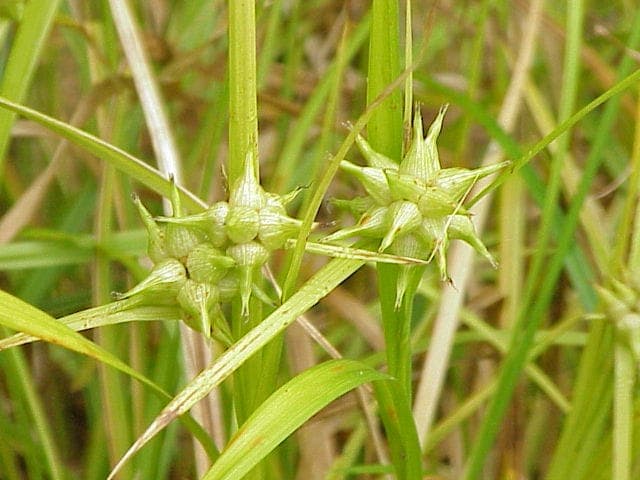
Gray's sedge features narrow, bright green to deep green foliage that grows in dense tufts. The leaves are 3 to 5 mm wide and can reach up to 50 cm in length, creating a lush, soft texture. Its most distinctive feature is the flowering structure: from April to June, upright green spikes emerge, topped with unusual, star-shaped bracts that give the plant its common name. These bracts encircle the seed heads, creating a unique 'morning star' silhouette that adds visual intrigue.
As summer progresses, the flowers mature into dark green to brownish seed clusters that persist into winter, offering food and shelter for small insects and birds. The plant remains evergreen in milder climates, while in colder zones it may die back slightly but regrows vigorously in spring.
Ideal location
This sedge performs best in partial to full shade, especially under deciduous trees where dappled sunlight filters through. It can tolerate morning sun if the soil stays consistently moist, but avoid hot afternoon sun, which dries out the roots too quickly. Ideal spots include the edges of ponds, damp woodland borders, or low-lying areas that collect rainwater.
Avoid planting in dry, sandy, or compacted soils. Choose a sheltered location to protect the delicate foliage from strong winds.
Soil requirements
Carex grayi prefers rich, loamy soil with high organic content. The pH should range between 5.7 and 7.2 – slightly acidic to neutral. Heavy clay soils work well as long as they don't become waterlogged. Sandy soils need amending with compost or leaf mould to improve moisture retention. Incorporate 5–8 cm of organic matter into the top 15 cm of soil before planting.
Avoid alkaline or chalky soils, as they can lead to nutrient deficiencies.
Free design
Want to see Gray's sedge: complete guide in your garden? Make a free design now.
Watering
Consistent moisture is key. During the growing season (April to September), water weekly if rainfall is below 2.5 cm. In periods of drought or heatwaves (above 28°C), increase frequency to twice a week. Use rainwater when possible, as tap water with high lime content can alter soil pH over time.
Mulch with shredded bark or leaf litter to retain moisture and regulate soil temperature.
Pruning
Minimal pruning is needed. In late winter or early spring (February to March), cut back old, tattered foliage to about 10 cm above the ground to make way for fresh growth. Use clean, sharp shears to prevent disease. Do not cut into the crown, as this can damage the plant.
Leave the plant intact through autumn and winter to provide habitat and visual structure.
Maintenance calendar
- Jan: Check for winter damage, avoid walking on frozen clumps
- Feb: Light pruning of dead leaves
- Mar: Divide overcrowded clumps if needed
- Apr: Monitor soil moisture, apply compost top-dressing
- May: Watch for emerging blooms, no pruning
- Jun: Maintain consistent moisture, especially in dry spells
- Jul: Continue watering during heatwaves
- Aug: No fertilising, prevent drying out
- Sep: Reduce watering as growth slows
- Oct: Leave foliage for winter interest
- Nov: Inspect for pests, avoid wet mulch
- Dec: Dormant period, no intervention
Winter hardiness
Gray's sedge is hardy in USDA zones 5 to 9. It tolerates winter temperatures down to -20°C when established. In colder regions, a light mulch of leaves or bark helps protect the crown. The plant remains semi-evergreen, with foliage turning bronze or brown but staying upright.
Avoid heavy mulching with straw, which can attract voles.
Companion plants
Pair Gray's sedge with moisture-loving perennials like Astilbe, Ligularia, Hosta, and ferns such as Dryopteris or Matteuccia. It also works well with other sedges like Carex vulpinoidea or grasses like Molinia caerulea. For contrast, plant alongside dark-leaved Heuchera or white-variegated Solomon's seal.
On gardenworld.app, you can simulate planting combinations to see how Gray's sedge fits into your shaded, damp garden layout.
Closing
Carex grayi is a resilient, ornamental sedge that excels in wet, shady areas where many plants struggle. Its unique flower form and low maintenance needs make it a smart choice for naturalistic planting schemes. Available at garden centres in spring, especially those specialising in native or woodland plants. With the right conditions – moist soil, partial shade, and organic matter – Gray's sedge will thrive for years with little fuss.
Want to see Gray's sedge: complete guide in your garden? Make a free design now.
Upload a photo, pick a style, and get a photorealistic design with plant list in under a minute.
No credit card required


Similar plants
Flat-stemmed club-rush: complete guide
Bolboschoenus planiculmis
Everything about Bolboschoenus planiculmis: growing conditions, watering, care, and use as a pond margin or wetland plant in garden design.
Great Plains flatsedge: complete guide
Cyperus lupulinus
Everything about Great Plains flatsedge (Cyperus lupulinus): growing conditions, care, garden uses, and ecological value. Tips for pond margins and dry sandy soils.
Golden beak sedge: complete guide
Rhynchospora corymbosa
Everything about golden beak sedge (Rhynchospora corymbosa): a dramatic tropical marginal for pond edges, bog gardens, and wet habitats.