
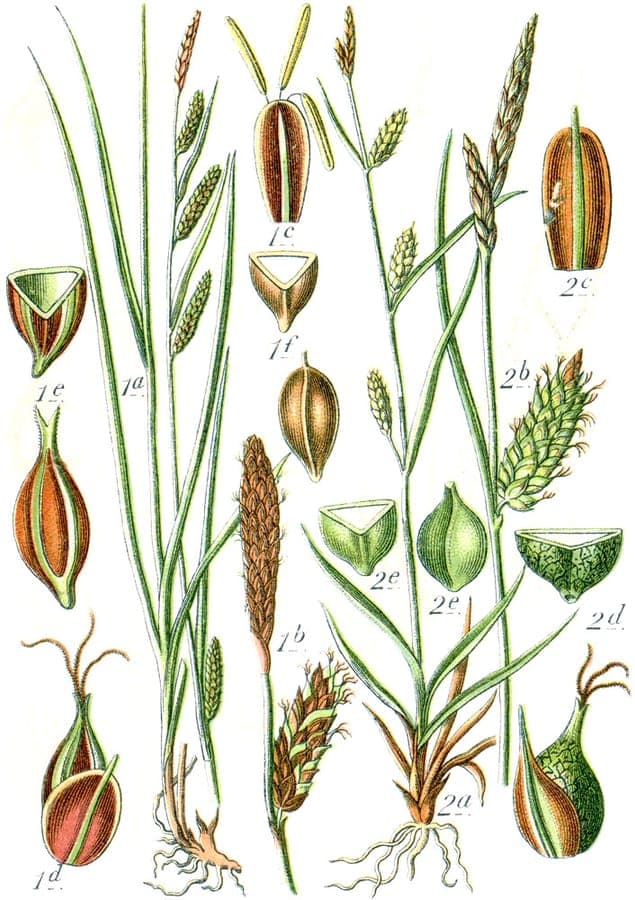
Johann Georg Sturm (Painter: Jacob Sturm) / Public domain, via Wikimedia Commons
Glacial sedge: complete guide
Carex glacialis
Want to see Glacial sedge: complete guide in your garden?
1 minute, no credit card
Overview
Carex glacialis, commonly known as Glacial sedge, is a resilient, evergreen ornamental grass that thrives in cool, moist, and rocky conditions. Native to mountainous and coastal regions from Alaska to Iceland and Finland, this sedge adapts well in garden settings with consistent moisture and partial shade. It's ideally suited for USDA hardiness zones 5 to 8, making it a strong choice for gardens across the UK, northern US, and Canada.
What sets Carex glacialis apart is its quiet strength and textural presence. It doesn't bloom with showy flowers, but instead offers year-round visual interest through its dense, arching foliage. If you're planning a damp corner near a stream or a shaded rock garden, consider using gardenworld.app to design a layout that highlights this sedge's subtle beauty.
Appearance & bloom cycle
Glacial sedge forms tight, mat-like clumps of fine, narrow leaves 20–30 cm long and no more than 2 mm wide. The leaves are dark green with a silvery underside, giving them a soft sheen when light filters through. In early spring, from April to June, it produces inconspicuous flower spikes-typical of the Carex genus-rising slightly above the foliage as slender, brassy-green spikes.
Mature plants reach 25–35 cm in height and spread slowly to about 40 cm wide. It grows via short rhizomes, forming neat colonies without becoming invasive. There's no fragrance or dramatic bloom, just steady, elegant growth that adds depth and movement to shaded areas.
Ideal location
This sedge prefers partial to light shade, but tolerates full sun if soil moisture is consistently maintained. A light value of 8 means it needs bright, indirect light but not harsh midday sun. In the UK or Pacific Northwest US, an east- or north-facing spot works best-under deciduous trees, beside a pond, or in a damp rock crevice.
For gardeners designing a woodland edge or a cool, moist border, gardenworld.app offers visual planning tools to test how Glacial sedge integrates with ferns, hostas, or mossy stones. It's particularly effective in alpine gardens or alongside slow-moving water features.
Soil requirements
The soil should be moist but well-drained, rich in organic matter. A mix of loam, compost, and coarse sand works well. Ideal pH ranges from 7.0 to 7.5-neutral to slightly alkaline. Avoid acidic peat-heavy soils; instead, amend with garden lime if your soil tests below pH 7.
Heavy clay soils can be improved with grit and compost to prevent waterlogging. While the plant likes moisture, it will rot if roots sit in stagnant water. Aeration and drainage are key, even in wet areas.
Free design
Want to see Glacial sedge: complete guide in your garden? Make a free design now.
Watering
Carex glacialis needs consistently moist soil. During the first growing season, water deeply 2–3 times per week, especially in dry spells. Once established, it's more resilient but still benefits from weekly watering in summer droughts. A 5–7 cm mulch layer of bark or leaf mould helps retain moisture and suppress weeds.
If using irrigation, set it to run early morning. Avoid wetting foliage overnight to reduce fungal risks.
Pruning
Pruning is minimal. In late winter or early spring (February–March), trim back any dead, tattered, or browned foliage with sharp shears. Do not cut into the crown-just remove surface debris. As an evergreen, it retains most leaves year-round, so aggressive cutting back is unnecessary and can weaken the plant.
Use the clippings in compost-they break down slowly and improve soil structure.
Maintenance calendar
- Jan: Check for frost heave; protect young clumps with breathable mulch
- Feb: Light pruning; remove old foliage
- Mar: Replant or divide if needed; monitor soil moisture
- Apr: New growth emerges; watch for slugs
- May: No feeding required; maintain moisture
- Jun: Flowering begins; inspect for dry leaf tips
- Jul: Water regularly in heatwaves
- Aug: Avoid pruning; monitor for drought stress
- Sep: Observe spread; no active care needed
- Oct: Apply mulch to insulate roots
- Nov: Leave foliage for winter protection
- Dec: Minimal care; check for fungal issues in wet areas
Winter hardiness
Carex glacialis is highly cold-tolerant, surviving temperatures down to -28°C (USDA zone 5). Foliage may bronze in winter but rarely dies back completely. Snow cover acts as insulation. In regions with freeze-thaw cycles, ensure soil drains well to prevent root damage from repeated expansion and contraction.
Companion plants
Pair with moisture-loving, shade-tolerant perennials like Athyrium filix-femina, Tellima grandiflora, Omphalodes verna, or Hakonechloa macra. Avoid aggressive spreaders like mint or bamboo. Good groundcovers include Heuchera or barrenwort (Epimedium).
Closing
Carex glacialis is a dependable, low-maintenance plant for damp, shady areas. It brings texture, year-round greenery, and a natural feel to challenging spots. Available in spring at garden centres across the UK and North America, often in 9x9 cm pots or as small clumps. For a tailored design idea, use gardenworld.app to create a garden plan that puts this sedge centre stage in a cool, moist border.
Want to see Glacial sedge: complete guide in your garden? Make a free design now.
Upload a photo, pick a style, and get a photorealistic design with plant list in under a minute.
No credit card required


Similar plants
Flat-stemmed club-rush: complete guide
Bolboschoenus planiculmis
Everything about Bolboschoenus planiculmis: growing conditions, watering, care, and use as a pond margin or wetland plant in garden design.
Great Plains flatsedge: complete guide
Cyperus lupulinus
Everything about Great Plains flatsedge (Cyperus lupulinus): growing conditions, care, garden uses, and ecological value. Tips for pond margins and dry sandy soils.
Golden beak sedge: complete guide
Rhynchospora corymbosa
Everything about golden beak sedge (Rhynchospora corymbosa): a dramatic tropical marginal for pond edges, bog gardens, and wet habitats.