
Robert H. Mohlenbrock. USDA SCS. 1989. Midwest wetland flora: Field office illustrated guide to plant species. Midwest National Technical Center, Lincoln. Courtesy of USDA NRCS Wetland Science Institute. / Public domain, via Wikimedia Commons
Carex frankii: complete guide
Carex frankii
Want to see Carex frankii: complete guide in your garden?
1 minute, no credit card
Overview: Carex frankii, commonly called Frank's sedge or bristly cattail sedge, is a North American marsh sedge ranging from Ontario to Mexico. This sedge grows 50-100 cm tall, forming elegant upright culms with highly ornamental flowering. Unlike many sedges, Carex frankii thrives in extremely wet, muddy ground where most plants cannot survive. This adaptation makes it invaluable for wetland restoration, marsh management, and naturally wet garden zones.
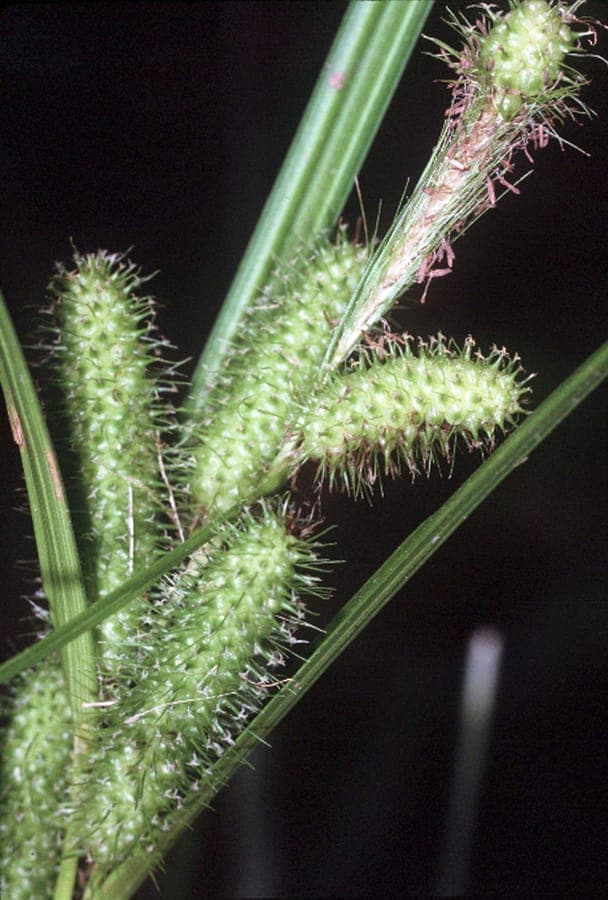
Appearance and Bloom: The plant bears narrow green leaves 3-5 mm wide, densely clustered toward base. Highly characteristic are upright spikelets with sharp, downward-pointing spines on female spikelets, giving the plant a distinctive bristly appearance. Male spikelets topmost, female below with very characteristic hooked-scale structure. Flowering peaks June-July. Leaves grow densely together, forming compact tufts.
Ideal Location: Choose permanently wet to very marshy terrain: marshes, wetlands, infiltration zones, low-lying landscapes where water tables never drop. Six-plus hours daily sunlight ideal; plant tolerates partial shade. Dutch, Belgian, German wetland zones perfect. French marshes in Loire, Aquitaine offer habitat. Dutch Intratuin, Gamma stock aquatic plants; German OBI, Hornbach sell Carex wetland selections. French Truffaut, Jardiland offer aquatic plants.
Soil: Use pure marsh or peat soil: blend peat, black silt, and aquatic plant soil. pH 4-7 very well tolerated (prefer 5-5.5 optimum). Moisture retention very high: soil never dries. Plant grows even in pure water to 15 cm submersion. No synthetic fertiliser needed: nutrition from water and sediment.
Watering: Carex frankii demands permanently very wet soil or even aquatic cultivation. Water table minimum 0-10 cm above ground surface. During dry periods water regularly: minimum 2-3 times weekly in summer. Pond culture ideal: plant grows submerged 10 plus cm below water surface. Critical fact: plant dies quickly in dry soil.
Pruning: Carex frankii requires minimal pruning. Remove dead foliage in spring for freshness. Bristly armature remains intact for ornamental value. Plant self-spreads via rhizomes; division possible in April post-growth. Keep pruning minimal: spines are defensive mechanism.
Maintenance Calendar: April-May remove dead leaves, moisture check. June-July flowering peaks, extreme water demand, very high moisture monitoring. August-September moisture monitoring critical in dry summers. October-November no pruning due to bristle-armature ornamental value. December-March minimal care, maintain water level. Annually inspect rhizome growth.
Winter Hardiness: Completely hardy to minus-20 degrees Celsius in wet microclimates. Foliage may yellow in severe winters with freezing. Plant fully recovers in spring. Snow impact minimal due to very dense tuft structure.
Companion Plants: Combine with other wetland sedges: Carex lacustris, Carex nebrascensis. Phalaris arundinacea for height. Typha latifolia for background mass. Iris versicolor for colour. Juncus effusus for contrast. Grouping 3-5 Carex plants creates massed effect.
Closing: Carex frankii is essential for wet marshes, wetland restoration, and natural water management projects. The bristle-armature delivers unique ornamental value. Plant demands permanently wet soil and no synthetic fertiliser. For wetland enthusiasts, indispensable.
Want to see Carex frankii: complete guide in your garden? Make a free design now.
Upload a photo, pick a style, and get a photorealistic design with plant list in under a minute.
No credit card required


Similar plants
Flat-stemmed club-rush: complete guide
Bolboschoenus planiculmis
Everything about Bolboschoenus planiculmis: growing conditions, watering, care, and use as a pond margin or wetland plant in garden design.
Great Plains flatsedge: complete guide
Cyperus lupulinus
Everything about Great Plains flatsedge (Cyperus lupulinus): growing conditions, care, garden uses, and ecological value. Tips for pond margins and dry sandy soils.
Golden beak sedge: complete guide
Rhynchospora corymbosa
Everything about golden beak sedge (Rhynchospora corymbosa): a dramatic tropical marginal for pond edges, bog gardens, and wet habitats.