
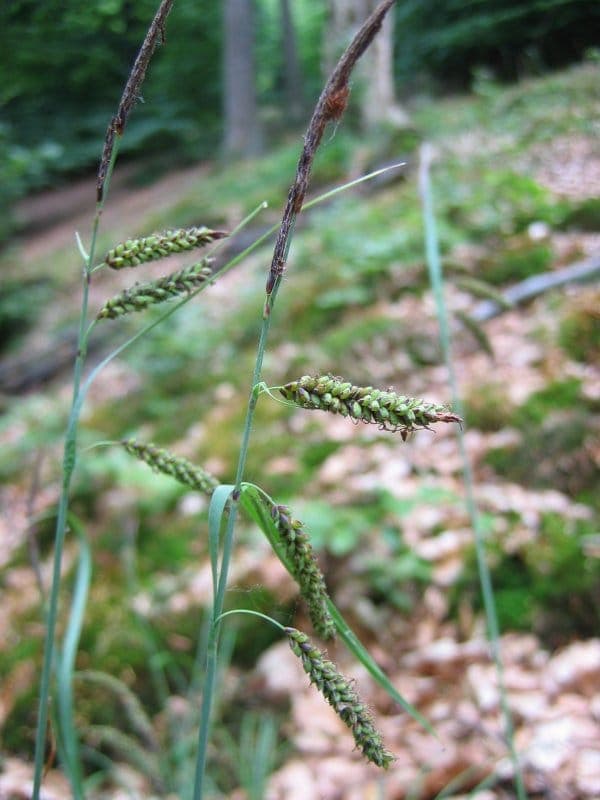
Kristian Peters -- Fabelfroh 09:16, 13 July 2006 (UTC) / CC BY-SA 3.0, via Wikimedia Commons
Blue-green sedge: complete guide
Carex flacca
Want to see Blue-green sedge: complete guide in your garden?
1 minute, no credit card
Overview
Carex flacca, commonly known as Blue-green sedge, is a graceful, clump-forming perennial that brings subtle structure to garden borders. Native to damp meadows and woodland edges across western and central Europe, this member of the Cyperaceae family thrives in conditions many plants avoid. It grows 30–50 cm tall and spreads slowly via rhizomes, forming dense, arching mounds of fine-textured foliage. Hardy in USDA zones 7–9, it remains evergreen through winter, offering year-round interest. Its low-maintenance nature makes it a favorite for modern and naturalistic planting schemes. On gardenworld.app you can plan a layered border design that highlights its cool tones against bolder foliage.
Appearance & bloom cycle
The narrow, strap-like leaves are a striking blue-green with a silvery sheen, 3–5 mm wide, and curve outward in a soft fountain-like habit. From April to June, slender blackish flower spikes rise just above the foliage, reaching up to 50 cm. While not showy in the traditional sense, the blooms add fine texture and subtle contrast. The seed heads persist into late summer, gradually fading but maintaining form. This sedge doesn't rely on flowers for impact - it's the foliage that steals the show, season after season.
Ideal location
Choose partial to full shade for best results, though it tolerates full sun if soil moisture is consistent. In full sun, the foliage color intensifies but may scorch during prolonged dry spells. Under light tree canopies or along the edge of a shaded path, it performs exceptionally well. Avoid deep, dry shade where growth becomes sparse. If you're working with a north-facing bed or a tricky damp corner, this sedge is a reliable performer. Use gardenworld.app to map out sun patterns and test how this plant fits into your existing shade garden layout.
Soil requirements
Blue-green sedge prefers moist, humus-rich soil with good drainage. It handles clay and loam well, as long as the ground doesn't dry out completely in summer. Sandy soils need amending with compost or leaf mold to improve water retention. Ideal pH ranges from 5.5 to 7.0 (slightly acidic to neutral). Avoid highly alkaline or compacted soils - they hinder root development and lead to patchy growth.
Free design
Want to see Blue-green sedge: complete guide in your garden? Make a free design now.
Watering
Keep the soil evenly moist, especially during the first growing season. Young plants need watering once a week during dry periods, about 10 liters per clump. Established plants are moderately drought-tolerant but look their best with consistent moisture. Mulch in spring with compost to conserve water and suppress weeds. Never allow the plant to sit in standing water - it tolerates dampness but not waterlogging.
Pruning
Cut back old growth in late winter or early spring (February to March) to make way for fresh foliage. Trim the clump to 10–15 cm above ground level using sharp shears. This removes winter-damaged leaves and prevents the center from becoming congested. Avoid cutting during active growth - it can weaken the plant. Light tidying up of stray leaves can be done anytime, but major pruning is strictly a pre-season task.
Maintenance calendar
- Jan: Check for frost heave; remove debris
- Feb: Begin light pruning of dead foliage
- Mar: Complete cutting back; apply compost mulch
- Apr: New growth emerges; monitor for slugs
- May: Flower spikes appear; keep soil moist
- Jun: Peak bloom; observe seed development
- Jul: Minimal care; watch for drought stress
- Aug: Water if rainfall is below 25 mm/week
- Sep: Leave seed heads; no pruning
- Oct: Remove only damaged leaves
- Nov: Reduce watering; prepare for dormancy
- Dec: Evergreen foliage remains; inspect clump density
Winter hardiness
Hardy down to -15°C (USDA zone 7), Carex flacca survives most UK and northern European winters without protection. In zone 6, a light mulch of straw or leaves can help, but isn't usually necessary. Foliage may yellow or brown slightly in harsh conditions but rebounds quickly in spring. It's not prone to snow damage, thanks to its flexible growth habit.
Companion plants
Pair it with moisture-loving plants like Astilbe, Ligularia, or Hosta for a lush, woodland feel. For contrast, plant near golden Hakonechloa or purple Heuchera. The cool blue-green tones also complement silver-leaved herbs like Artemisia or Stachys. Avoid pairing with aggressive spreaders like mint or bamboo that can overwhelm its clumping form.
Closing
Carex flacca is a quiet achiever in the garden - not flashy, but dependable. It excels in damp, shady areas where few plants thrive, and its neat habit fits seamlessly into formal and wild designs alike. Available at most garden centres, especially in spring, it's an easy addition to any planting plan. With its year-round presence and minimal care needs, it's a smart choice for beginner and experienced gardeners. Pick up plugs or 1-litre pots from garden centres and watch it slowly fill in gaps with elegance.
Want to see Blue-green sedge: complete guide in your garden? Make a free design now.
Upload a photo, pick a style, and get a photorealistic design with plant list in under a minute.
No credit card required


Similar plants
Flat-stemmed club-rush: complete guide
Bolboschoenus planiculmis
Everything about Bolboschoenus planiculmis: growing conditions, watering, care, and use as a pond margin or wetland plant in garden design.
Great Plains flatsedge: complete guide
Cyperus lupulinus
Everything about Great Plains flatsedge (Cyperus lupulinus): growing conditions, care, garden uses, and ecological value. Tips for pond margins and dry sandy soils.
Golden beak sedge: complete guide
Rhynchospora corymbosa
Everything about golden beak sedge (Rhynchospora corymbosa): a dramatic tropical marginal for pond edges, bog gardens, and wet habitats.