
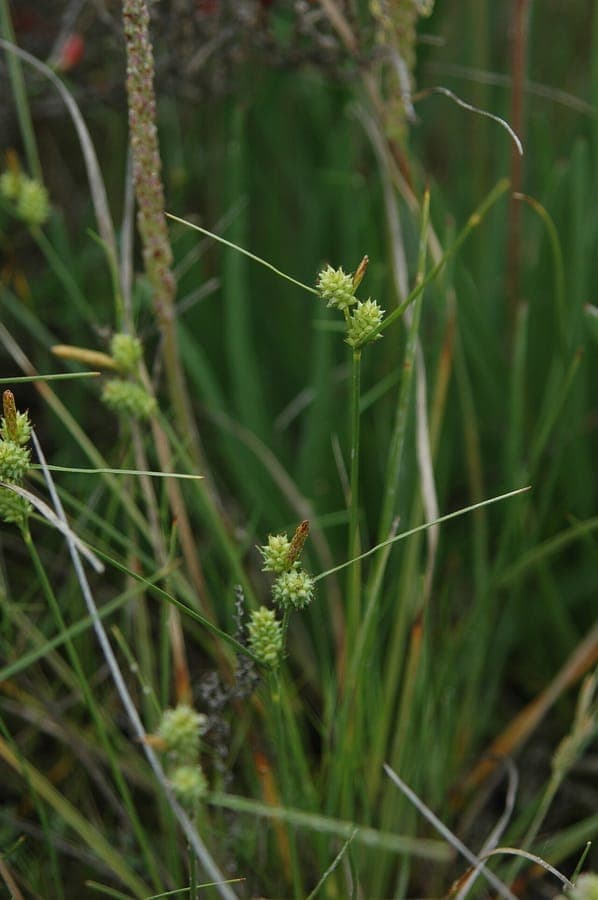
Guillaume FRIED / CC BY-SA 2.0 fr, via Wikimedia Commons
Longbract sedge: complete guide
Carex extensa
Want to see Longbract sedge: complete guide in your garden?
1 minute, no credit card
Overview
Longbract sedge (Carex extensa) is a graceful, clump-forming perennial that thrives in consistently moist soils. Native to parts of southern and central Europe - including the Baltic States, Albania, and the Azores - this sedge brings year-round texture to damp corners where many plants struggle. It's especially valuable in rain gardens, wet meadows, or beside water features. With its fine, upright foliage and unobtrusive flowering, it adds subtle movement and structure without overwhelming a planting scheme.
Longbract sedge is evergreen in milder climates and stays visually present from early spring through winter. It's a quiet achiever - not flashy, but dependable. On gardenworld.app, you can visualise how this sedge integrates into your garden, especially in moist zones or alongside water elements.
Appearance & bloom cycle
This sedge grows to 40–60 cm in height, with a spread of about 30 cm. The leaves are narrow (2–3 mm wide), bright green, and arch slightly at the tips. They emerge strongly in March, forming tight, upright tufts that persist through the seasons.
From May to June, slender greenish-brown flower spikes appear, rising 10–15 cm above the foliage. These aren't showy, but they add fine detail and attract pollinators like small flies and beetles. By late summer, the seeds mature and may self-sow in ideal conditions - loose, damp soil with partial shade.
In autumn, foliage may take on a soft golden tint, but generally remains green well into winter. New growth appears as early as February, making it one of the first signs of life in the waking garden.
Ideal location
Choose a spot in light to partial shade for best results. Full sun is acceptable only if the soil stays reliably moist. Avoid dry, sandy patches or deep shade under dense tree canopies. Longbract sedge excels along pond margins, in damp woodland edges, or in swales that collect rainwater.
Plant in groups of 3–5 for a naturalistic effect. It works well tucked between stones, along a gravel path, or mixed into a bog garden. For gardeners planning a water-wise or rain garden, gardenworld.app offers layout tools to position Longbract sedge where it'll thrive.
Soil requirements
It prefers moist, humus-rich loam or clay-loam soils but tolerates sandy-loam if organic matter is added. The pH range is flexible - from slightly acidic (5.5) to neutral (7.5). At planting, mix in well-rotted compost or leaf mould to boost moisture retention.
Avoid heavy, compacted clay without drainage. If your soil is dense, amend the planting hole with horticultural sand or grit to improve permeability. In containers, use a mix of potting soil, compost, and perlite to prevent waterlogging while maintaining moisture.
Free design
Want to see Longbract sedge: complete guide in your garden? Make a free design now.
Watering
This sedge has high water needs, especially from March through July. Keep the soil consistently damp - never let it dry out completely. During hot, dry spells, water deeply once or twice a week.
If planted near a pond or in a rain garden, supplemental watering is rarely needed. In pots, check every 2–3 days; the top 2.5 cm of soil should feel cool and slightly damp.
Pruning
Pruning isn't essential, but in late winter (February to early March), you can trim back old, tattered, or browned foliage to about 10 cm from the base. Use sharp shears to avoid tearing the leaves. Leave standing foliage through winter if possible - it provides habitat for overwintering insects.
If the clump becomes too dense, divide in early spring. Replant sections 30 cm apart to maintain airflow and vigour.
Maintenance calendar
- January: Check for frost damage. Leave old growth for insulation.
- February: Cut back damaged foliage. Prepare for new growth.
- March: Divide overcrowded clumps. Add compost around the base.
- April: Monitor soil moisture. New shoots emerge.
- May: Flowers appear. No feeding required.
- June: Peak bloom. Watch for drought stress.
- July: Water regularly during heatwaves.
- August: Seeds ripen. Light self-seeding may occur.
- September: Leave seed heads for texture and wildlife.
- October: No maintenance needed.
- November: Protect potted plants with hessian wraps.
- December: Winter hardy. Maintain structure.
Winter hardiness
Longbract sedge is hardy in USDA zones 5–9 (-23°C to -1°C). It remains evergreen in zones 7–9 and semi-evergreen in colder regions. In containers, move pots to a sheltered spot or insulate with bubble wrap. Ground-planted specimens usually survive without protection.
Companion plants
Pair with other moisture-loving plants like Carex vulpinoidea, Eutrochium maculatum, or Iris versicolor. For bold contrast, plant near Astilbe or Rodgersia. Low-growers like Tellima grandiflora or Carex divulsa work well as ground cover.
For a wilder look, combine with Molinia caerulea, Eriophorum angustifolium, or Osmunda regalis. Near water, mix with Lythrum salicaria or Menyanthes trifoliata.
Closing
Longbract sedge is a low-effort, high-reward plant for wet areas. It adds quiet elegance, supports wildlife, and stays attractive year-round. Available at garden centres across the UK and online. Plant in drifts for best effect, and use gardenworld.app to explore how it fits into your overall garden plan.
Want to see Longbract sedge: complete guide in your garden? Make a free design now.
Upload a photo, pick a style, and get a photorealistic design with plant list in under a minute.
No credit card required


Similar plants
Flat-stemmed club-rush: complete guide
Bolboschoenus planiculmis
Everything about Bolboschoenus planiculmis: growing conditions, watering, care, and use as a pond margin or wetland plant in garden design.
Great Plains flatsedge: complete guide
Cyperus lupulinus
Everything about Great Plains flatsedge (Cyperus lupulinus): growing conditions, care, garden uses, and ecological value. Tips for pond margins and dry sandy soils.
Golden beak sedge: complete guide
Rhynchospora corymbosa
Everything about golden beak sedge (Rhynchospora corymbosa): a dramatic tropical marginal for pond edges, bog gardens, and wet habitats.