
Wikimedia Commons / CC BY-SA 3.0, via Wikimedia Commons
Rare spring-sedge: complete guide
Carex ericetorum
Want to see Rare spring-sedge: complete guide in your garden?
1 minute, no credit card
Overview
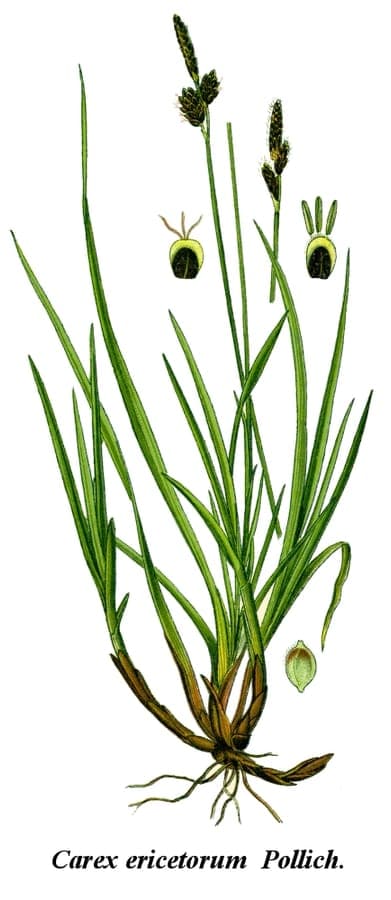
Carex ericetorum, known commonly as Rare spring-sedge, is a graceful, low-growing perennial sedge native to heathlands and open woodlands across central and northern Europe. Reaching just 20 to 30 cm in height, it forms dense, soft tussocks of fine, arching foliage that add subtle texture to the garden. Despite its delicate appearance, it's tough and adaptable, thriving in acidic, well-drained soils with partial shade. This sedge is increasingly popular among gardeners aiming for naturalistic planting schemes, especially in woodland edges, rock gardens, or native meadow designs.
With gardenworld.app, you can design a planting scheme tailored to Rare spring-sedge, factoring in soil pH, light levels, and compatible neighbours for a cohesive, low-effort garden.
Appearance & bloom cycle
The foliage of Carex ericetorum is narrow, linear, and ranges from pale green to grey-green, with a soft, cascading habit. In early spring-typically from April-the plant sends up slender, inconspicuous flower spikes, which are brownish and sit just above the foliage. These aren't showy blooms, but they add quiet structure to the garden's early season. By late spring, the seed heads mature and may self-sow lightly in favourable conditions. The plant remains semi-evergreen in milder climates, with old leaves persisting through winter to protect the crown.
Ideal location
Rare spring-sedge performs best in light to partial shade-around 7 out of 10 on the light scale-meaning 4 to 6 hours of morning or dappled sunlight daily. Full sun is acceptable only if the soil stays reliably moist, but intense afternoon sun in southern exposures may cause leaf scorch. Ideal spots include beneath open-canopy trees like birch or pine, or in the middle layer of a mixed border with shrubs like Rhododendron or Kalmia. Avoid deep, dry shade under dense evergreens.
Soil requirements
This sedge demands acidic soil with a pH between 4.5 and 5.0. It thrives in sandy, gritty, or peaty substrates that drain well but retain some moisture. Clay-heavy or alkaline soils are unsuitable unless amended with ericaceous compost, pine bark, or leaf mould. If your soil is too neutral, consider growing it in a raised bed with acid mix. Avoid liming the area or using tap water high in calcium, as this can raise pH over time.
Watering
Once established, Carex ericetorum is moderately drought-tolerant but benefits from consistent moisture during its active growth phase (April to June). Water weekly during dry spells, using rainwater when possible. In summer, reduce frequency but don't let the root zone dry out completely-especially if planted under trees with competing roots. Mulch with pine needles or oak leaves to conserve moisture and maintain acidity.
Free design
Want to see Rare spring-sedge: complete guide in your garden? Make a free design now.
Pruning
Minimal pruning is needed. In early March, trim back any old, tattered foliage to 5 cm above the crown using sharp shears. This encourages fresh growth and prevents matting. Avoid cutting too low, as the crown is sensitive. Don't remove all foliage at once-stagger the pruning if needed to maintain winter interest and protection.
Maintenance calendar
- Jan: Check for frost heave; keep mulch in place.
- Feb: Remove debris; inspect crowns for damage.
- Mar: Cut back old leaves; refresh mulch with acidic compost.
- Apr: Begin regular watering; watch for new shoots.
- May: Monitor for self-sown seedlings; transplant if desired.
- Jun: Remove spent flower spikes; check soil moisture.
- Jul: Reduce watering slightly; avoid overwatering.
- Aug: No fertiliser; let plant rest.
- Sep: Observe autumn colour (soft bronze); apply light mulch.
- Oct: Leave dead foliage-provides winter cover.
- Nov: Secure loose plants; protect from heavy leaf fall.
- Dec: Minimal care; ensure drainage remains open.
Use the seasonal planner on gardenworld.app to customise this calendar for your local weather and microclimate.
Winter hardiness
Rare spring-sedge is hardy to USDA zone 5 (-25°C). It tolerates cold winters well, especially when protected by its own foliage or a light mulch of pine needles. In wet winters, good drainage is critical-avoid waterlogged soils to prevent root rot. The plant stays semi-evergreen, with older leaves browning but not dying back completely.
Companion plants
Pair Carex ericetorum with other acid-loving plants: Calluna vulgaris, Erica carnea, Molinia caerulea, or Deschampsia cespitosa. It also complements spring bulbs like Scilla or Anemone blanda. For contrast, plant alongside silver-foliage species such as Stachys byzantina or Artemisia. Avoid aggressive ground covers like ivy or Lysimachia, which can overwhelm its gentle growth. It looks stunning in gravel gardens or between stepping stones in woodland paths.
Closing
Rare spring-sedge may not grab attention with bold flowers, but its quiet elegance and resilience make it a garden staple for naturalistic designs. It asks little, delivers texture year-round, and supports ecological planting goals. Find Carex ericetorum at garden centres across the UK, or search specialty nurseries. For design inspiration and planting layouts, visit gardenworld.app and explore how this sedge integrates into sustainable, beautiful gardens.
Want to see Rare spring-sedge: complete guide in your garden? Make a free design now.
Upload a photo, pick a style, and get a photorealistic design with plant list in under a minute.
No credit card required


Similar plants
Flat-stemmed club-rush: complete guide
Bolboschoenus planiculmis
Everything about Bolboschoenus planiculmis: growing conditions, watering, care, and use as a pond margin or wetland plant in garden design.
Great Plains flatsedge: complete guide
Cyperus lupulinus
Everything about Great Plains flatsedge (Cyperus lupulinus): growing conditions, care, garden uses, and ecological value. Tips for pond margins and dry sandy soils.
Golden beak sedge: complete guide
Rhynchospora corymbosa
Everything about golden beak sedge (Rhynchospora corymbosa): a dramatic tropical marginal for pond edges, bog gardens, and wet habitats.