
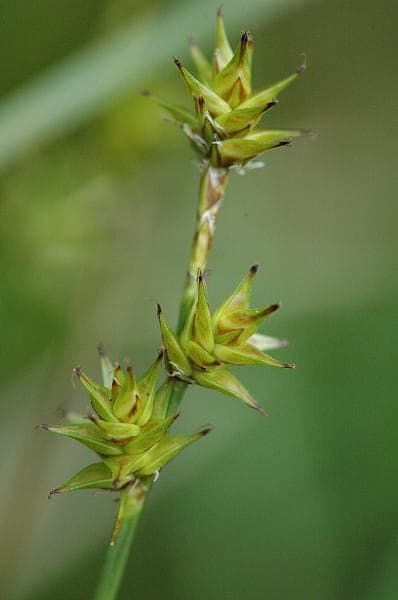
James K. Lindsey / CC BY-SA 3.0, via Wikimedia Commons
Star sedge: complete guide
Carex echinata
Want to see Star sedge: complete guide in your garden?
1 minute, no credit card
Overview
Star sedge (Carex echinata) is a compact, tuft-forming perennial sedge native to wetlands across northern Europe and North America. Part of the Cyperaceae family, it thrives in damp, acidic to neutral soils and is often found in bogs, wet woodlands, and along stream edges. In gardens, it's an excellent choice for challenging moist areas where few other plants succeed. It's not flashy, but its fine texture and subtle structure bring quiet elegance to shaded corners.
Mature plants reach 10–30 cm in height, forming dense, rounded clumps with narrow, dark green leaves. The plant spreads slowly by short rhizomes, making it well-behaved in mixed plantings. It's wintergreen in milder climates but may die back in harsh winters-don't worry, it returns strong in spring.
On gardenworld.app, you can design a planting scheme that highlights Star sedge's natural elegance in damp, shaded areas of your garden.
Appearance & bloom cycle
Star sedge has slender, glossy green leaves up to 2 mm wide, arching gently at the tips. In late spring (May to June), it produces distinctive flower spikes: small, egg-shaped, and covered in bristly scales that give them a star-like appearance-hence the common name. These spikes rise just above the foliage on slender stalks.
The plant is monoecious, with male and female flowers on the same spike, pollinated by wind. After flowering, the spikes turn brown by mid-summer and persist into autumn, adding texture and interest long after blooming ends. The foliage remains neat and tidy year-round in most conditions.
Ideal location
Star sedge prefers partial to full shade. It performs best under deciduous trees, along woodland edges, or beside ponds where sunlight is dappled. Avoid hot, dry afternoon sun-it can scorch the delicate leaves, especially in July and August.
Plant in groups of 5–9 for best visual impact. It works well as a groundcover in shaded borders or in rock gardens with consistent moisture. Once established, it tolerates light foot traffic, making it suitable for narrow forest paths or between stepping stones in damp areas.
Soil requirements
Keep the soil consistently moist. Star sedge grows well in loamy or sandy-loam soils that retain moisture but aren't waterlogged. It struggles in dry sand or heavy clay that cracks in summer. The ideal pH range is 5.0–6.8 (slightly acidic to neutral).
If your soil is too alkaline or fast-draining, amend it with peat-free compost or leaf mould at planting time. A mulch of pine needles or fine wood chips helps retain moisture and maintains soil acidity.
Free design
Want to see Star sedge: complete guide in your garden? Make a free design now.
Watering
Water weekly during the first growing season, increasing frequency during dry spells. Established plants are somewhat drought-tolerant but thrive with steady moisture. In prolonged summer droughts, supplement with deep watering every 7–10 days.
Use rainwater when possible-Star sedge is sensitive to lime-rich tap water, which can cause leaf tip browning. Avoid overhead watering in winter to prevent crown rot.
Pruning
Minimal pruning is needed. In early spring, gently rake out old or damaged leaves by hand to make way for new growth. Avoid using shears-this can damage emerging shoots.
Leave the brown flower spikes through winter; they add visual texture and shelter for overwintering insects. Clean up only if the plant looks untidy, ideally in February or March.
Maintenance calendar
- January: Check for frost damage, leave old growth in place
- February: Begin light tidying of dead foliage
- March: Remove old leaves, check soil moisture
- April: New growth appears, apply light compost dressing
- May: Flower spikes emerge, monitor moisture levels
- June: Peak bloom, no pruning needed
- July: Watch for drying in heatwaves
- August: Continue watering during dry periods
- September: No action required
- October: Stop fertilising, let plant enter dormancy
- November: Leave seed heads for winter interest
- December: Mulch lightly in exposed areas
Winter hardiness
Star sedge is hardy to USDA zone 4 (-34°C). In zones 5–8, it typically remains evergreen. In colder zones or exposed sites, the top growth may die back, but the roots survive and re-sprout in spring. A light mulch of straw or leaf litter protects young plants during their first winter.
Companion plants
Pair Star sedge with other moisture-loving shade plants like wild ginger (Asarum europaeum), wood anemone (Anemone nemorosa), or bluebell (Hyacinthoides non-scripta). For contrast, combine with ferns such as Athyrium filix-femina or Dryopteris affinis.
It also works well with other sedges like Carex remota or Carex divulsa in layered woodland plantings. Use gardenworld.app to visualise planting combinations that suit your soil and light conditions.
Closing
Star sedge is a quiet achiever in the garden-unspectacular but invaluable for wet, shady spots. Its fine texture, low upkeep, and ecological benefits make it a smart choice for naturalistic planting. Available at garden centres in spring, especially those specialising in native or woodland plants. Look for established clumps at least 7 cm wide for faster coverage.
Want to see Star sedge: complete guide in your garden? Make a free design now.
Upload a photo, pick a style, and get a photorealistic design with plant list in under a minute.
No credit card required


Similar plants
Flat-stemmed club-rush: complete guide
Bolboschoenus planiculmis
Everything about Bolboschoenus planiculmis: growing conditions, watering, care, and use as a pond margin or wetland plant in garden design.
Great Plains flatsedge: complete guide
Cyperus lupulinus
Everything about Great Plains flatsedge (Cyperus lupulinus): growing conditions, care, garden uses, and ecological value. Tips for pond margins and dry sandy soils.
Golden beak sedge: complete guide
Rhynchospora corymbosa
Everything about golden beak sedge (Rhynchospora corymbosa): a dramatic tropical marginal for pond edges, bog gardens, and wet habitats.