
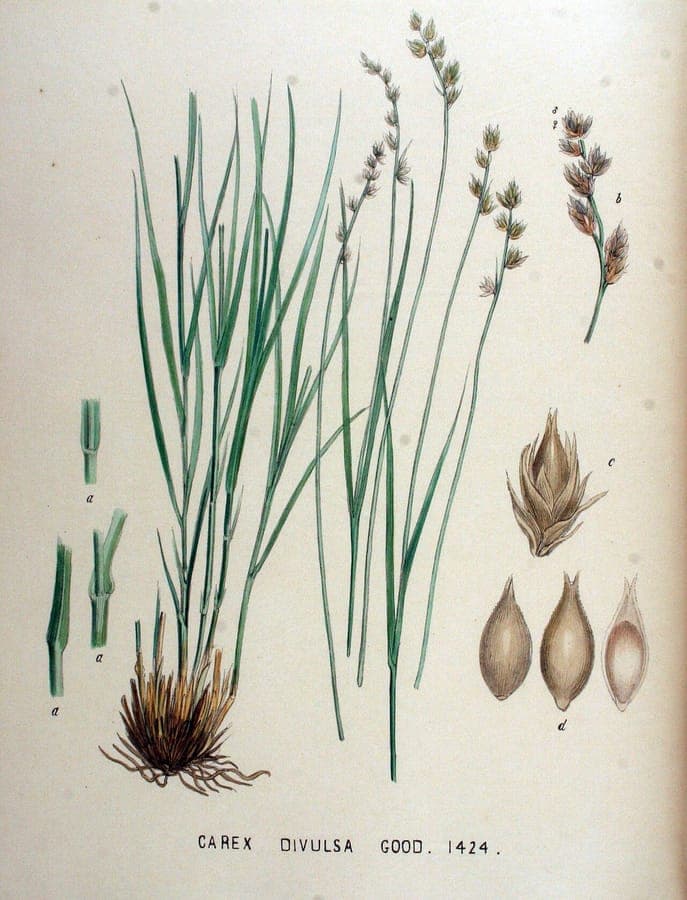
Jan Kops / Public domain, via Wikimedia Commons
Grey sedge: complete guide
Carex divulsa
Want to see Grey sedge: complete guide in your garden?
1 minute, no credit card
Overview
Carex divulsa, commonly known as grey sedge, is a graceful, clump-forming perennial grass that adds soft texture and subtle movement to garden beds. Native to parts of Europe including the Balkans, Azores, and Baltic states, this sedge thrives in moist, well-drained soils and partial shade. It reaches a mature height of 30–50 cm with a spread of about 40 cm, making it perfect for edging, ground cover, or underplanting beneath shrubs and trees.
What sets Carex divulsa apart is its non-invasive growth habit and year-round presence. Unlike aggressive grasses, it forms neat, slowly expanding mounds without choking out neighbouring plants. It's a favourite among gardeners who value structural detail over flashy blooms. On gardenworld.app, you can design a planting scheme that highlights its airy, fountain-like form alongside bolder-leaved companions.
Appearance & bloom cycle
The plant features narrow, arching blades of soft green foliage, typically 20–40 cm long, with a slightly silvery underside that gives it a 'grey' appearance in certain light. In April through June, slender green flower spikes emerge, held just above the foliage. These are not showy in the traditional sense, but they add delicate structure and attract small pollinators like hoverflies and early bees.
After flowering, the seed heads dry slowly, turning pale tan by late summer. While not ornamental in colour, they provide visual interest during transitional months. The foliage remains evergreen in milder climates (USDA zones 6–8), though it may yellow slightly in prolonged winter cold. In colder zones, it dies back partially but regrows vigorously in spring.
Ideal location
Carex divulsa prefers a light level of 6 out of 10 - meaning partial shade. Ideal spots include north-facing borders, beneath deciduous trees with dappled light, or along damp pathways. While it can tolerate full sun, especially in cooler northern regions, the soil must remain consistently moist to prevent leaf scorch and desiccation.
Avoid planting in hot, reflective areas like south-facing walls unless additional irrigation is possible. This sedge works well in woodland gardens, rain gardens, or as a soft edging along ponds. For modern designs, pair it with dark-leaved Heuchera or upright Iris for contrast. On gardenworld.app, explore layout ideas that use Carex divulsa to soften hardscapes and blur garden edges.
Soil requirements
It grows best in loamy or clay-loam soils with a pH between 6.5 and 7.0. While it tolerates a range of soil types, it demands consistent moisture. Sandy soils dry out too quickly unless amended with compost or well-rotted manure. Heavy clay can work if it's not waterlogged - ensure there's some drainage to prevent root rot.
When planting, mix in 2–3 cm of organic matter to improve water retention. A light mulch of leaf mould or compost in early spring helps suppress weeds and maintains soil moisture. Avoid high-nitrogen fertilisers, which can cause floppy growth.
Free design
Want to see Grey sedge: complete guide in your garden? Make a free design now.
Watering
During the first two growing seasons, water weekly with 10–15 litres per plant, especially in dry spells. Once established, it's moderately drought-tolerant but performs best with consistent moisture. In summer droughts, supplement with deep watering every 5–7 days.
Use rainwater when possible, as tap water with high lime content may affect long-term soil pH. Water in the early morning or evening to reduce evaporation. Container-grown plants dry out faster and may need daily watering in hot weather.
Pruning
Minimal pruning is required. In early March, cut back old, damaged, or tattered foliage to about 10 cm above the crown using sharp, clean shears. Avoid cutting into the central growing point. If the clump becomes sparse in the centre after 3–4 years, divide it in early spring before new growth begins.
Do not compost diseased material. Dispose of it separately to prevent fungal spread. Regular tidying keeps the plant looking fresh and prevents it from collapsing under its own weight in wet conditions.
Maintenance calendar
- January: Dormant; no action needed
- February: Inspect for winter damage
- March: Cut back old foliage, divide if needed, apply mulch
- April: Begin regular watering, check for aphids
- May: Flowering begins; keep soil moist
- June: Peak bloom; avoid cutting
- July: Monitor for dryness, especially in sun
- August: Watch for leaf scorch in drought
- September: Reduce watering gradually
- October: Leave foliage for winter protection
- November: Leave standing; may show minor browning
- December: Dormant; protect young clumps with leaf litter
Winter hardiness
Carex divulsa is hardy to USDA zone 5 (–20°C). In zones 6–8, it remains evergreen or semi-evergreen. In colder zones, foliage may die back but regrows reliably in spring. In areas with freeze-thaw cycles, apply a light layer of leaf mulch to insulate the crown without smothering it.
Avoid heavy mulching with wood chips, which can retain too much moisture and encourage crown rot. In containers, wrap pots or move to a sheltered spot to prevent root freezing.
Companion plants
Pair with moisture-loving, shade-tolerant species such as:
- Hosta spp. – for bold leaf contrast
- Astilbe chinensis – for feathery summer blooms
- Ferns (e.g., Dryopteris, Athyrium) – for woodland texture
- Ligularia dentata – for bright foliage and damp sites
- Hakonechloa macra – for cascading effect
Avoid xeric plants like Sedum or Lavender, which prefer dry, alkaline soils and compete poorly in moist conditions.
Closing
Carex divulsa is a quiet achiever in the garden - unobtrusive yet essential for texture, movement, and year-round structure. It asks for little beyond consistent moisture and a bit of spring grooming. Use it to soften edges, fill gaps, or add rhythm to shaded areas. It's equally at home in cottage gardens, modern landscapes, or naturalistic plantings.
Available at garden centres across the UK and online. Look for healthy, compact clumps with vibrant green foliage. Avoid plants with dry roots or yellowing leaves. With the right care, this sedge will become a dependable backbone in your planting design for years to come.
Want to see Grey sedge: complete guide in your garden? Make a free design now.
Upload a photo, pick a style, and get a photorealistic design with plant list in under a minute.
No credit card required


Similar plants
Flat-stemmed club-rush: complete guide
Bolboschoenus planiculmis
Everything about Bolboschoenus planiculmis: growing conditions, watering, care, and use as a pond margin or wetland plant in garden design.
Great Plains flatsedge: complete guide
Cyperus lupulinus
Everything about Great Plains flatsedge (Cyperus lupulinus): growing conditions, care, garden uses, and ecological value. Tips for pond margins and dry sandy soils.
Golden beak sedge: complete guide
Rhynchospora corymbosa
Everything about golden beak sedge (Rhynchospora corymbosa): a dramatic tropical marginal for pond edges, bog gardens, and wet habitats.