
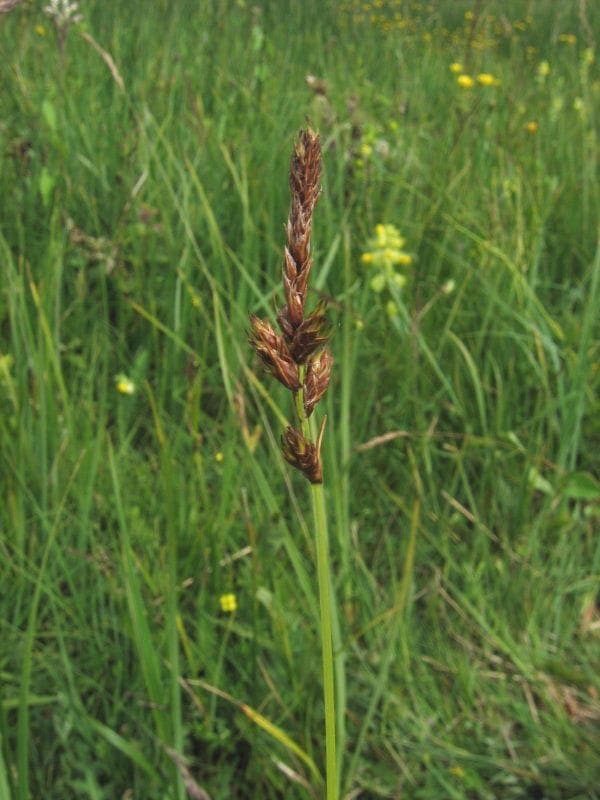
Kristian Peters -- Fabelfroh 09:37, 23 July 2006 (UTC) / CC BY-SA 3.0, via Wikimedia Commons
Tworank sedge: complete guide
Carex disticha
Want to see Tworank sedge: complete guide in your garden?
1 minute, no credit card
Overview
Carex disticha, commonly known as tworank sedge, is a graceful, clump-forming grass-like perennial that brings quiet elegance to temperate gardens. Native to much of Central and Eastern Europe-from Denmark to Bulgaria and the Baltic States-it thrives in consistently moist, slightly acidic soils. Though not flashy, its upright, two-ranked foliage creates a clean, architectural look, perfect for naturalistic planting schemes. It's hardy to USDA zone 4, making it a resilient choice across much of Europe and North America.
This sedge blooms from May through July, producing modest brown flower spikes that add subtle texture rather than color. It's not a focal point, but a supporting player-ideal for filling damp corners where other plants struggle. On gardenworld.app, you can design a planting layout that uses tworank sedge to stabilize wet areas and enhance biodiversity.
Appearance & bloom cycle
Tworank sedge grows 20–40 cm tall with narrow, linear leaves arranged in two distinct vertical rows along the stem-hence the name "disticha." The foliage is bright to dark green, about 2 mm wide, and has a fine, comb-like appearance. In late spring, slender, brownish spikelets emerge on wiry stems, reaching just above the leaves. These are wind-pollinated and produce small seeds that feed local insects and birds.
The bloom period lasts from May to July. After flowering, the spent spikes persist into winter, providing visual interest and shelter. The plant forms dense tussocks over time but spreads slowly via rhizomes-never aggressively. It retains much of its evergreen foliage in mild winters, making it valuable for year-round structure.
Ideal location
Tworank sedge prefers partial to full shade but tolerates full sun if soil moisture is maintained. A light level of 8 means it needs 6–8 hours of dappled or indirect sunlight daily. In full sun with dry soil, it will scorch and decline. Best locations include the edge of a pond, a rain garden, or under open-canopy deciduous trees where morning light filters through.
For garden designers: use it in groups of 5–7 for a natural drift effect or as a groundcover in shaded, wet areas. Pair it with plants that thrive in similar conditions. On gardenworld.app, you can simulate how tworank sedge integrates into shaded borders or native plantings.
Soil requirements
It needs moist, humus-rich soil with good water retention. A pH between 5.5 and 6.5 is ideal-slightly acidic to neutral. Avoid sandy, fast-draining soils unless amended with compost or leaf mould. Clay-loam mixes work well, especially when enriched with well-rotted manure. A 5 cm layer of organic mulch (e.g., shredded bark or leaf compost) helps retain moisture and suppress weeds.
If your garden has dry summers, consider planting in a swale or low-lying area where water naturally collects. Raised beds are less suitable unless irrigated regularly.
Free design
Want to see Tworank sedge: complete guide in your garden? Make a free design now.
Watering
This sedge is moisture-dependent. Keep the soil consistently damp, especially from March to September. During drought, water deeply 2–3 times per week. In containers, check daily-pots dry out fast. Use rainwater when possible, as tap water high in lime can alter soil pH over time.
For ponds or wetland gardens, plant at the margin where water is shallow (up to 5 cm deep). Never let the root zone dry out completely.
Pruning
Minimal pruning is needed. In late winter or early spring (February–March), cut back old, damaged foliage to about 10 cm above the ground. This encourages fresh growth and keeps the plant tidy. Avoid cutting in autumn, as the foliage provides winter insulation. Use sharp, sterilized shears to prevent disease transmission.
Maintenance calendar
- Jan: inspect for frost damage; leave foliage intact
- Feb: begin light cleanup
- Mar: cut back old growth; check soil moisture
- Apr: monitor for new shoots; optional light feeding
- May: flowering begins; maintain moist soil
- Jun: peak bloom; no fertilizing needed
- Jul: flowering ends; continue watering
- Aug: watch for dry spells; increase irrigation
- Sep: reduce watering; stop feeding
- Oct: leave foliage for winter protection
- Nov: check for slugs; mulch if needed
- Dec: dormant; minimal care required
Winter hardiness
Hardy to USDA zone 4 (–34°C to –29°C), tworank sedge survives harsh winters with little care. In zones 5–8, it remains semi-evergreen, providing structure in the winter garden. No covering is needed, though container-grown plants benefit from root insulation using bubble wrap or hessian.
Companion plants
Pair with moisture-loving perennials like Iris versicolor, Filipendula rubra, or Molinia caerulea. For contrast, combine with variegated grasses such as Phalaris arundinacea 'Picta' or dark-leaved Anthriscus 'Ravenswing'. Add seasonal color with Lobelia cardinalis or Eutrochium maculatum. Avoid pairing with drought-tolerant or sun-loving species in the same bed.
Closing
Tworank sedge is a reliable, low-maintenance plant that excels in wet, shady areas. It's not showy, but its structural presence and resilience make it a smart addition to any ecological garden. Look for it at garden centres across Europe-though it may be listed under its botanical name. In the UK and Ireland, check larger independents; in the US, it's occasionally found in native plant nurseries. And remember: on gardenworld.app, you can build a custom planting plan that maximizes the potential of Carex disticha in your space.
Want to see Tworank sedge: complete guide in your garden? Make a free design now.
Upload a photo, pick a style, and get a photorealistic design with plant list in under a minute.
No credit card required


Similar plants
Flat-stemmed club-rush: complete guide
Bolboschoenus planiculmis
Everything about Bolboschoenus planiculmis: growing conditions, watering, care, and use as a pond margin or wetland plant in garden design.
Great Plains flatsedge: complete guide
Cyperus lupulinus
Everything about Great Plains flatsedge (Cyperus lupulinus): growing conditions, care, garden uses, and ecological value. Tips for pond margins and dry sandy soils.
Golden beak sedge: complete guide
Rhynchospora corymbosa
Everything about golden beak sedge (Rhynchospora corymbosa): a dramatic tropical marginal for pond edges, bog gardens, and wet habitats.