
Krzysztof Ziarnek, Kenraiz / CC BY-SA 4.0, via Wikimedia Commons
Finger sedge: complete guide
Carex digitata
Want to see Finger sedge: complete guide in your garden?
1 minute, no credit card
Overview
Carex digitata, commonly known as finger sedge, is a graceful perennial sedge in the Cyperaceae family. Native to damp forests across central and eastern Europe-from Austria to the Baltic States-it's a subtle yet structurally valuable plant for naturalistic garden designs. On gardenworld.app, you can create a planting plan that integrates finger sedge into shaded, moist areas with precision.
This plant reaches 40–60 cm in height and spreads slowly via rhizomes to form clumps around 30 cm wide. It's ideal for woodland edges, shaded borders, or as ground cover under deciduous trees. Hardy to USDA zone 5 (-23°C), finger sedge tolerates cold winters and stays semi-evergreen in milder conditions.
Finger sedge blooms from April to June with slender, purple-tinged flowering spikes that rise above the foliage. While not showy, these inflorescences add quiet texture and support small pollinators. It's a perfect choice for gardeners seeking understated elegance and year-round structure.
Appearance & bloom cycle
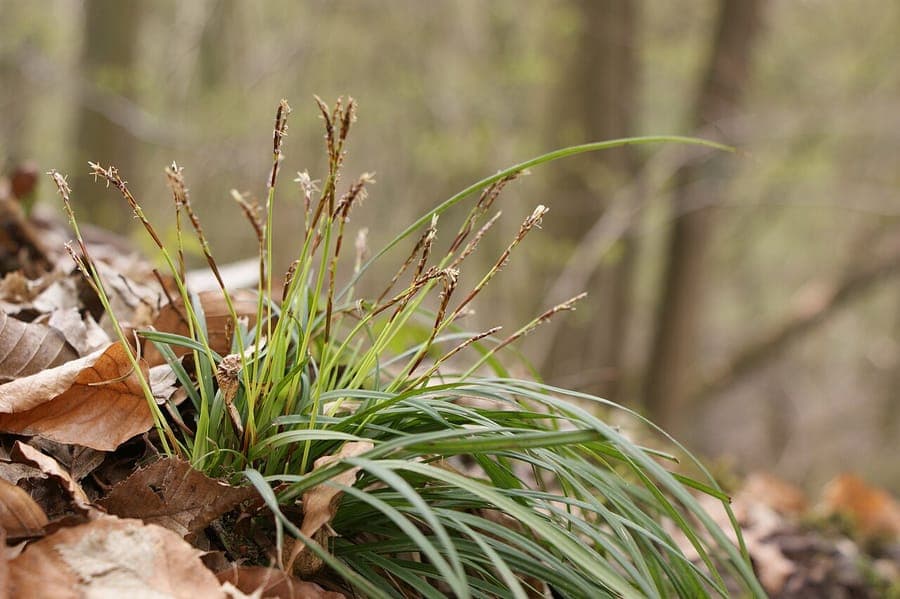
The foliage is light green, narrow (3–5 mm wide), and arches gently outward in a fountain-like clump. Leaves grow up to 50 cm long and remain soft to the touch. The plant forms dense tufts that slowly expand over time.
Flowering begins in April, peaking in May. The spikes appear in a distinctive finger-like arrangement-hence the name digitata-and are purplish-brown. After flowering, small dark fruits develop and persist into early summer. By late August, foliage may start to yellow, especially during dry spells. In sheltered spots, some leaves stay green through winter, offering rare visual interest.
Ideal location
Finger sedge thrives in partial shade (light level 5/10). It performs best under open-canopy trees like birch or hazel, where dappled sunlight reaches the ground. Full sun is too intense and leads to leaf scorch unless soil moisture is consistently high. Full shade is tolerable but results in slower growth and looser clumps.
Choose a spot in a moist woodland border, along a stream, or in a low-lying area that retains water. On gardenworld.app, use the microclimate planner to assess moisture and shade levels before planting.
Soil requirements
Soil should be moist, humus-rich, and slightly acidic (pH 5.5–6.5). Clay-loam or silt-based soils work well if they retain moisture without becoming waterlogged. Avoid sandy or chalky soils-they dry out too quickly and raise pH, leading to chlorosis.
Amend poor soils with well-rotted leaf mould or compost to improve water retention and nutrient content. A light mulch of shredded bark or leaf litter in spring helps maintain moisture and suppress weeds.
Free design
Want to see Finger sedge: complete guide in your garden? Make a free design now.
Watering
Keep soil consistently moist, especially during the first two growing seasons. In summer (June–August), water once a week during dry periods-about 10–15 litres per plant. Rainwater is preferred, as tap water can be too alkaline over time.
Once established, finger sedge is moderately drought-tolerant for short periods, but prolonged dryness causes leaf browning and stunted growth. Monitor soil moisture in containers or shallow soils more closely.
Pruning
Minimal pruning is needed. In late winter or early spring (February–March), remove old, damaged, or browned foliage with sharp shears. Cut back to about 10 cm above ground level, taking care not to damage emerging shoots.
There's no need to deadhead flowers-they fade naturally. If clumps become too dense after 5–6 years, divide them in early spring. Use a spade to lift and split the root mass into 15–20 cm sections, then replant immediately.
Maintenance calendar
- January: Check for frost heave. No action needed.
- February: Begin clearing old foliage. Watch for new growth.
- March: Divide overcrowded clumps. Apply a thin compost layer.
- April: Blooming begins. Ensure consistent soil moisture.
- May: Peak bloom. Monitor for dry patches.
- June: Flowers fade. No pruning required.
- July–August: Water weekly if dry. Avoid overhead watering in heat.
- September: Foliage starts yellowing. No intervention.
- October: Leave dead material-it insulates roots.
- November–December: Light watering during extended dry spells.
Winter hardiness
Hardy to USDA zone 5, finger sedge withstands winter lows of -23°C. In zones 6–8, it remains semi-evergreen, providing texture in the winter garden. No winter protection is usually needed, but in exposed or sandy sites, a light mulch of leaves can help retain moisture and protect roots.
Avoid heavy mulching-this can trap excess moisture and encourage rot. Remove any standing water from container-grown plants before hard freezes.
Companion plants
Finger sedge pairs well with other shade- and moisture-loving perennials:
- Helleborus orientalis – early blooms contrast with sedge's fine texture.
- Dryopteris filix-mas – robust fern that adds vertical interest.
- Carex remota – a similar sedge with complementary growth habits.
- Lysimachia nummularia – creeping golden ground cover.
- Galium odoratum – fragrant, delicate white flowers in late spring.
Avoid aggressive spreaders like Geranium pratense or Artemisia ludoviciana, which may overwhelm the sedge.
Closing
Finger sedge is a reliable, low-maintenance choice for moist, shady gardens. With partial shade, acidic soil (pH 5.5–6.5), and consistent moisture, it forms dense, attractive clumps over time. It's excellent for naturalistic planting schemes and adds subtle structure to borders.
Plant in groups of 3–5 for visual impact. Available at garden centres across the UK and US. Before planting, use gardenworld.app to simulate how Carex digitata will fit into your garden layout, including companion planting and seasonal changes.
Want to see Finger sedge: complete guide in your garden? Make a free design now.
Upload a photo, pick a style, and get a photorealistic design with plant list in under a minute.
No credit card required


Similar plants
Flat-stemmed club-rush: complete guide
Bolboschoenus planiculmis
Everything about Bolboschoenus planiculmis: growing conditions, watering, care, and use as a pond margin or wetland plant in garden design.
Great Plains flatsedge: complete guide
Cyperus lupulinus
Everything about Great Plains flatsedge (Cyperus lupulinus): growing conditions, care, garden uses, and ecological value. Tips for pond margins and dry sandy soils.
Golden beak sedge: complete guide
Rhynchospora corymbosa
Everything about golden beak sedge (Rhynchospora corymbosa): a dramatic tropical marginal for pond edges, bog gardens, and wet habitats.