
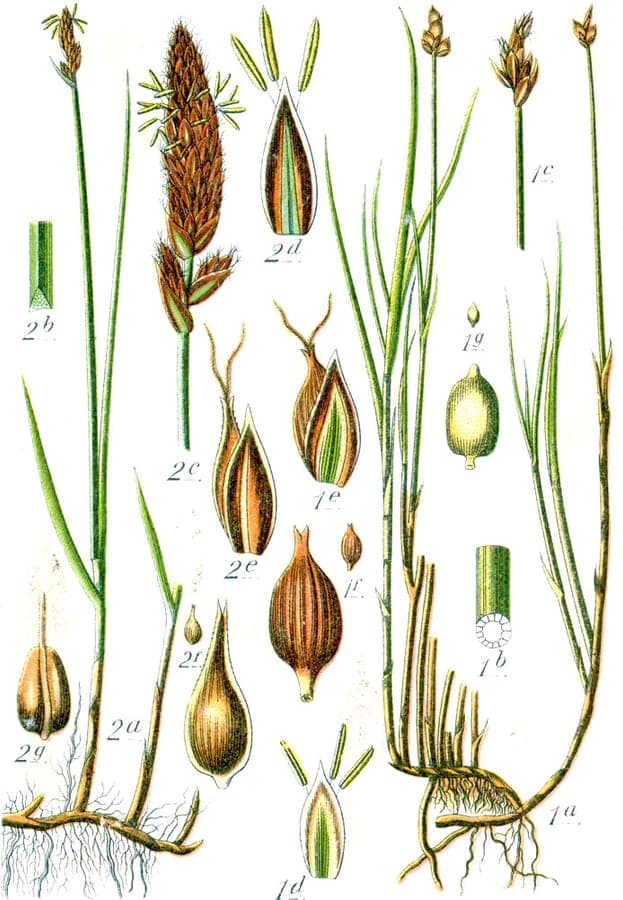
Johann Georg Sturm (Painter: Jacob Sturm) / Public domain, via Wikimedia Commons
String sedge: complete guide
Carex chordorrhiza
Want to see String sedge: complete guide in your garden?
1 minute, no credit card
Overview
Carex chordorrhiza, commonly known as string sedge, is a graceful, creeping perennial grass-like plant that thrives in damp, shaded corners of the garden. If you've got soggy soil where nothing else wants to grow, this is your go-to graminoid. It's not flashy, but it's tough, resilient, and spreads steadily through long, thread-like stolons that root at intervals, forming new clumps.
Native to boreal and temperate regions across Europe and North America, it's perfectly suited to USDA zones 5–8. It's not a common sight in mainstream garden centres, but specialist nurseries and eco-gardeners are starting to catch on. If you're planning a naturalistic planting scheme, string sedge fits right in - especially near ponds, streams, or in bog gardens. On gardenworld.app, you can map out a planting zone tailored to moisture-loving species like this one.
Appearance & bloom cycle
String sedge forms loose, fountain-shaped tussocks with slender, bright green leaves up to 50 cm tall. The foliage is fine-textured and arching, creating a soft visual layer. From May to July, short brown flower spikes appear, rising just above the foliage. They're not showy, but they add subtle texture and attract minimal attention - which is part of the charm.
The real spectacle is its growth habit. The plant spreads via long, horizontal stolons that can stretch up to 60 cm, rooting where they touch the ground. This creates a network of individual plants, slowly forming a dense, weed-suppressing mat. It's not aggressive like some invasive sedges, but it's persistent - give it room to move.
Ideal location
Aim for dappled shade to partial sun - think under deciduous trees or along the north side of a hedge. It handles light exposure rated 8 well, meaning it tolerates some morning sun but burns in hot afternoon rays. Full shade slows growth; full sun in southern zones can scorch the leaves.
Best planted in moist woodland edges, damp borders, or along streambanks. Avoid dry, sandy soils or exposed, windy spots. If you're unsure about light levels in your garden, use gardenworld.app to simulate sun patterns and find the ideal spot for string sedge.
Soil requirements
This sedge loves acidic to slightly acidic soil - pH 5.5 to 6.5. The soil should be rich in organic matter, consistently moist, and well-aerated. Heavy clay is fine if it doesn't compact; sandy soils need amending with compost or leaf mould to hold moisture.
Avoid alkaline soils - it won't survive long-term in pH above 7. Test your soil with a simple kit. If you're on chalk or limestone, grow it in a raised bed with ericaceous compost mix.
Free design
Want to see String sedge: complete guide in your garden? Make a free design now.
Watering
Keep the soil evenly moist. Drought is the fastest way to kill this plant. During dry spells in summer, water deeply twice a week. Mulch with bark chips or leaf litter to retain moisture and reduce evaporation.
In containers, check daily in warm weather - pots dry out fast. Use a deep container (at least 30 cm) to give roots space and stability.
Pruning
Minimal pruning needed. In late winter or early spring, cut back any dead or damaged foliage to make way for new growth. Use sharp shears and avoid cutting into the crown. Don't shear it completely - just tidy up.
Leave the old flower stems through winter for structure and habitat value. They'll break down naturally by spring.
Maintenance calendar
- Jan: Check for frost damage
- Feb: Light pruning, remove old foliage
- Mar: Monitor for new shoots
- Apr: Check moisture, control weeds
- May: Bloom begins, no extra care
- Jun: Peak bloom, ensure consistent moisture
- Jul: Stolons actively spreading
- Aug: Watch for drying edges
- Sep: Stop fertilizing, let seed heads remain
- Oct: Add leaf mulch
- Nov: Observe winter resilience
- Dec: Minimal intervention
Winter hardiness
Hardy down to -20°C (USDA zone 5). In the UK (zone 8) and most of the northern US, it overwinters with ease. Foliage may turn yellow or brown but stays upright, protecting the crown. No need to cut back in autumn - let it stand.
In harsh winters, a light mulch helps, but it's rarely necessary. No winter protection indoors required.
Companion plants
Pair with moisture-loving perennials: Iris versicolor, Astilbe, Ligularia, or hostas. Combine with other Carex species like C. vulpinoidea for contrast. Add spring ephemerals like primroses or wood anemones for early colour.
Avoid drought-tolerant plants like sedum or lavender. Give string sedge space - its runners need room to root.
Closing
String sedge isn't for those chasing bold blooms, but it's a quiet hero for wet, shady spots. It's low maintenance, spreads gently, and improves soil structure over time. Buy it in spring from garden centres specialising in native or bog plants. Look for established plugs rather than seed - faster establishment. And remember, on gardenworld.app you can design a planting layout that accounts for its spreading rate and companion needs.
Want to see String sedge: complete guide in your garden? Make a free design now.
Upload a photo, pick a style, and get a photorealistic design with plant list in under a minute.
10,000+ gardens designed already
No credit card required


Similar plants
Flat-stemmed club-rush: complete guide
Bolboschoenus planiculmis
Everything about Bolboschoenus planiculmis: growing conditions, watering, care, and use as a pond margin or wetland plant in garden design.
Great Plains flatsedge: complete guide
Cyperus lupulinus
Everything about Great Plains flatsedge (Cyperus lupulinus): growing conditions, care, garden uses, and ecological value. Tips for pond margins and dry sandy soils.
Golden beak sedge: complete guide
Rhynchospora corymbosa
Everything about golden beak sedge (Rhynchospora corymbosa): a dramatic tropical marginal for pond edges, bog gardens, and wet habitats.