
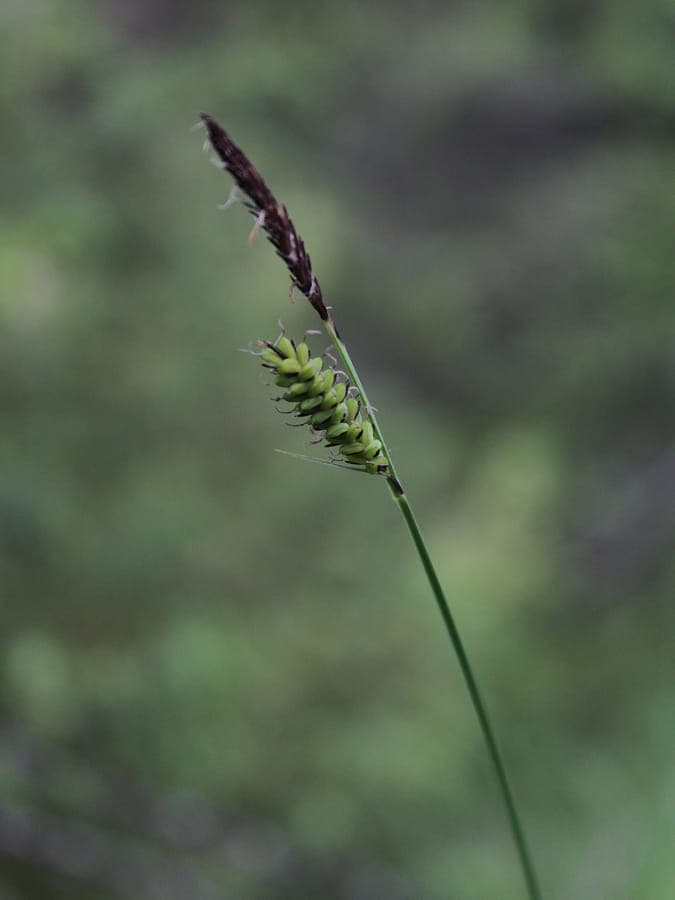
Matti Virtala / CC0, via Wikimedia Commons
Carex cespitosa: complete guide
Carex cespitosa
Want to see Carex cespitosa: complete guide in your garden?
1 minute, no credit card
Overview
Carex cespitosa, commonly known as tufted sedge, is a reliable and graceful grass-like perennial that thrives in cool, moist environments. Native to woodlands and forest margins across Central and Eastern Europe-from Austria and the Baltic States to Belarus and Bulgaria-this sedge forms dense, neat clumps without spreading aggressively. That makes it a top choice for gardeners who want structure without the chaos of invasive runners. At gardenworld.app, you can design a planting scheme that highlights its compact form and seasonal texture.
This hardy perennial stays semi-evergreen in mild winters, holding onto most of its foliage and adding subtle year-round interest. It reaches a mature height of 30–50 cm and spreads slowly to about 40 cm across. Its growth habit is upright and fountain-like, making it ideal for softening edges or filling gaps in shaded borders.
Appearance & bloom cycle
Carex cespitosa features fine, arching leaves that are bright green in spring and summer, measuring 20–40 cm long and 2–4 mm wide. In May, slender greenish-brown flower spikes rise just above the foliage, forming delicate, narrow panicles. These aren't showy, but they add quiet structure and attract small pollinators. By late summer, the seed heads dry to a warm tan, persisting through winter and catching frost or early morning light.
The foliage remains attractive throughout the year. In autumn, it may take on soft golden tones, and in winter, even when lightly frosted, it keeps its form. This makes it a valuable plant for four-season garden design-especially in naturalistic plantings.
Ideal location
This sedge performs best in partial shade (light level 6 out of 10), such as under deciduous trees, along stream banks, or at the edge of a pond. It tolerates full sun only if the soil stays consistently moist. Too much direct sun in dry conditions leads to leaf scorch and thinning clumps. Deep shade, on the other hand, reduces vigour and causes loose, leggy growth.
It's a great fit for woodland gardens, damp borders, or rain gardens. Pair it with taller perennials like Geranium phaeum or Athyrium ferns to create layered depth. Use gardenworld.app to visualise spacing and growth patterns over time-especially useful when planning for moisture-sensitive plants.
Soil requirements
Carex cespitosa prefers moist, well-drained loam or clay-loam soils with a pH between 6.5 and 7.0. It thrives in fertile, humus-rich ground that retains moisture without becoming waterlogged. Avoid sandy or fast-draining soils unless heavily amended with compost or leaf mould.
If your soil is heavy clay, lightly fork in some grit or composted bark to improve aeration. Do not plant in calcareous soils unless pH is monitored and kept within range. A layer of organic mulch in spring helps retain moisture and feeds the soil gradually.
Free design
Want to see Carex cespitosa: complete guide in your garden? Make a free design now.
Watering
Keep the soil consistently moist, especially during the first growing season. Young plants need watering twice weekly during dry spells. Once established, mature clumps are moderately drought-tolerant but perform best with steady moisture. During prolonged dry periods in summer, supplement with deep watering.
Using rainwater is preferable, as tap water with high lime content can affect long-term health. Mulching with leaf litter or wood chips in early summer reduces evaporation and suppresses weeds.
Pruning
Minimal pruning is required. In late winter or early spring (February to March), gently rake out dead or damaged foliage by hand. Avoid cutting back hard-this can damage emerging shoots. If clumps become sparse or lift out of the soil over time, divide them every 4–5 years in early spring.
To divide, lift the plant with a fork, cut the root mass into quarters with a sharp knife, and replant immediately at the same depth. Space divisions 30 cm apart for full coverage within two seasons.
Maintenance calendar
- Jan: Check for frost heave; protect exposed roots with mulch
- Feb: Remove old foliage; prepare for spring growth
- Mar: Divide if needed; apply light compost mulch
- Apr: Monitor soil moisture, especially in exposed areas
- May: Flower spikes emerge; no feeding required
- Jun: Apply organic mulch; maintain soil moisture
- Jul: Watch for dry edges; water deeply if needed
- Aug: Keep area weed-free; avoid disturbing roots
- Sep: Leave seed heads for winter texture
- Oct: No action; soil moisture naturally increases
- Nov: Leave fallen leaves around base for insulation
- Dec: Minimal care; check for winter damage
Winter hardiness
Carex cespitosa is hardy to USDA zone 5 (-25°C). In zone 4, a light mulch of straw or pine needles helps protect the crown during freeze-thaw cycles. The plant remains evergreen to semi-evergreen, depending on winter severity. Avoid walking on frozen foliage, as it can snap easily.
Companion plants
Excellent companions include ferns (Dryopteris filix-mas), wild ginger (Asarum europaeum), and moisture-loving perennials like Ligularia or Astilbe. For contrast, pair with golden sedges like Carex elata 'Aurea' or dark-leaved Hostas. Avoid invasive groundcovers like ivy or Lysimachia that could overwhelm it.
It also works well in modern, low-maintenance schemes with grasses such as Molinia or Deschampsia. Think in layers-tall behind, medium in front-and match water needs carefully.
Closing
Carex cespitosa is a quiet achiever in the garden: tough, beautiful, and low-fuss. It brings texture, stability, and year-round presence to damp, shaded corners where many plants struggle. You'll find it at garden centres across the UK and online. For a tailored planting plan that considers light, soil, and companions, try the design tools on gardenworld.app. It's the smart way to grow with confidence.
Want to see Carex cespitosa: complete guide in your garden? Make a free design now.
Upload a photo, pick a style, and get a photorealistic design with plant list in under a minute.
No credit card required


Similar plants
Flat-stemmed club-rush: complete guide
Bolboschoenus planiculmis
Everything about Bolboschoenus planiculmis: growing conditions, watering, care, and use as a pond margin or wetland plant in garden design.
Great Plains flatsedge: complete guide
Cyperus lupulinus
Everything about Great Plains flatsedge (Cyperus lupulinus): growing conditions, care, garden uses, and ecological value. Tips for pond margins and dry sandy soils.
Golden beak sedge: complete guide
Rhynchospora corymbosa
Everything about golden beak sedge (Rhynchospora corymbosa): a dramatic tropical marginal for pond edges, bog gardens, and wet habitats.