
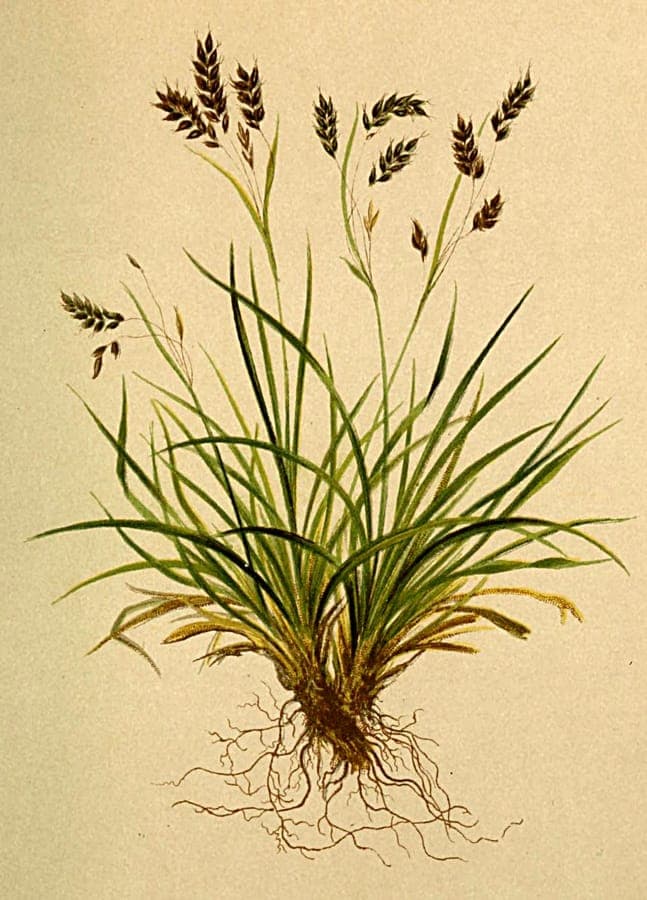
Anton Hartinger / Public domain, via Wikimedia Commons
Hair sedge: complete guide
Carex capillaris
Want to see Hair sedge: complete guide in your garden?
1 minute, no credit card
Overview
Carex capillaris, commonly known as Hair sedge, is a graceful, fine-leaved perennial that thrives where many other plants struggle. Native to alpine and subalpine regions across North America and Eurasia, it's well adapted to cool, moist environments but holds up surprisingly well in lowland gardens. This grass-like sedge brings year-round structure and subtle texture, making it a quiet hero in naturalistic planting schemes. If you're dealing with damp soil, shady spots, or just want a low-maintenance plant with soft movement, Carex capillaris deserves a spot on your list.
Unlike flashy ornamental grasses, this sedge doesn't shout - it whispers. But that's its charm. It forms neat, slowly spreading clumps up to 30 cm tall, with arching green blades that stay semi-evergreen through winter. In colder zones, the foliage turns a warm golden brown, adding depth when little else is growing. You can use gardenworld.app to design a planting layout that highlights its texture alongside taller grasses or bold perennials.
Appearance & bloom cycle
Hair sedge has narrow, hair-like leaves about 1–2 mm wide, forming dense, fountain-like mounds. The foliage stays under 30 cm high, with flower stems reaching up to 35 cm during the blooming season. From June to August, slender brown spikes emerge, rising just above the foliage. These are not showy flowers, but they add quiet interest and provide seed for small birds like finches.
The plant spreads slowly via short rhizomes, forming soft, cohesive patches over time. It won't take over your garden, but it will fill in gaps gracefully. The overall effect is airy and light - perfect for softening edges, spilling over rocks, or blending into meadow-style plantings.
Ideal location
This sedge performs best in full sun to light shade. Aim for a light level of 8 out of 10 - meaning at least 6 hours of direct sunlight daily. In deep shade, the plant becomes leggy and flops over. In very hot climates, afternoon shade can help prevent scorching, especially if soil dries out.
It's hardy in USDA zones 5–8, making it suitable for most temperate gardens in the UK, northern Europe, and much of the northern US and Canada. Choose open, well-ventilated spots - rock gardens, damp borders, or near ponds work well. Avoid enclosed, humid areas where fungal issues might arise.
Soil requirements
Carex capillaris prefers moist, well-drained soil rich in organic matter. The ideal pH range is 5.8 to 7.4 - slightly acidic to neutral. Heavy clay can work if amended with grit or compost to improve drainage. Sandy soils need extra organic matter to retain moisture.
If planting in containers, use a mix of loam-based compost, perlite, and leaf mould. The goal is moisture retention without waterlogging. Standing water leads to root rot, so drainage is critical.
Free design
Want to see Hair sedge: complete guide in your garden? Make a free design now.
Watering
Keep the soil consistently moist, especially during the first growing season and in dry summers. Water deeply once or twice a week if rainfall is low. The root zone should stay damp to about 15 cm deep. In containers, check moisture weekly - water when the top 3 cm feel dry.
While drought-tolerant once established, prolonged dry spells will cause leaf tips to brown. Mulch with leaf mould or compost in spring to help retain moisture and suppress weeds.
Pruning
Pruning is minimal. In late winter or early spring (February to March), trim back any damaged, dead, or tatty foliage with sharp shears. Cut to about 10 cm above ground, taking care not to damage the crown. Avoid cutting too hard - this delays spring growth.
Every 3–4 years, you can divide overcrowded clumps in early spring or autumn. Use a spade or garden fork to lift and separate, ensuring each division has healthy roots and 3–4 growing points.
Maintenance calendar
- Jan: Check for frost heave, protect container plants
- Feb: Light pruning, remove old foliage
- Mar: Divide if needed, apply compost mulch
- Apr: New growth appears, monitor slugs
- May: Maintain soil moisture, watch for dry spells
- Jun-Aug: Blooming period, do not prune
- Sep: Allow seed heads to mature for birds
- Oct: Leave foliage for winter interest
- Nov: Reduce watering, check drainage
- Dec: Protect pots from freezing, leave structure intact
Winter hardiness
Hardy down to -25°C (USDA zone 5), Carex capillaris handles cold winters well. Foliage may turn golden or bronze but remains standing, adding structure to the winter garden. In exposed sites, a light mulch of straw or leaves can protect the crown from extreme freeze-thaw cycles.
Potted plants are more vulnerable - insulate containers with hessian or bubble wrap, and elevate them off cold ground.
Companion plants
Pair with moisture-loving companions like Eriophorum angustifolium, Molinia caerulea, or Iris versicolor. For contrast, plant with low, spreading thymes or sedums. Add spring interest with Anemone blanda or Omphalodes cappadocica.
In naturalistic schemes, combine with Deschampsia, Stipa, or ferns. The fine texture of Hair sedge contrasts beautifully with bolder leaves like rodgersia or ligularia.
Closing
Carex capillaris is a quietly effective plant that earns its place through reliability and elegance. It asks for little but gives back texture, movement, and year-round presence. Whether you're filling a damp corner, designing a wildlife-friendly space, or just love the look of fine grasses, this sedge delivers. Buy healthy plants from local garden centres or trusted online nurseries. And don't forget - gardenworld.app lets you create a custom planting plan that matches growth rate, water needs, and seasonal rhythm, so your Carex thrives from day one.
Want to see Hair sedge: complete guide in your garden? Make a free design now.
Upload a photo, pick a style, and get a photorealistic design with plant list in under a minute.
No credit card required


Similar plants
Flat-stemmed club-rush: complete guide
Bolboschoenus planiculmis
Everything about Bolboschoenus planiculmis: growing conditions, watering, care, and use as a pond margin or wetland plant in garden design.
Great Plains flatsedge: complete guide
Cyperus lupulinus
Everything about Great Plains flatsedge (Cyperus lupulinus): growing conditions, care, garden uses, and ecological value. Tips for pond margins and dry sandy soils.
Golden beak sedge: complete guide
Rhynchospora corymbosa
Everything about golden beak sedge (Rhynchospora corymbosa): a dramatic tropical marginal for pond edges, bog gardens, and wet habitats.