
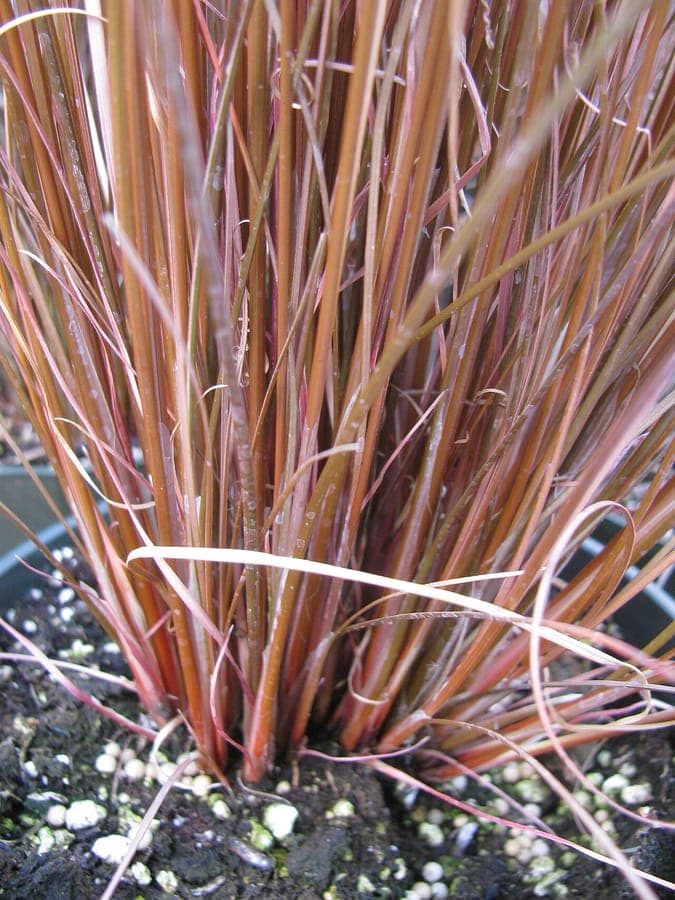
Forest and Kim Starr / CC BY 3.0 us, via Wikimedia Commons
Leatherleaf sedge: complete guide
Carex buchananii
Want to see Leatherleaf sedge: complete guide in your garden?
1 minute, no credit card
Overview
Carex buchananii, commonly known as Leatherleaf sedge, is a striking ornamental grass native to the North Island of New Zealand. Unlike many grasses that rely on seasonal blooms, this plant shines through its ever-changing foliage. It's a member of the Cyperaceae family, which includes sedges, and it grows in dense, arching clumps that stay evergreen in milder climates. What sets it apart is its rich, coppery-brown leaf color that intensifies in full sun - a feature that adds warmth and texture to garden designs year-round.
It doesn't spread aggressively and won't self-seed, making it ideal for controlled landscapes. On gardenworld.app, you can explore how this grass integrates into modern, drought-tolerant garden plans, especially in xeriscaping or gravel gardens.
Appearance & bloom cycle
The plant forms mounds of slender, fine-textured leaves that reach 40–60 cm in length. The foliage emerges in early spring with a soft copper hue and deepens to a rich russet or burnt umber by summer. In winter, the leaves may become slightly ragged but rarely die back completely, maintaining structure when many other perennials have collapsed.
Flowers appear from June to August but are inconspicuous - small, greenish-brown spikes nestled among the leaves. The real show is in the foliage, which catches sunlight beautifully, especially in the morning and late afternoon. Mature plants reach 40 cm tall and spread to about 50 cm wide, growing slowly over several years.
Ideal location
Full sun is best for maximum color development. In partial shade, the leaves tend to turn greener and lose their warm tones. A south- or southwest-facing spot where the plant gets at least 6 hours of direct sunlight daily will bring out the richest hues.
It performs well in rock gardens, dry borders, and as a groundcover in grass-dominated schemes. It's also excellent in containers, where its fountain-like form can be appreciated up close. For gardeners in the UK or northern US, pairing it with architectural plants enhances its sculptural quality. Check gardenworld.app for layout suggestions that highlight its textural contrast with spiky or broad-leaved companions.
Soil requirements
Leatherleaf sedge is adaptable but thrives in well-drained soil. It tolerates sandy, loamy, and even heavy clay soils - as long as water doesn't pool. Ideal pH ranges from 5.5 to 7.5 (slightly acidic to neutral). If planting in heavy clay, amend the soil with grit or coarse sand to improve drainage.
Avoid rich compost or high-nutrient soils. Excessive fertility leads to floppy, weak growth and duller leaf color. A light mulch of gravel or fine bark in spring is sufficient.
Free design
Want to see Leatherleaf sedge: complete guide in your garden? Make a free design now.
Watering
Once established (after about 6–8 weeks), Carex buchananii is drought-tolerant. During the first few weeks after planting, water deeply once a week with 3–5 liters per plant, depending on pot size and weather. After establishment, only water during prolonged dry spells in summer.
Allow the top 2–3 cm of soil to dry out between waterings. Overwatering, especially in winter, can cause root rot. In containers, ensure pots have drainage holes and avoid letting them sit in saucers of water.
Pruning
Pruning is minimal. In late winter or early spring (February to March), trim back old, damaged foliage to about 10–15 cm above the crown. Use sharp shears and cut carefully to avoid injuring new growth emerging from the center.
Do not cut into the crown. The plant will regrow quickly, producing fresh, vibrant leaves. Old foliage can be composted - it breaks down slowly but adds structure to the pile.
Maintenance calendar
- Jan: Check for winter damage, ensure good drainage
- Feb: Begin light pruning, remove dead material
- Mar: Finish trimming, apply light mulch
- Apr: New growth emerges, no extra feeding needed
- May: Monitor for pests, check soil moisture
- Jun: Flowering begins (subtle), full sun ideal
- Jul: Peak foliage color, tolerate dry conditions
- Aug: No maintenance required
- Sep: Growth slows, avoid fertilizing
- Oct: Foliage remains decorative, good winter structure
- Nov: Leave standing, provides habitat
- Dec: Minimal care, protect container plants if needed
Winter hardiness
Hardy to USDA zones 7b–10 (tolerates down to -15°C). In zones 7 and 8, it remains evergreen with proper drainage. In colder zones, foliage may die back but often resprouts in spring if the crown survives. Mulching isn't necessary in-ground, but potted plants benefit from insulation - wrap with hessian or move to a sheltered spot.
Avoid wet, cold winters - that's when root rot becomes a risk. Elevate pots or improve soil grade to prevent waterlogging.
Companion plants
Pair with plants that complement its color and texture:
- Stipa tenuissima (for airy movement)
- Eryngium giganteum (for spiky blue contrast)
- Sedum 'Matrona' (for pink stems and late blooms)
- Heuchera 'Palace Purple' (for foliage drama)
- Phormium cookianum (for vertical accent)
Avoid moisture-loving species like Astilbe or Ligularia. This sedge works best in dry, Mediterranean-style or New Zealand-inspired gardens.
Closing
Carex buchananii is a quiet performer with high impact. It doesn't shout, but it adds depth, warmth, and year-round interest with little effort. Its copper tones blend beautifully with both warm and cool palettes, and its non-invasive habit makes it a safe choice for mixed borders.
You'll find it at most garden centres in the UK and US. For design inspiration, visit gardenworld.app and search for 'textural grass schemes' or 'drought-resistant gardens' to see how this sedge can anchor a low-maintenance yet striking planting plan.
Want to see Leatherleaf sedge: complete guide in your garden? Make a free design now.
Upload a photo, pick a style, and get a photorealistic design with plant list in under a minute.
No credit card required


Similar plants
Flat-stemmed club-rush: complete guide
Bolboschoenus planiculmis
Everything about Bolboschoenus planiculmis: growing conditions, watering, care, and use as a pond margin or wetland plant in garden design.
Great Plains flatsedge: complete guide
Cyperus lupulinus
Everything about Great Plains flatsedge (Cyperus lupulinus): growing conditions, care, garden uses, and ecological value. Tips for pond margins and dry sandy soils.
Golden beak sedge: complete guide
Rhynchospora corymbosa
Everything about golden beak sedge (Rhynchospora corymbosa): a dramatic tropical marginal for pond edges, bog gardens, and wet habitats.