
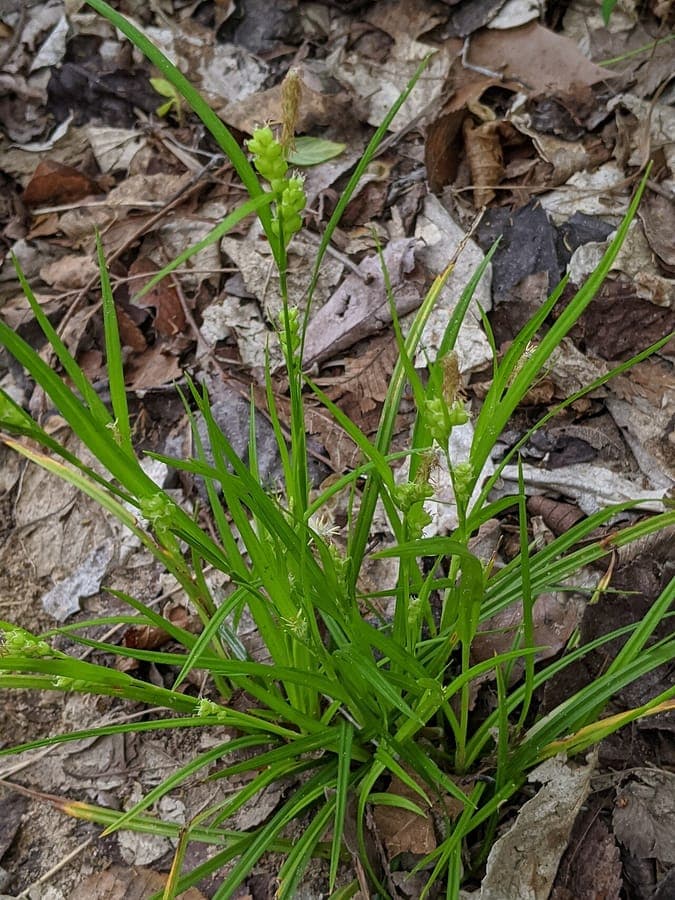
Alison Northup / CC BY 4.0, via Wikimedia Commons
Carex blanda: complete guide
Carex blanda
Want to see Carex blanda: complete guide in your garden?
1 minute, no credit card
Overview: Carex blanda, commonly called eastern woodland sedge or bland sedge, is a native North American woodland plant ranging from southeastern Canada through central and eastern United States. This sedge grows 30-60 cm tall, forming loose tufts of gray-green foliage. For temperate European gardens, Carex blanda offers excellent qualities: deep shade tolerance, seasonal moisture needs, and authentic woodland character for naturalistic landscaping.
Appearance and Bloom: The plant produces narrow, gray-green leaves averaging 3-4 mm wide. In May, inconspicuous flower spikes emerge: male spikelets atop stems (greenish), female spikelets below (brown-green). Fruits are tiny, burnished brown-green. Peak flowering occurs April-May. The plant retains evergreen character: foliage remains green through December in temperate zones.
Ideal Location: Choose deep shade to partial light: beneath beeches, oaks, or mixed deciduous trees where direct sunlight is minimal. The plant thrives in moisture-retentive woodland soil more than in dry sandy ground. Locations along forest edges or beneath shrubs combine partial shade with consistent soil moisture. Dutch retailers Intratuin and Gamma stock sedges; German centres OBI and Hornbach carry selections. French Truffaut and Jardiland may stock similar Carex species.
Soil: Use moisture-retentive woodland soil: blend of leaf mould (humus-rich), forest loam, or peat substitute. Sedges tolerate acidic to neutral pH (4.4-7): ideal range 5-6. Drainage must allow moisture movement, not waterlogging. Sedges thrive in consistently moist (not boggy) conditions. Add no artificial fertiliser; sedges feed from decomposing leaf litter.
Watering: Sedges demand consistent soil moisture: neither waterlogged nor drought-stressed. During dry spells, water until soil visibly moist. Summer moisture demand is high; winter demand is low. Sedges that endure months of dryness decline. Mulch with 5 cm decomposing leaves maintains moisture.
Pruning: Carex blanda requires minimal pruning. Remove dead or diseased foliage in spring for freshness. Overgrown tufts can be gently thinned, though not necessary. Autumn leaves may remain for rustic effect or be removed in March-April. Sedges self-spread via rhizomes.
Maintenance Calendar: March-April remove dead leaves, check soil moisture. May-June growth peaks, weekly water during dry spells. July-September monitor moisture, no feeding. October-November leaf drop possible, no action. December-February minimal care, very low moisture needs. Every three years inspect for overcrowding; divide congested clumps.
Winter Hardiness: Completely hardy in Netherlands, Belgium, northern France, Germany down to minus-15 degrees Celsius. No protection required. Plant grows beneath snow cover. Sedges retain foliage: attractive winter silhouette.
Companion Plants: Combine Carex blanda with Hepatica nobilis for spring interest, Helleborus foetidus for winter appeal. Hosta cultivars add height variation. Polystichum setiferum provides textural contrast. Grouping 3-5 plants creates naturalistic effect.
Closing: Carex blanda is excellent for woodland borders, shaded corners, and moist ground in temperate gardens. Minimal maintenance, evergreen character, and ecological value make this a winner for nature-minded gardeners.
Want to see Carex blanda: complete guide in your garden? Make a free design now.
Upload a photo, pick a style, and get a photorealistic design with plant list in under a minute.
No credit card required


Similar plants
Flat-stemmed club-rush: complete guide
Bolboschoenus planiculmis
Everything about Bolboschoenus planiculmis: growing conditions, watering, care, and use as a pond margin or wetland plant in garden design.
Great Plains flatsedge: complete guide
Cyperus lupulinus
Everything about Great Plains flatsedge (Cyperus lupulinus): growing conditions, care, garden uses, and ecological value. Tips for pond margins and dry sandy soils.
Golden beak sedge: complete guide
Rhynchospora corymbosa
Everything about golden beak sedge (Rhynchospora corymbosa): a dramatic tropical marginal for pond edges, bog gardens, and wet habitats.