
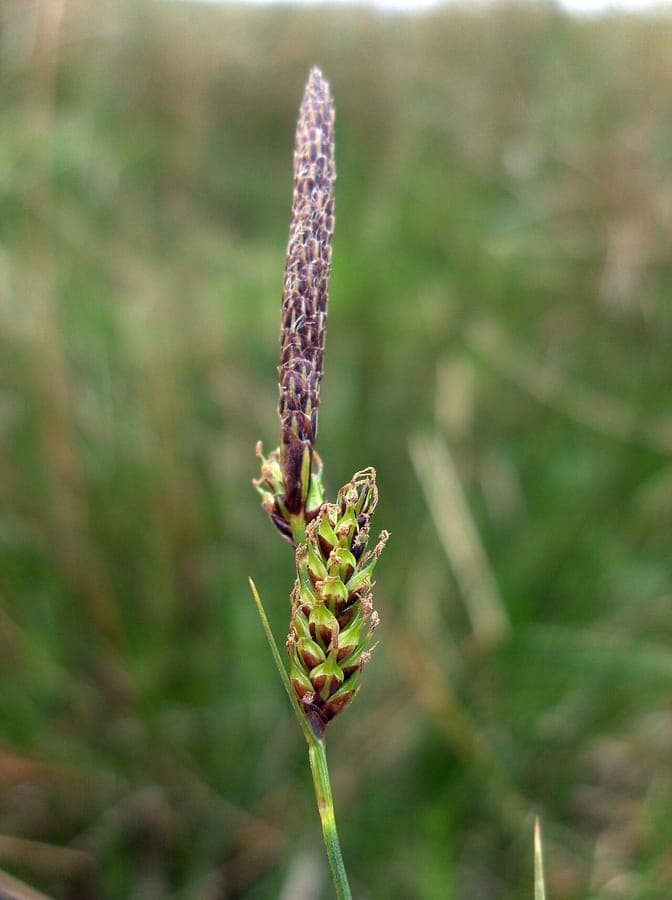
Stemonitis / CC BY-SA 3.0, via Wikimedia Commons
Green-ribbed sedge: complete guide
Carex binervis
Want to see Green-ribbed sedge: complete guide in your garden?
1 minute, no credit card
Overview
Carex binervis, commonly known as green-ribbed sedge, is a resilient, evergreen grass-like perennial native to damp moorlands and heathlands across western and northern Europe. It's not a plant that shouts for attention, but one that quietly holds a border together with its fine texture and year-round presence. Standing 30–50 cm tall with a spread of up to 40 cm, it forms dense, soft mounds that slowly expand via shallow rhizomes. This is a workhorse in the garden - subtle, dependable, and perfectly adapted to tough, wet conditions.
It thrives in environments that challenge most ornamental grasses: acidic, water-retentive soils with consistent moisture. In the wild, you'll find it alongside heathers, bog myrtle, and cotton grass. In the garden, it's a natural fit for bog gardens, pond margins, or naturalistic planting schemes. On gardenworld.app you can design a moisture-rich planting plan that incorporates Carex binervis with complementary species and proper drainage solutions.
Appearance & bloom cycle
The leaves are narrow (2–3 mm), bright green to olive, with two prominent veins running lengthwise - hence the name 'binervis'. They arch gently at the tips, creating a soft, fountain-like effect. New growth in early spring emerges in a vibrant lime green, softening to deeper tones as the season progresses.
Flowering occurs from April to June. The flower spikes are modest: greenish-brown, with male and female flowers on the same stem. The seed heads that follow are inconspicuous but provide food for small insects and seed-eating birds. While not showy, the entire blooming process adds subtle seasonal interest.
Ideal location
Aim for a spot with light to partial shade - about a 7 out of 10 on the light scale. Full sun is acceptable only if the soil remains consistently moist. In hot, dry summers, full exposure will scorch the foliage and cause dieback. Deep shade, on the other hand, leads to weak, leggy growth.
Best planted under open-canopy trees like birch or silver birch, or along the damp edge of a pond. It also works well in rain gardens or swales where water collects. If you're unsure whether your garden fits the bill, gardenworld.app offers a site assessment tool to help match your conditions with suitable plants like Carex binervis.
Soil requirements
This sedge demands acidic soil with a pH between 3 and 4. Neutral or alkaline soils will cause chlorosis and stunted growth. Use ericaceous compost mixed with leaf mould and a bit of sharp sand for drainage. Avoid lime, wood ash, or mushroom compost - all raise pH.
If your soil is heavy clay, amend it with peat-free ericaceous mix and perlite to improve aeration and acidity. A top dressing of pine needles or oak leaf litter in autumn helps maintain low pH and retains moisture.
Free design
Want to see Green-ribbed sedge: complete guide in your garden? Make a free design now.
Watering
Consistent moisture is non-negotiable. The soil should never dry out, especially during establishment and summer heatwaves. Water deeply once a week during dry spells, more if planted in full sun or containers.
Use rainwater when possible - tap water, especially in hard water areas, can gradually increase soil pH. If using tap water, dilute it with collected rainwater to reduce mineral buildup.
Pruning
Minimal pruning is needed. In late winter or early spring (February to March), trim back any dead, damaged, or tatty foliage to about 10 cm above the crown. Use sharp, clean secateurs to avoid infection. Do not cut into the crown - this can kill the plant.
Divide congested clumps every 3–4 years in early spring or autumn. Lift the plant, split with a spade or knife, ensuring each division has several healthy shoots. Replant immediately and water well.
Maintenance calendar
- January: Check for frost damage; remove loose debris
- February: Light trim of old growth
- March: Divide and replant if needed
- April: New growth appears; monitor moisture
- May: Watch for slugs on young shoots
- June: Flowering begins; inspect for pests
- July: Water weekly in dry weather
- August: No feeding; keep soil moist
- September: Optional division; no pruning
- October: Leave foliage for winter protection
- November: No action required
- December: Dormant; ensure soil doesn't freeze solid
Winter hardiness
Carex binervis is hardy in USDA zones 6–9. It tolerates temperatures down to -15°C without issues. Foliage may turn bronze or brown in winter but rebounds fully in spring. In containers, roots are more exposed to freeze-thaw cycles. Protect pots by elevating them on feet and wrapping with hessian or bubble wrap during prolonged cold.
No mulch is needed in the ground - the plant's own foliage provides insulation. Avoid piling organic mulch around the crown, as this can encourage rot.
Companion plants
Pair with other acid-loving, moisture-tolerant plants: Erica carnea, Calluna vulgaris, Molinia caerulea, Eriophorum angustifolium, and Iris versicolor. It also blends well with ferns like Dryopteris filix-mas and moisture-loving perennials such as Lobelia cardinalis.
Avoid drought-tolerant species like lavender, sedum, or echinacea. Stick to plants with similar needs: acidic soil, high moisture, and partial shade.
Closing
Carex binervis is a quiet achiever in the garden. It won't stop traffic, but it creates texture, movement, and stability in wet, challenging spots. Once established, it asks for little but repays with years of reliable growth.
Available in spring at most garden centres in the UK, look for well-rooted 9 cm or 1L pots. Reputable nurseries often stock it, and online suppliers offer mail-order options. On gardenworld.app, you can build a custom planting scheme with Carex binervis as a key structural element, complete with care reminders and companion suggestions.
Want to see Green-ribbed sedge: complete guide in your garden? Make a free design now.
Upload a photo, pick a style, and get a photorealistic design with plant list in under a minute.
No credit card required


Similar plants
Flat-stemmed club-rush: complete guide
Bolboschoenus planiculmis
Everything about Bolboschoenus planiculmis: growing conditions, watering, care, and use as a pond margin or wetland plant in garden design.
Great Plains flatsedge: complete guide
Cyperus lupulinus
Everything about Great Plains flatsedge (Cyperus lupulinus): growing conditions, care, garden uses, and ecological value. Tips for pond margins and dry sandy soils.
Golden beak sedge: complete guide
Rhynchospora corymbosa
Everything about golden beak sedge (Rhynchospora corymbosa): a dramatic tropical marginal for pond edges, bog gardens, and wet habitats.