
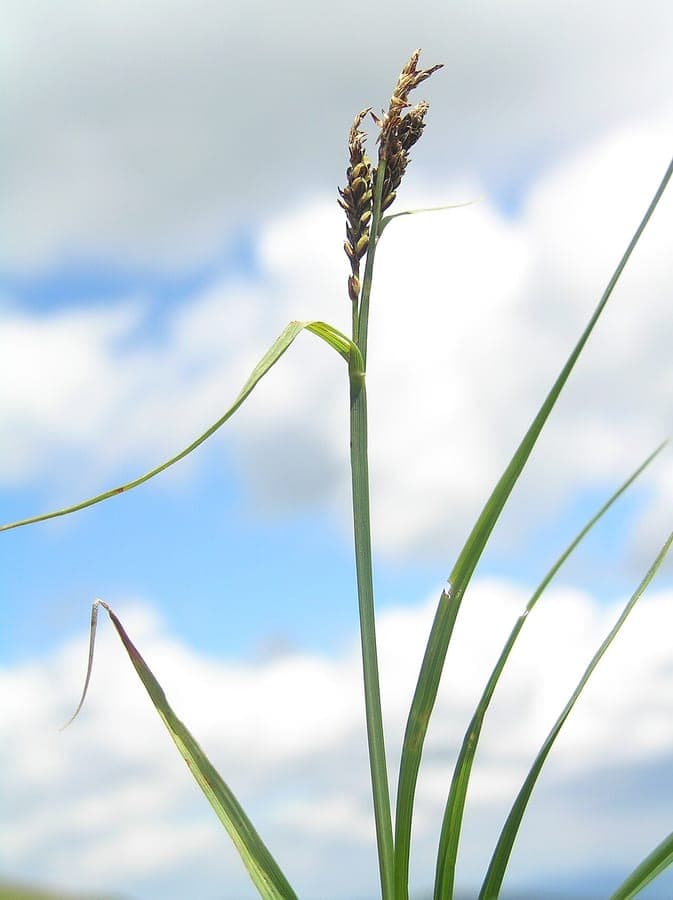
Petr Filippov / CC BY-SA 3.0, via Wikimedia Commons
Stiff sedge: complete guide
Carex bigelowii
Want to see Stiff sedge: complete guide in your garden?
1 minute, no credit card
Overview
Carex bigelowii, commonly known as stiff sedge, is a hardy, creeping perennial sedge that thrives in cool, wet, and acidic environments. Native to alpine and subarctic regions from Alaska to Siberia and Greenland, this grass-like plant is perfect for gardeners dealing with boggy soil or designing rain gardens. It's not flashy, but it's dependable - forming dense, low mats that suppress weeds and stabilise soil. If you've got a soggy corner where nothing seems to grow, stiff sedge might be your answer.
On gardenworld.app, you can design a garden layout that incorporates Carex bigelowii into wetland-style planting schemes, especially in zones prone to water pooling.
Appearance & bloom cycle
Stiff sedge grows in compact tufts reaching 15–30 cm in height, with narrow, stiff, upright leaves that stay green year-round in milder climates. The foliage has a fine texture and a slightly rough feel, typical of many sedges in the Cyperaceae family. In late spring, from May to June, small greenish flower spikes emerge, blending into the foliage rather than standing out. These are not ornamental per se but serve to produce seed and support local pollinators.
The plant spreads slowly via rhizomes, forming dense colonies over time - ideal for ground cover without being invasive. In autumn, the leaves may take on a bronze hue, adding subtle seasonal interest. It doesn't die back completely, so it provides structure even in winter.
Ideal location
Choose a spot with partial to full shade. While it can tolerate some morning sun, especially in cooler USDA zones (3–7), it performs best when protected from hot afternoon sun. Avoid hot, dry, south-facing beds - these will stress the plant. Ideal microclimates include the edges of ponds, damp woodland borders, or low-lying areas where water naturally collects.
Wind exposure should also be considered. Though resilient, strong gusts can flatten or damage the upright foliage. Plant near low shrubs or rocks for natural windbreaks.
Soil requirements
This sedge prefers acidic soil with a pH between 4.8 and 6.4. It thrives in consistently moist, humus-rich soils - think peat, loam, or mucky garden soil. Avoid alkaline or sandy soils unless amended with organic matter like leaf mould or well-rotted compost. If your soil is too alkaline, lower the pH with elemental sulfur or peat moss (though use peat responsibly due to environmental concerns).
Aim for a soil mix that's 60% organic matter and 40% mineral soil. Test your pH annually with a soil meter - it's worth the investment if you're growing acid-loving plants.
Free design
Want to see Stiff sedge: complete guide in your garden? Make a free design now.
Watering
Keep the soil consistently moist - never let it dry out. During the growing season (April to September), water weekly if rainfall is less than 25 mm. Use about 20 litres per square meter when irrigating. Rainwater is ideal, as it's slightly acidic and free of chlorine.
Avoid waterlogging - while the plant likes wet feet, stagnant water can lead to root rot. Mulch with pine needles or wood chips to retain moisture and reduce evaporation. In prolonged droughts, increase watering frequency to twice a week.
Pruning
Pruning is minimal. In early spring (March), trim back any dead, damaged, or discoloured foliage to about 5 cm above the ground. Use clean, sharp shears to prevent disease transmission. Don't cut too early - wait until you see new growth emerging to avoid removing fresh shoots.
There's no need to deadhead flowers - they're inconspicuous and don't affect plant health. Avoid heavy cutting in summer or late autumn, as this can weaken the plant going into winter.
Maintenance calendar
- Jan: Check for winter damage
- Feb: No action needed
- Mar: Cut back old foliage; inspect soil moisture
- Apr: Begin regular watering; apply organic mulch
- May: Flowers emerge; monitor for pests
- Jun: No pruning; light top-dressing with compost
- Jul: Watch for drying; water deeply during heatwaves
- Aug: Maintain moisture; avoid fertilising
- Sep: Gradually reduce watering
- Oct: Leave foliage for winter protection
- Nov: Apply 2–3 cm mulch layer
- Dec: Final check for frost heave
On gardenworld.app, you can generate a custom maintenance schedule for Carex bigelowii based on your local weather and soil conditions.
Winter hardiness
Stiff sedge is extremely cold-hardy, thriving in USDA zones 3–7. It handles temperatures down to -35°C and remains semi-evergreen in most winters. The foliage may brown slightly but doesn't need cutting back unless aesthetics are a priority. Snow cover acts as natural insulation, protecting the crowns. No additional winter protection is required, though a light mulch helps in exposed or sandy soils.
Companion plants
Pair with moisture-loving perennials like Eriophorum angustifolium, Menyanthes trifoliata, or Osmunda regalis. It also works well with other sedges such as Carex vulpinoidea or Carex vulpis. For contrast, plant near low-growing heathers (Calluna vulgaris) or purple moor grass (Molinia caerulea). Avoid pairing with drought-tolerant species like lavender or yarrow.
In rain gardens, combine with Iris versicolor or Eutrochium maculatum for height and seasonal colour.
Closing
Carex bigelowii is a quiet achiever - not showy, but incredibly useful in the right setting. It's perfect for erosion control, wetland restoration, or simply filling tricky damp spots. It's low-maintenance, deer-resistant, and supports biodiversity. You can find it at garden centres across the UK and North America, often sold in trays of 9 or 12 plugs. Start with 3–5 plants per square meter - they'll form a solid cover in 2–3 years. With thoughtful placement and minimal care, stiff sedge becomes a backbone plant in sustainable garden design.
Want to see Stiff sedge: complete guide in your garden? Make a free design now.
Upload a photo, pick a style, and get a photorealistic design with plant list in under a minute.
10,000+ gardens designed already
No credit card required


Similar plants
Flat-stemmed club-rush: complete guide
Bolboschoenus planiculmis
Everything about Bolboschoenus planiculmis: growing conditions, watering, care, and use as a pond margin or wetland plant in garden design.
Great Plains flatsedge: complete guide
Cyperus lupulinus
Everything about Great Plains flatsedge (Cyperus lupulinus): growing conditions, care, garden uses, and ecological value. Tips for pond margins and dry sandy soils.
Golden beak sedge: complete guide
Rhynchospora corymbosa
Everything about golden beak sedge (Rhynchospora corymbosa): a dramatic tropical marginal for pond edges, bog gardens, and wet habitats.