
Thomas Mathis / CC BY-SA 3.0, via Wikimedia Commons
Darkbrown sedge: complete guide
Carex atrofusca
Want to see Darkbrown sedge: complete guide in your garden?
1 minute, no credit card
Overview
Carex atrofusca, commonly known as Darkbrown sedge, is a modest yet striking perennial sedge native to cool temperate regions across Europe, Asia, and North America. Often overlooked in mainstream garden centres, it's a gem for wetland gardens and naturalistic plantings. Reaching 30–50 cm in height with a spread of about 40 cm, this sedge forms dense, grass-like clumps that slowly expand via short rhizomes. It's fully winter hardy in USDA zones 4 to 8, tolerating temperatures down to -25°C without protection.
What sets Carex atrofusca apart is its subtle beauty - fine textured foliage, a soft growth habit, and flower spikes that mature from green to deep chocolate brown. It's not flashy, but it brings lasting structure to moist areas where other plants might struggle. If you're designing a rain garden or restoring a boggy patch, this sedge deserves a spot. On gardenworld.app, you can build a planting scheme that highlights moisture-loving perennials like this one.
Appearance & bloom cycle
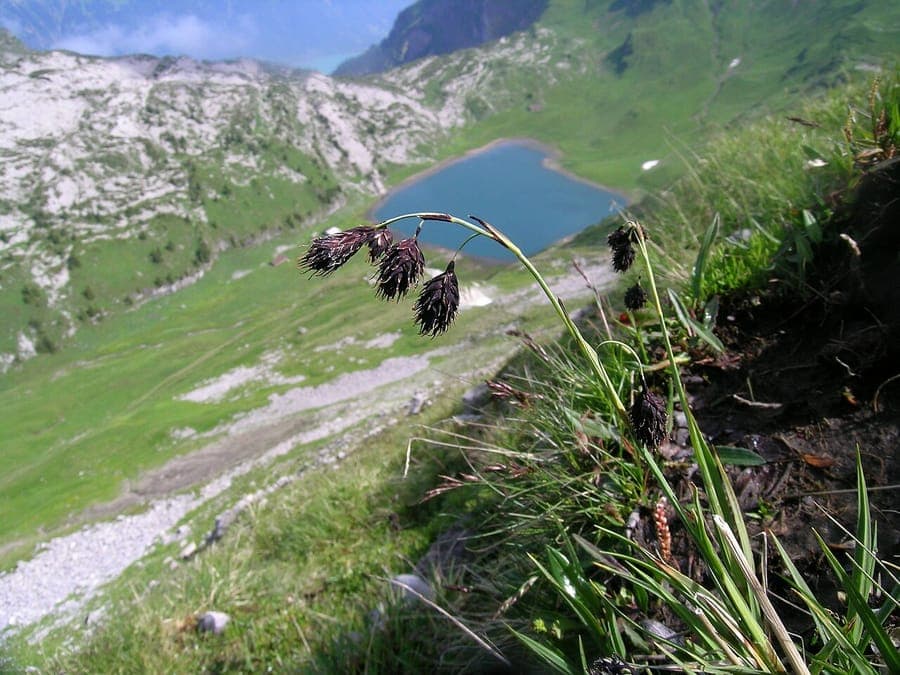
The leaves are narrow, around 2–4 mm wide, with a bright to mid-green hue and a slight sheen. They arch gently from the base, creating a fountain-like effect. In late spring (late May to early June), triangular flower spikes emerge - initially green, then turning a rich, smoky brown. Each spike is 2–3 cm long and densely packed, giving a soft, fuzzy look. The contrast between the green blades and dark spikes is subtle but effective.
After flowering, the spikes fade into a warm tan, persisting through autumn and often into winter. Unlike many sedges, Carex atrofusca retains most of its foliage year-round, offering visual interest even in the bleakest months. It doesn't die back completely, so you won't need to fill gaps with seasonal plants.
Ideal location
This sedge thrives in full sun to light shade. In full sun, it forms the tightest, most compact mounds and produces the darkest flower spikes. In deeper shade, growth becomes leggy and flowering diminishes. It's ideal for bog gardens, pond margins, stream banks, or any consistently damp area. Avoid hot, dry borders - this plant won't survive there.
It's also excellent for rain gardens or swales where water collects temporarily. If you're dealing with a soggy corner in your garden, Carex atrofusca could be the answer. On gardenworld.app, you can visualise how this sedge integrates into a layered wetland planting with companion species.
Soil requirements
Carex atrofusca prefers wet, acidic to neutral soils (pH 4.5–6.5). It grows well in peaty loam, humus-rich clay, or saturated sandy soils as long as moisture is consistent. Avoid alkaline or chalky soils - this sedge is sensitive to lime and will show signs of chlorosis. Do not add garden lime near this plant.
In heavy clay, ensure some organic matter is mixed in to improve root development. If planting in sandy soil, amend with compost or leaf mould to boost water retention. A 5–10 cm mulch layer of bark or reed can help maintain moisture and suppress weeds.
Free design
Want to see Darkbrown sedge: complete guide in your garden? Make a free design now.
Watering
Constant moisture is non-negotiable. From April to September, keep the soil damp at all times. In dry spells, water every 2–3 days, especially for young plants. Mature clumps are more resilient but still depend on wet conditions. Use rainwater when possible - tap water with high calcium content can alter soil pH over time.
In pond margins or naturalised wetlands, supplemental watering is rarely needed. In borders, use a soaker hose or drip system during summer to maintain moisture.
Pruning
Pruning is minimal. In late winter (February to early March), cut back old, tattered foliage to about 10 cm above ground. This clears space for fresh growth and keeps the plant looking tidy. Use sharp, clean shears to prevent disease. Leave the flower spikes intact over winter - they add texture and shelter for overwintering insects.
Avoid cutting too early in winter, as the standing foliage provides insulation. Never remove all green growth - some evergreen retention is normal and healthy.
Maintenance calendar
- Jan: Check for frost heave; no action needed
- Feb: Begin light pruning of dead material
- Mar: Finish pruning; inspect soil moisture
- Apr: New growth appears; monitor water levels
- May: Flower spikes form; ensure consistent moisture
- Jun: Peak bloom; watch for dry patches
- Jul: Continue watering in heatwaves
- Aug: Replenish mulch if faded
- Sep: Growth slows; reduce watering frequency
- Oct: Leave foliage and spikes for winter interest
- Nov: No maintenance required
- Dec: Observe; protect only in exposed, windy sites
Winter hardiness
This sedge is reliably hardy in USDA zones 4–8. It survives harsh winters with no protection, though tips may bronze in extreme cold. The plant remains semi-evergreen, and the crown stays intact. No winter mulch is necessary unless planted in shallow, rocky soil or exposed sites.
Companion plants
Pair with other moisture-loving species: Eriophorum angustifolium (cotton grass), Molinia caerulea (purple moor grass), Carex riparia (greater pond sedge), or Menyanthes trifoliata (bogbean). For contrast, add Iris pseudacorus (yellow flag iris) or Lythrum salicaria (purple loosestrife). Space plants 40 cm apart to allow for natural spread.
Avoid drought-tolerant plants like lavender or sedum - they won't survive in the same conditions. Stick to a wetland palette.
Closing
Carex atrofusca may not grab attention like a flowering perennial, but its quiet strength makes it indispensable in wet gardens. It's low maintenance, long-lived, and adds year-round texture. Whether you're restoring a bog, planting a pond edge, or tackling a soggy corner, this sedge delivers. You can find it at select garden centres or through specialist nurseries. Look for it in spring at garden centres like OBI or Hornbach in Europe, or check online retailers that support native wetland species.
Want to see Darkbrown sedge: complete guide in your garden? Make a free design now.
Upload a photo, pick a style, and get a photorealistic design with plant list in under a minute.
No credit card required


Similar plants
Flat-stemmed club-rush: complete guide
Bolboschoenus planiculmis
Everything about Bolboschoenus planiculmis: growing conditions, watering, care, and use as a pond margin or wetland plant in garden design.
Great Plains flatsedge: complete guide
Cyperus lupulinus
Everything about Great Plains flatsedge (Cyperus lupulinus): growing conditions, care, garden uses, and ecological value. Tips for pond margins and dry sandy soils.
Golden beak sedge: complete guide
Rhynchospora corymbosa
Everything about golden beak sedge (Rhynchospora corymbosa): a dramatic tropical marginal for pond edges, bog gardens, and wet habitats.