
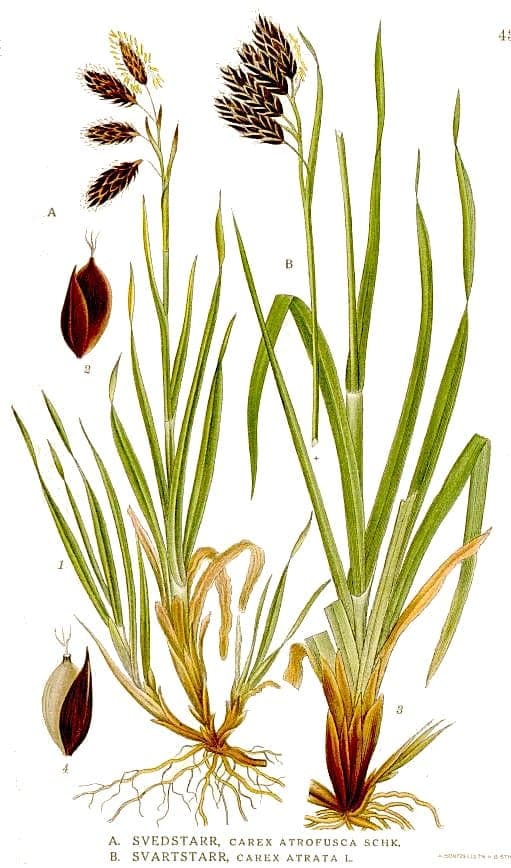
Carl Axel Magnus Lindman / Public domain, via Wikimedia Commons
Black alpine sedge: complete guide
Carex atrata
Want to see Black alpine sedge: complete guide in your garden?
1 minute, no credit card
Overview
Carex atrata, commonly known as black alpine sedge, is a compact, evergreen-like perennial that stands out in the garden with its deep, almost black foliage. Though not a true grass, it belongs to the sedge family (Cyperaceae) and grows in tight, fountain-shaped clumps reaching 15–25 cm in height. Native to alpine and subalpine regions across Europe and Asia, it thrives in cool, moist, shaded environments-making it a perfect fit for UK and northern European gardens.
This sedge is prized for its year-round visual impact. It remains semi-evergreen in mild winters and regrows vigorously each spring. Hardy to USDA zone 5 (-20 °C), it adds structure when little else is green. On gardenworld.app, you can design a shaded border layout that features Carex atrata as a dark accent among lighter foliage plants.
Appearance & bloom cycle
The dark, glossy leaves are narrow (up to 2 mm wide) and form dense, arching tufts. Their near-black colour is most intense in spring and summer but holds well into autumn. Tiny, inconspicuous brown flower spikes appear in April and May, but they're not the highlight-this plant is all about foliage.
Unlike many sedges, Carex atrata doesn't brown off completely in winter. The outer leaves may fade or dry slightly, but the core stays intact, providing winter interest. In early spring, old foliage can be gently combed out to make way for fresh growth.
Ideal location
Choose a spot with partial to full shade. Avoid hot afternoon sun, which scorches the delicate leaves and dries out the soil too fast. A north-facing slope, under deciduous trees, or along a woodland edge works best. The plant also tolerates morning sun if the soil stays consistently moist.
Use it in rock gardens, along damp pathways, or as a groundcover under shrubs. It's excellent for adding contrast in naturalistic planting schemes. Gardeners in the UK often pair it with ferns or hostas. Explore planting combinations on gardenworld.app to visualise how it fits in layered shade beds.
Soil requirements
Carex atrata prefers humus-rich, moisture-retentive soil with good drainage. Loam or clay-loam soils amended with compost work well. The ideal pH range is slightly acidic to neutral (5.5–7.0). Avoid sandy soils unless you mulch heavily and water regularly.
When planting, mix in a generous amount of well-rotted leaf mould or compost. Do not use high-nitrogen fertilisers-excess nutrients lead to floppy, weak growth. The roots need consistent moisture but hate waterlogged conditions, so ensure the site doesn't become soggy.
Watering
Keep the soil evenly moist, especially during the first growing season and dry spells. Water deeply 2–3 times per week in summer if rainfall is below 25 mm per week. Use rainwater when possible, as tap water with high lime content can affect long-term health.
Reduce watering in autumn and winter, but don't let the rootball dry out completely during prolonged dry cold periods. Mulching lightly with leaf litter helps retain moisture and protects the crown.
Free design
Want to see Black alpine sedge: complete guide in your garden? Make a free design now.
Pruning
Pruning is minimal. In late winter or early spring (February–March), remove dead or tattered leaves by hand or with sharp scissors. Avoid cutting into the crown-pull old growth gently to prevent damage. If the clump becomes too dense or starts dying out in the centre, divide it every 3–4 years in early spring.
Use a sharp spade to lift and split the plant into sections of at least 5 cm diameter. Replant immediately in prepared soil and water well.
Maintenance calendar
- Jan: Check for frost heave; protect exposed roots
- Feb: Remove old foliage; inspect for pests
- Mar: Divide if needed; apply thin mulch
- Apr: Begin regular watering; watch for dry spells
- May: Monitor soil moisture; no feeding required
- Jun: Ensure shade coverage; avoid midday sun
- Jul: Water during heatwaves; check for leaf scorch
- Aug: Maintain moisture; observe clump health
- Sep: Reduce watering gradually; leave foliage for winter
- Oct: Leave undisturbed; mulch lightly if desired
- Nov: Monitor for wet soils; improve drainage if needed
- Dec: Leave standing; check for rodent activity
Winter hardiness
Hardy to USDA zone 5, Carex atrata withstands temperatures down to -20 °C. It remains semi-evergreen, with the centre of the clump surviving winter cold. In colder zones (6 and above), it's fully evergreen. Avoid locations with poor winter drainage-frozen, waterlogged soil causes root rot.
No winter protection is usually needed, but in exposed areas, a light layer of bracken or dried leaves can help shield the crown.
Companion plants
Pair with plants that enjoy similar conditions: ferns (Dryopteris filix-mas), wood millet (Milium effusum), or golden variegated sedges like Carex elata 'Aurea'. The contrast between light and dark foliage creates depth. Early spring bulbs like snowdrops (Galanthus nivalis) or bluebells (Hyacinthoides non-scripta) also work well, blooming before the sedge fills out.
Avoid invasive or overly dominant plants. Stick to well-behaved perennials that won't crowd out the delicate clump. Preview these combinations on gardenworld.app's planting planner for real-time visual feedback.
Closing
Carex atrata is a quiet standout-low fuss, high impact. It brings drama through colour and texture rather than flowers, thriving in spots where many plants struggle. Use it to define edges, add depth to shade beds, or unify a woodland planting. Available at most garden centres across the UK, it's worth seeking out for any gardener wanting year-round interest. With minimal care and solid hardiness, this sedge earns its place in modern, naturalistic designs.
Want to see Black alpine sedge: complete guide in your garden? Make a free design now.
Upload a photo, pick a style, and get a photorealistic design with plant list in under a minute.
No credit card required


Similar plants
Flat-stemmed club-rush: complete guide
Bolboschoenus planiculmis
Everything about Bolboschoenus planiculmis: growing conditions, watering, care, and use as a pond margin or wetland plant in garden design.
Great Plains flatsedge: complete guide
Cyperus lupulinus
Everything about Great Plains flatsedge (Cyperus lupulinus): growing conditions, care, garden uses, and ecological value. Tips for pond margins and dry sandy soils.
Golden beak sedge: complete guide
Rhynchospora corymbosa
Everything about golden beak sedge (Rhynchospora corymbosa): a dramatic tropical marginal for pond edges, bog gardens, and wet habitats.