
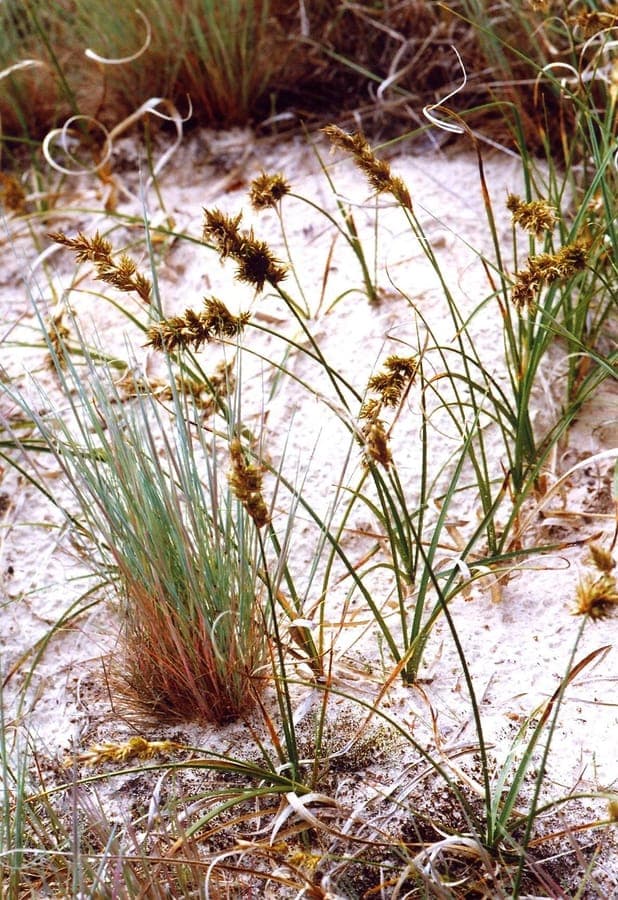
Christian Fischer / CC BY-SA 3.0, via Wikimedia Commons
German-sarsaparilla: complete guide
Carex arenaria
Want to see German-sarsaparilla: complete guide in your garden?
1 minute, no credit card
Overview
Carex arenaria, commonly known as German-sarsaparilla, is a tough, clump-forming sedge native to coastal dunes and sandy heaths across Northwest Europe. Found from Ireland to the Baltic states, it thrives in harsh, dry conditions where few other plants survive. In cultivation, it's prized for its silvery-green, arching foliage and ability to spread slowly via rhizomes, forming dense mats that suppress weeds and stabilise light soils.
This isn't a flashy plant, but a reliable workhorse in the garden. It stays low, looks good year-round, and asks for almost nothing in return. Ideal for gardeners tired of high-maintenance borders, Carex arenaria fits perfectly in naturalistic designs, gravel gardens, or as a grassy alternative to lawn in dry spots. On gardenworld.app, you can design a layout that uses Carex arenaria to unify sunny, sandy areas with texture and movement.
Appearance & bloom cycle
German-sarsaparilla grows 20–30 cm tall with a spread of 40–60 cm. The narrow, ribbon-like leaves are 2–4 mm wide and have a soft, silvery sheen, especially in full sun. They arch gracefully outward, creating a fountain-like effect. In winter, the foliage turns golden-brown but remains upright, adding visual interest during colder months.
Flowering occurs from April to June. The blooms are modest-small, greenish-brown spikes rising just above the foliage. They're not showy, but they add subtle structure. After flowering, dark brown achenes develop, though these are rarely noticeable. The real appeal lies in the plant's texture and resilience, not its flowers.
Ideal location
Full sun is best for tight growth and vivid colour. It tolerates light shade, but in deeper shade, the foliage becomes looser and greener. Choose a spot with excellent drainage-slopes, rock gardens, or dry borders work well. It's excellent for coastal gardens due to its salt and wind tolerance.
Avoid wet or heavy clay soils. This sedge evolved in dunes, so it expects dry, airy conditions. If your garden mimics that-sandy, exposed, and low in nutrients-you've found its sweet spot. On gardenworld.app, you can simulate microclimates to see if your garden suits German-sarsaparilla's preferences.
Soil requirements
German-sarsaparilla prefers sandy, well-drained soils with a pH between 5.5 and 7.0. It thrives in poor, low-fertility conditions and actually performs worse in rich soils, where it can become floppy. Avoid organic-heavy amendments-this isn't a plant that wants feeding.
If your soil is heavy, mix in coarse sand or fine gravel to improve drainage. A top dressing of grit helps reduce moisture retention around the crown, preventing rot. Raised beds or mounds are excellent options in less-than-ideal conditions.
Free design
Want to see German-sarsaparilla: complete guide in your garden? Make a free design now.
Watering
Once established, Carex arenaria is extremely drought-tolerant. Water regularly in the first growing season, especially during dry spells. After that, it rarely needs supplemental irrigation, even in prolonged droughts.
Overwatering is a bigger risk than underwatering. Wet soil, especially in winter, can lead to root rot. Water deeply but infrequently to encourage deep rooting. Avoid overhead watering if possible, as damp foliage in humid conditions can encourage fungal issues.
Pruning
Minimal pruning is needed. In late winter or early spring (February to March), trim back old, tattered, or brown foliage to make way for fresh growth. Use hand shears-never a mower-as the plant is too delicate.
Cut only the top layer, leaving the base intact. If the plant spreads beyond its bounds, lift and divide congested clumps. Replant or share the divisions, or discard them.
Maintenance calendar
- Jan: Check for winter damage; leave old foliage for insulation
- Feb: Begin light pruning of dead leaves
- Mar: Complete cutback; monitor for new growth
- Apr: Flowers emerge; no feeding required
- May: Peak bloom; check for weeds between clumps
- Jun: Flowering ends; no action needed
- Jul–Sep: Dormant period; no maintenance
- Oct: Assess spread; divide if necessary
- Nov: Leave foliage for winter protection
- Dec: Dormancy; minimal care
Winter hardiness
Hardy in USDA zones 5–9, German-sarsaparilla handles cold winters with ease. In the UK, Ireland, and most of continental Europe, it needs no protection. Foliage may brown in harsh winters but rebounds strongly in spring.
No mulch is required-the plant insulates itself with its own leaves. Avoid cutting back in autumn; wait until late winter to avoid exposing the crown to freezing.
Companion plants
Pair Carex arenaria with drought-loving plants like Thymus vulgaris, Sedum 'Autumn Joy', or Stachys byzantina. It blends well with low heathers (Calluna vulgaris) or other sand-tolerant grasses like Festuca ovina.
Use it as a soft contrast to bolder perennials or as a ground cover under shrubs. Avoid aggressive spreaders that might overwhelm it. For design ideas, check gardenworld.app to visualise combinations that highlight its texture and form.
Closing
German-sarsaparilla is a quiet achiever-unassuming but invaluable. It thrives where other plants fail, offers year-round structure, and asks for little in return. It's not for those seeking bold blooms, but perfect for gardeners who value resilience, texture, and low input.
You can find Carex arenaria at garden centres across the UK and Europe. In the UK, check local nurseries or online retailers. In the US, specialty grass nurseries often carry it. When planting, give it space to spread and full sun for best results. With the right start, it will serve your garden faithfully for years.
Want to see German-sarsaparilla: complete guide in your garden? Make a free design now.
Upload a photo, pick a style, and get a photorealistic design with plant list in under a minute.
No credit card required


Similar plants
Flat-stemmed club-rush: complete guide
Bolboschoenus planiculmis
Everything about Bolboschoenus planiculmis: growing conditions, watering, care, and use as a pond margin or wetland plant in garden design.
Great Plains flatsedge: complete guide
Cyperus lupulinus
Everything about Great Plains flatsedge (Cyperus lupulinus): growing conditions, care, garden uses, and ecological value. Tips for pond margins and dry sandy soils.
Golden beak sedge: complete guide
Rhynchospora corymbosa
Everything about golden beak sedge (Rhynchospora corymbosa): a dramatic tropical marginal for pond edges, bog gardens, and wet habitats.