
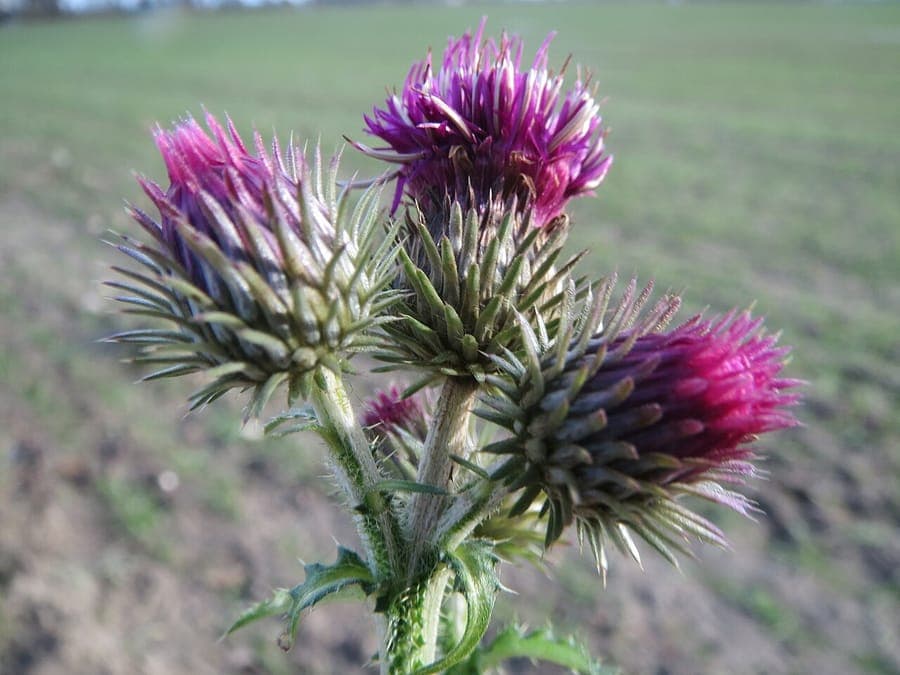
AnRo0002 / CC0, via Wikimedia Commons
Welted thistle: complete guide
Carduus acanthoides
Want to see Welted thistle: complete guide in your garden?
1 minute, no credit card
Overview
Carduus acanthoides, commonly known as welted thistle, is a rugged, spiny biennial or annual that thrives in disturbed soils, roadside verges, and dry field margins. Native across much of Europe and parts of Asia, it's a plant that commands attention - not just for its sharp spines, but for its ecological value. While often dismissed as a weed, this thistle supports a wide range of pollinators and adds vertical drama to naturalistic planting schemes.
On gardenworld.app, you can design a garden layout that embraces bold species like the welted thistle, using it as a structural anchor in wildflower meadows or gravel gardens.
Appearance & bloom cycle
Welted thistle grows 50–120 cm tall, with upright, branching stems that are deeply ribbed and often tinged with purple. The leaves are dark green, lance-shaped, and heavily lobed, with prominent yellow spines up to 1.5 cm long. The undersides are woolly, especially on younger foliage. In its first year, biennial plants form a low rosette; in the second, they bolt and flower.
Flowering occurs from July to September. The flower heads are 2–3 cm wide, deep pink to purple, and surrounded by spiny bracts. Each head contains dozens of tubular florets that attract bees, hoverflies, and butterflies. After blooming, the seeds develop a feathery pappus, allowing wind dispersal over long distances.
Ideal location
Full sun is essential - aim for at least 6 hours of direct sunlight daily. This plant dislikes shade and performs poorly in crowded or competitive plantings. It's ideal for dry, open areas: gravel gardens, roadside plantings, or wild corners of the garden where maintenance is minimal.
Avoid planting near walkways or play areas due to its sharp spines. If you're using gardenworld.app to plan your garden, use the hazard layer to flag spiky plants and position them safely.
Soil requirements
Welted thistle adapts to a wide range of soils but prefers well-drained, sandy, or loamy types with a pH from 5.5 to 7.5. It tolerates poor fertility and even compacted soils, but struggles in heavy clay or waterlogged conditions.
No fertiliser is needed - in fact, rich soils lead to weak, floppy growth. Choose a lean site, like a former building plot or a neglected border, to keep the plant compact and upright.
Watering
Once established, this thistle is highly drought tolerant. Young plants in their first season benefit from occasional watering during dry spells, especially in June and July.
Water at the base to prevent fungal issues. In average UK or US climates (zones 6–8), rainfall is usually sufficient after establishment. Use a rain barrel if possible - it's cost-effective and better for the plant.
Free design
Want to see Welted thistle: complete guide in your garden? Make a free design now.
Pruning
Pruning isn't required for health, but you may want to deadhead spent flowers to limit self-seeding. Cut the flower heads just below the base before the seeds disperse. Wear thick gloves and long sleeves - the spines are sharp and can cause irritation.
Leave some seed heads in place if you want to support birds like goldfinches, which feed on the seeds in late autumn.
Maintenance calendar
- January: No action needed.
- February: Clear old stems if they're in the way.
- March: Sow seeds directly on bare soil.
- April: Seedlings emerge; thin to 30–40 cm spacing.
- May: Weed around young plants.
- June: Water during dry periods.
- July: Flowers begin; monitor for pollinators.
- August: Peak bloom; deadhead if desired.
- September: Final flowering; collect seeds if saving.
- October: Leave some stems for wildlife or cut back.
- November: Clear debris if needed.
- December: Dormant.
Winter hardiness
As a biennial, Carduus acanthoides forms a rosette in year one and overwinters in USDA zones 6–8. The rosette is semi-evergreen and can survive light to moderate frost. In zone 6, mulching isn't necessary, but a light layer of leaf litter can help in colder microclimates.
Annual forms complete their life cycle in one season. New plants typically emerge from seed each spring, so don't expect the same individual to return.
Companion plants
Pair welted thistle with other tough, drought-tolerant species. Good matches include common knapweed (Centaurea nigra), oxeye daisy (Leucanthemum vulgare), and yarrow (Achillea millefolium). Grasses like sheep's fescue (Festuca ovina) add soft texture and won't compete aggressively.
Avoid delicate perennials or dense groundcovers - this thistle needs space and light. Use gardenworld.app's companion planting tool to test combinations and avoid overcrowding.
Closing
The welted thistle isn't a polite plant. It's spiky, bold, and spreads with ease. But in the right setting - a sunny, low-fertility patch where wildness is welcomed - it becomes a powerhouse for biodiversity. With minimal care and real visual impact, it's a plant worth considering for gardeners who value function as much as form.
Find seeds at garden centres like those from Intratuin, Gamma, OBI, Hornbach, Truffaut, or Jardiland, or look for native wildflower mixes online. Once you've picked your plants, upload them to gardenworld.app to visualise how they'll grow together over the seasons.
Want to see Welted thistle: complete guide in your garden? Make a free design now.
Upload a photo, pick a style, and get a photorealistic design with plant list in under a minute.
No credit card required


Similar plants
Calendula stellata: complete guide
Calendula stellata
Complete guide to Calendula stellata, the star-flowered marigold from Sicily: location, soil, watering and companion planting tips.
Korean chrysanthemum: complete guide
Chrysanthemum x rubellum
Chrysanthemum x rubellum is a hardy autumn perennial with single pink to copper flowers from August to November. Care and combinations.
Helianthus divaricatus: complete guide
Helianthus divaricatus
Helianthus divaricatus is a North American woodland sunflower with yellow summer blooms, ideal for naturalistic borders and shady edges.