
Ermell / CC BY-SA 4.0, via Wikimedia Commons
Meadow cress: complete guide
Cardamine pratensis
Want to see Meadow cress: complete guide in your garden?
1 minute, no credit card
Overview
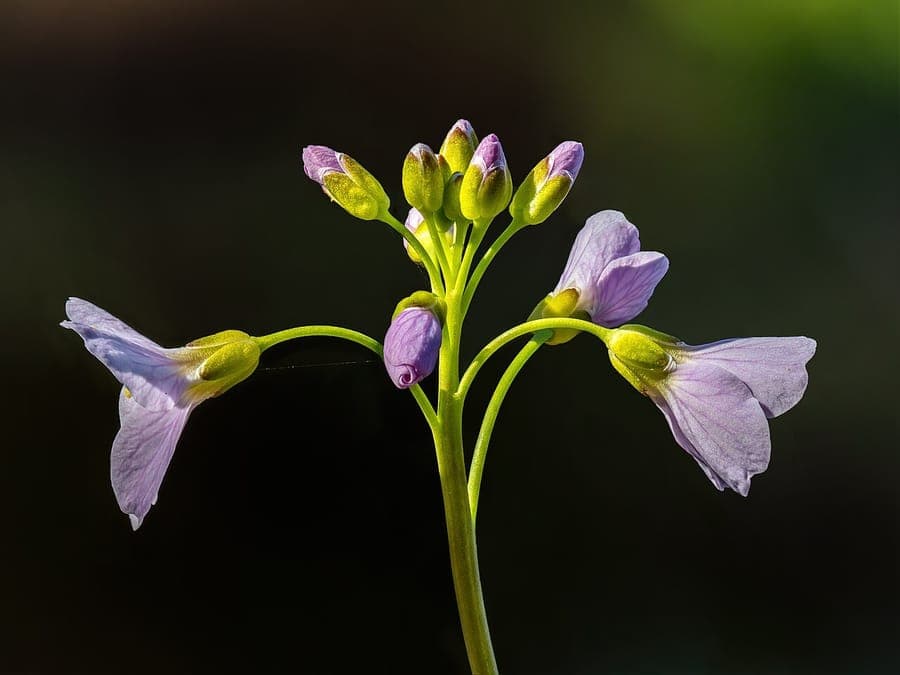
Meadow cress (Cardamine pratensis) is a graceful, early-flowering perennial that naturally thrives in damp meadows, ditch banks, and open woodland edges. Native to much of Europe and parts of western Asia, it's a valuable addition to wildlife gardens, damp borders, and naturalistic planting schemes. Reaching 15–30 cm in height, it produces delicate pink to white flowers from mid-March to late May, making it one of the first signs of spring in cooler climates. As a member of the Brassicaceae family, it's related to wallflowers, rocket, and watercress, but it's grown purely for its ornamental and ecological value.
On gardenworld.app, you can design a planting plan that works with the natural rhythm of Meadow cress, helping you place it where it'll thrive with minimal fuss.
Appearance & bloom cycle
The plant forms a low clump of deeply toothed, bright green basal leaves, with upright flowering stems bearing loose clusters of four-petalled flowers. Blooms are typically soft pink, though pure white forms exist. Each flower measures about 1–2 cm across, with a subtle, sweet fragrance that attracts early pollinators.
Flowering begins in early to mid-spring (late March in mild zones, April in colder areas) and lasts 4–6 weeks. Because plants bloom slightly out of sync, planting in groups of 10 or more ensures a longer visual display. After flowering, the foliage dies back by early summer, entering dormancy until the next season.
Ideal location
Meadow cress prefers partial shade to dappled sunlight-think under deciduous trees like birch or alder where light increases in spring before the canopy closes. It needs a light level of around 6/10, meaning 4–5 hours of indirect or morning sun daily. Full sun is acceptable only in consistently moist, cool sites such as north-facing slopes or near ponds.
Avoid hot, dry south-facing spots. In exposed gardens, position it behind taller perennials like Iris pseudacorus or Carex species to provide light shade during the afternoon. Use gardenworld.app to map your garden's light patterns and find the best spot for this moisture-loving plant.
Soil requirements
This plant thrives in moist, humus-rich, neutral to slightly alkaline soil (pH 7.0–7.5). It struggles in sandy, drought-prone soils or acidic conditions below pH 6.5. The key is consistent moisture-avoid letting the soil dry out, especially during spring growth.
Improve heavy clay soils with well-rotted leaf mould or garden compost. If your soil is too acidic, lightly amend with dolomitic lime, but test first. Meadow cress does not tolerate waterlogged conditions for long, so ensure the site has decent drainage even when wet.
Free design
Want to see Meadow cress: complete guide in your garden? Make a free design now.
Watering
From emergence in late winter to the end of flowering, keep the soil evenly moist. During dry spells in March or April, water weekly, preferably with rainwater. Tap water with high lime content can affect soil pH over time.
Once flowering finishes and foliage begins to yellow, reduce watering. The plant goes dormant in summer, so overwatering then can promote rot. Still, never let the root zone dry out completely, especially in container plantings or sandy soils.
Pruning
Pruning is minimal. After blooming, cut back spent flower stems to ground level to prevent excessive self-seeding if you prefer a neater look. However, allowing a few plants to set seed encourages natural spread, which works well in wildflower meadows or informal borders.
Do not cut back healthy foliage until it yellows naturally-this allows the plant to store energy in its roots for next year's growth.
Maintenance calendar
- January: Check for early shoots; protect from frost if necessary.
- February: Loosen soil around clumps; add compost.
- March: Begin regular watering; watch for slugs.
- April: Peak bloom; deadhead selectively.
- May: Finish deadheading; allow some seed heads to mature.
- June: Foliage dies back; reduce watering.
- July–August: Dormant phase-no care needed.
- September: Divide overcrowded clumps if desired.
- October–December: Leave undisturbed; mulch lightly in cold zones.
Winter hardiness
Meadow cress is hardy in USDA zones 4–8. It survives freezing temperatures with no protection, relying on underground rhizomes to regrow each spring. In zone 4, a light mulch of leaf litter or straw helps young plants endure harsh winters. In milder zones (7–8), it often stays semi-evergreen.
Avoid piling mulch too thickly-this can trap moisture and lead to crown rot.
Companion plants
Pair Meadow cress with other spring ephemerals: Primula elatior, Anemone blanda, and early ferns like Athyrium filix-femina. It also works well with moisture-loving grasses such as Deschampsia cespitosa or Carex elata 'Aurea'.
Avoid planting near aggressive spreaders like bamboo or mint, which will outcompete it for water and space.
Closing
Meadow cress brings quiet elegance and early-season biodiversity to the garden. It's low-maintenance, supports pollinators, and fits beautifully into naturalistic designs. Plant it in drifts, keep the soil damp, and let it weave its subtle charm into your spring landscape.
You can find Meadow cress at most garden centres in early spring, especially those focusing on native or wildlife-friendly plants. Look for locally sourced stock to support regional ecotypes.
Want to see Meadow cress: complete guide in your garden? Make a free design now.
Upload a photo, pick a style, and get a photorealistic design with plant list in under a minute.
No credit card required


Similar plants
Brassica cretica: complete guide
Brassica cretica
Brassica cretica, the Cretan cabbage, grows wild on Aegean cliffs. Discover how to grow this drought-tolerant, yellow-flowered Mediterranean perennial.
Corsican cabbage: complete guide
Brassica insularis
Corsican cabbage is a rare Mediterranean rock cabbage with white flowers and blue-green leaves. Location, soil and winter protection.
Prostrate cabbage: complete guide
Brassica procumbens
Prostrate cabbage is a creeping North African cliff plant with yellow flowers. Discover location, soil type and winter protection.