
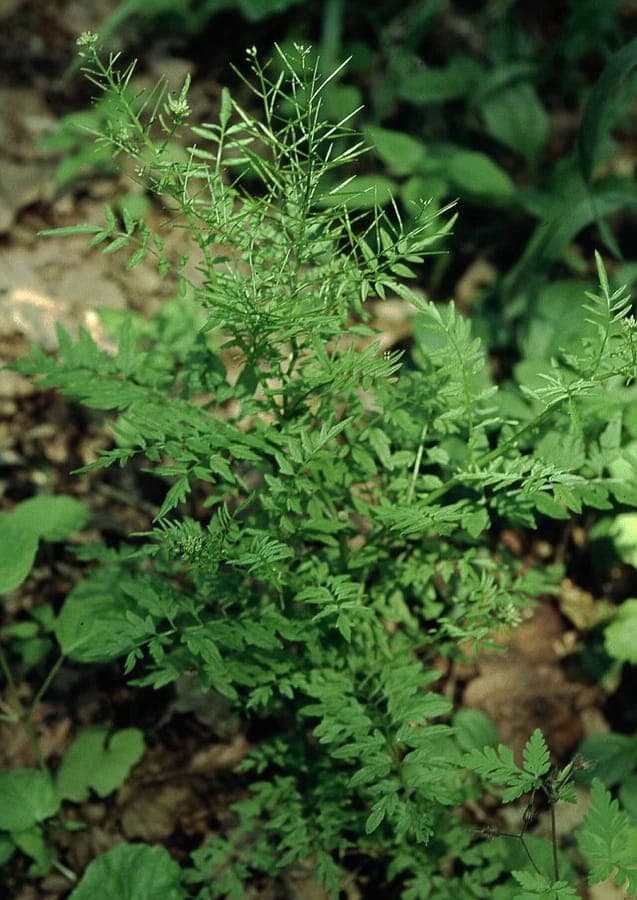
Wikimedia Commons / CC BY-SA 3.0, via Wikimedia Commons
Narrow-leaf bittercress: complete guide
Cardamine impatiens
Want to see Narrow-leaf bittercress: complete guide in your garden?
1 minute, no credit card
Overview
Narrow-leaf bittercress (Cardamine impatiens) is a delicate, herbaceous perennial that thrives in the quiet corners of woodlands and shaded gardens. A member of the Brassicaceae family, it's native to temperate regions across Europe and parts of Asia, including the Baltic States, Austria, and regions of northern China. In gardens, it's often seen popping up in early spring beneath deciduous trees, where it enjoys the brief window of sunlight before the canopy closes.
This plant isn't showy, but it plays a quiet, important role in the garden ecosystem. It's one of the first herbs to bloom, offering nectar to early pollinators like hoverflies and small bees. Its lifecycle is short-typically from March to July-but during that time, it adds subtle charm to naturalistic planting schemes. The name 'impatiens' refers not to its temperament, but to its explosive seed pods that burst open when touched, scattering seeds several feet.
If you're designing a woodland garden, consider using gardenworld.app to map out planting zones that support native spring ephemerals like Narrow-leaf bittercress.
Appearance & bloom cycle
The plant grows 15–40 cm tall, with slender, branching stems and pinnately divided leaves. The leaflets are narrow, lance-shaped, and coarsely toothed, giving the foliage a feathery look. Lower leaves have longer petioles, while upper ones clasp the stem more tightly.
Flowers appear from March to June, depending on local climate. Each bloom is small (8–12 mm), with four pale greenish-white to whitish-yellow petals arranged in loose racemes. They may not grab attention, but up close, they have a quiet elegance. The flowering period peaks in April, often coinciding with the emergence of daffodils and early primroses.
After pollination, slender seed pods (siliques) develop and lengthen. When mature, they twist and explode at the slightest disturbance-hence the common French name 'Herbe au Diable' (Devil's herb). This trait allows the plant to self-seed vigorously in moist, undisturbed areas.
Ideal location
Narrow-leaf bittercress prefers partial to full shade, ideally under open-canopy deciduous trees like ash, birch, or hornbeam. A light level of 5 out of 10 (dappled shade) is ideal. Too much sun, especially in spring afternoons, dries out the soil too quickly and shortens its growing season.
It works well in woodland gardens, beneath shrubs, or along the north side of buildings where moisture lingers. Avoid south-facing slopes or hot, dry borders. The plant is happiest where leaf litter accumulates naturally, mimicking its native forest floor habitat.
Use gardenworld.app to assess your garden's light patterns and identify shaded microclimates perfect for spring ephemerals.
Free design
Want to see Narrow-leaf bittercress: complete guide in your garden? Make a free design now.
Soil requirements
This species thrives in moist, humus-rich loam or sandy loam with a pH between 6.5 and 7.0. The soil should drain well but retain moisture-think of the damp, crumbly texture of forest soil. Avoid heavy clay or dry, sandy soils unless amended with organic matter.
Before planting, work in 5–8 cm of well-rotted leaf compost or garden compost. This not only improves moisture retention but also provides the slow-release nutrients the plant needs. Steer clear of high-nitrogen fertilizers, which can promote excessive leaf growth at the expense of flowering.
Watering
Consistent soil moisture is key. Water weekly during dry spells in spring, especially if the plant is growing in a raised bed or near thirsty tree roots. Use a watering can with a rose attachment to avoid disturbing the soil or triggering premature seed pod explosion.
Once the plant dies back in early summer, watering is no longer needed. The seeds lie dormant until the following spring.
Pruning
No pruning is required. The plant completes its lifecycle naturally by midsummer. If you want to limit self-seeding, deadhead the flower stalks just after blooming but before seeds mature. Wear gloves-handling the pods can cause them to burst and scatter seeds.
Maintenance calendar
- Jan: Dormant. No action needed.
- Feb: Watch for emerging shoots. Avoid walking on patches.
- Mar: Growth begins. Keep soil moist.
- Apr: Peak bloom. Protect from heavy foot traffic.
- May: Flowers fade. Monitor seed development.
- Jun: Cut back seed stalks if self-seeding is unwanted.
- Jul: Plant dies down. No further care.
- Aug–Dec: Dormant phase. Add leaf litter or compost in autumn.
Winter hardiness
Hardy in USDA zones 5–8. In zone 7 and above, the plant survives as seed in the soil. No mulch or protection is necessary. It reappears reliably each spring when conditions are right.
Companion plants
Pair Narrow-leaf bittercress with other spring-woodland species that share its growing conditions:
- Erythronium dens-canis (Dog's-tooth violet)
- Pulmonaria saccharata (Bethlehem sage)
- Hepatica nobilis
- Primula elatior (Oxlip)
- Carex sylvatica (Wood sedge)
Avoid aggressive spreaders like mint or Lamium maculatum, which can overwhelm it.
Closing
Narrow-leaf bittercress won't win any beauty contests, but it's a thoughtful addition to any shade garden that values ecology over spectacle. It's low-maintenance, supports early pollinators, and integrates seamlessly into naturalistic designs.
You might find it at garden centres in early spring, though it's not always stocked. Try specialist nurseries or seed suppliers. In the UK, check with local native plant retailers; in the US, look for woodland plant sales.
With the right conditions-moist soil, dappled shade, and minimal disturbance-this humble herb will return year after year, quietly enriching your garden's biodiversity.
Want to see Narrow-leaf bittercress: complete guide in your garden? Make a free design now.
Upload a photo, pick a style, and get a photorealistic design with plant list in under a minute.
No credit card required


Similar plants
Brassica cretica: complete guide
Brassica cretica
Brassica cretica, the Cretan cabbage, grows wild on Aegean cliffs. Discover how to grow this drought-tolerant, yellow-flowered Mediterranean perennial.
Corsican cabbage: complete guide
Brassica insularis
Corsican cabbage is a rare Mediterranean rock cabbage with white flowers and blue-green leaves. Location, soil and winter protection.
Prostrate cabbage: complete guide
Brassica procumbens
Prostrate cabbage is a creeping North African cliff plant with yellow flowers. Discover location, soil type and winter protection.