
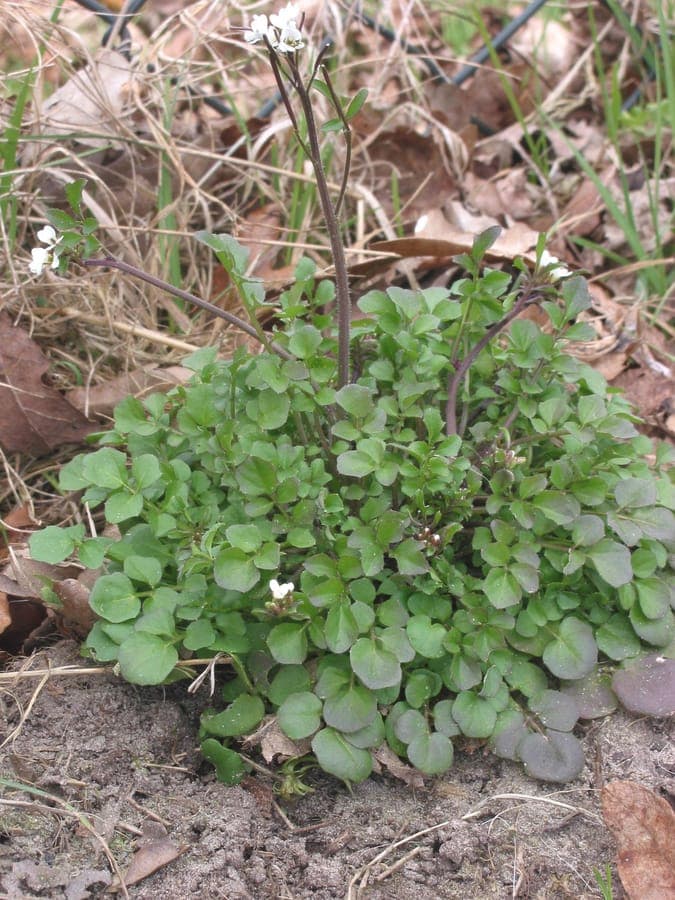
Rasbak / CC BY-SA 3.0, via Wikimedia Commons
Common bittercress: complete guide
Cardamine hirsuta
Want to see Common bittercress: complete guide in your garden?
1 minute, no credit card
Overview
Common bittercress, or Cardamine hirsuta, is a small, fast-growing herb in the Brassicaceae family you'll often spot in gardens, cracks in paving, or between plant pots. Native across much of Europe and parts of Asia, it's a familiar sight in UK gardens from late winter through spring. While many gardeners treat it as a weed, its neat mounds of foliage and tiny white flowers can add texture to informal spaces. At just 5–15 cm tall, it fits well in crevices, rockeries, or as a temporary ground cover. On gardenworld.app, you can design a planting scheme that either embraces or suppresses this quick colonizer.
Appearance & bloom cycle
This herb forms compact rosettes of pinnate leaves, each with 2–6 pairs of oval to lance-shaped leaflets. The foliage is bright to mid-green, often with a hint of purple on the stems, and slightly hairy. From February to June, depending on local conditions, it sends up slender flowering stems topped with clusters of small white flowers-four petals, classic crucifer style. After flowering, the seed pods (siliques) explode violently, flinging seeds up to a metre away. This explosive dispersal means a single plant can spawn dozens in just weeks. Multiple generations can appear in one season under moist, mild conditions.
Ideal location
Cardamine hirsuta thrives in partial shade with a light rating of 5 out of 10. It prefers sheltered, damp spots-think beneath shrubs with open canopies, along damp walls, or in the joints of patio stones where moisture collects. Full sun works only if the soil stays consistently moist. Avoid hot, dry borders. It's common in greenhouses and on nursery benches, where overwintering pots provide perfect germination conditions. Use gardenworld.app to map microclimates in your garden and predict where bittercress is likely to pop up next.
Soil requirements
It grows best in moist, well-drained soil with a pH between 5.5 and 6.5. Rich, loamy garden soil with organic matter suits it perfectly, but it's adaptable-even thriving in poor or compacted soils if moisture is sufficient. In containers, mix multipurpose compost with a bit of perlite or horticultural sand to improve drainage. Avoid waterlogged conditions, which can rot the shallow roots. The plant's ability to grow in cracks shows how little it demands, but for controlled growth, amend soil with compost to encourage competition from desirable plants.
Watering
Keep the soil consistently moist, especially during dry spells in late winter and early spring. Water container-grown plants when the top inch of soil feels dry. In garden beds, natural rainfall is usually enough, but monitor during extended dry periods. Overhead watering is fine, but avoid saturating the crown. In greenhouse settings, where it often appears uninvited, reduce watering frequency once seedlings are removed to discourage re-emergence.
Free design
Want to see Common bittercress: complete guide in your garden? Make a free design now.
Pruning
Pruning isn't needed for health, but cutting back flowering stems before seed set is crucial if you want to limit spread. Use sharp scissors or pinch stems off by hand. Regular deadheading can extend the display and reduce seeding. If using it as a temporary filler, trim back after flowering to tidy the area. Always dispose of seed-bearing material in the bin-don't compost, unless you're certain your heap gets hot enough to kill seeds.
Maintenance calendar
- Jan: Watch for early seedlings in mild, sheltered areas.
- Feb: Growth accelerates. Begin monitoring for flower buds.
- Mar: Peak bloom. Remove flower stems to prevent seeding.
- Apr: Continue cutting back. Check pots and greenhouses.
- May: Final flush of flowers. Keep beds weeded.
- Jun: Most plants die back. Clear dead foliage.
- Jul: Dormant period. Minimal intervention needed.
- Aug: Occasional new seedlings in damp spots.
- Sep: Germination resumes with autumn rains.
- Oct: Monitor for new rosettes. Thin if overcrowded.
- Nov: Cool, moist conditions favour growth.
- Dec: Slow growth in mild winters. Check for rosettes.
Winter hardiness
Hardy in USDA zones 6–9, common bittercress survives UK winters easily. It often grows as a winter annual or biennial, germinating in autumn or early spring. Rosettes persist through frost, though hard freezes may damage top growth. Seeds lie dormant in soil until conditions improve. In colder zones, mulch can protect overwintering plants, but it's rarely necessary.
Companion plants
Pair bittercress with early spring bulbs like Chionodoxa or Scilla, or use it as a filler among hellebores and pulmonarias. It works well in woodland edge plantings with hostas or ferns, provided moisture is steady. Avoid pairing with slow-growing alpines or succulents, which it can quickly overwhelm. In containers, combine with pansies or small primroses for a fresh spring look.
Closing
Common bittercress walks the line between charming little herb and persistent weed. Whether you welcome it or wage war, understanding its life cycle helps. Remove it before it seeds, or embrace its fleeting beauty in low-traffic areas. Use mulch or dense ground covers to reduce bare soil where it likes to germinate. Garden centres like those in the UK often unknowingly spread it via potted plants-always check root balls before planting out. For a strategic approach to managing self-seeders, visit gardenworld.app to create custom garden plans and track seasonal growth patterns. With the right balance, even bittercress can have its place.
Want to see Common bittercress: complete guide in your garden? Make a free design now.
Upload a photo, pick a style, and get a photorealistic design with plant list in under a minute.
No credit card required


Similar plants
Brassica cretica: complete guide
Brassica cretica
Brassica cretica, the Cretan cabbage, grows wild on Aegean cliffs. Discover how to grow this drought-tolerant, yellow-flowered Mediterranean perennial.
Corsican cabbage: complete guide
Brassica insularis
Corsican cabbage is a rare Mediterranean rock cabbage with white flowers and blue-green leaves. Location, soil and winter protection.
Prostrate cabbage: complete guide
Brassica procumbens
Prostrate cabbage is a creeping North African cliff plant with yellow flowers. Discover location, soil type and winter protection.