
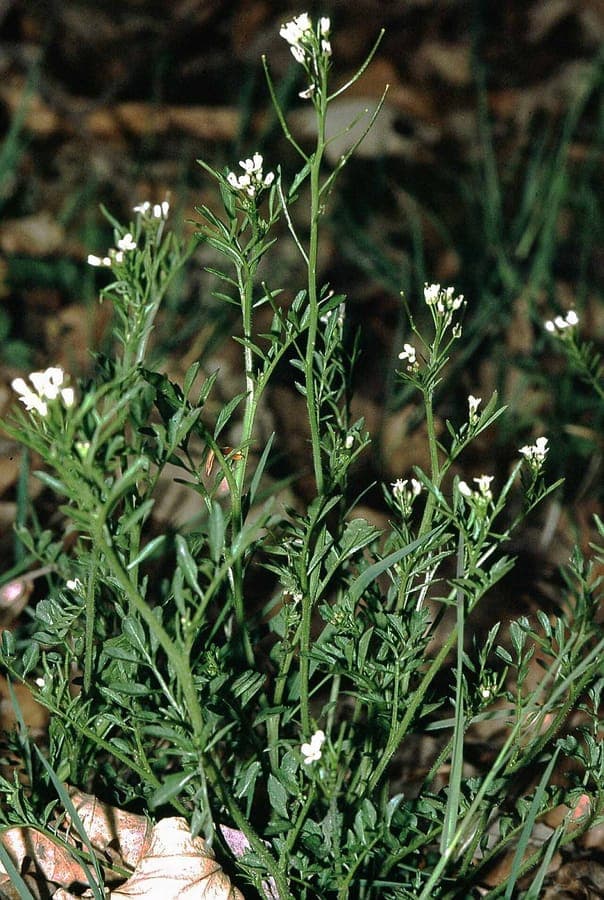
Wikimedia Commons / CC BY-SA 3.0, via Wikimedia Commons
Greater bittercress: complete guide
Cardamine flexuosa
Want to see Greater bittercress: complete guide in your garden?
1 minute, no credit card
Overview
Cardamine flexuosa, commonly known as greater bittercress, is a herbaceous perennial in the Brassicaceae family. Native to woodlands across Central and Southern Europe, it thrives in moist, shaded environments like forest edges, hedgerows, and damp slopes. In the UK and Ireland, it's often found in deciduous woods, where it forms loose colonies in spring. While it self-seeds readily, it's not invasive and integrates well into naturalistic planting schemes.
For gardeners aiming for a relaxed, cottage-style or woodland aesthetic, greater bittercress brings subtle charm without demanding much. On gardenworld.app, you can design a shaded planting layout that highlights this plant's airy structure and early-season presence.
Appearance & bloom cycle
Greater bittercress grows 20–40 cm tall with slender, often zigzagging stems – a trait reflected in its species name 'flexuosa'. The leaves are pinnate, composed of 3 to 7 oval to lance-shaped leaflets with a slightly toothed margin. Basal leaves form a low rosette, while upper leaves are smaller and less divided.
From April to June, the plant produces small, four-petaled flowers in shades of white to pale pink. Each bloom is about 1 cm across and arranged in loose racemes at the stem tips. The flowering period aligns with early spring, making it a valuable nectar source for emerging pollinators. After blooming, narrow seed pods (siliques) develop and burst open when ripe, flinging seeds up to a meter away – a clever adaptation to spread without animal help.
Ideal location
This plant prefers partial to full shade, scoring a 4 on the light scale (1–10). It performs best under deciduous trees like oak or hazel, where dappled light filters through in spring before leaf canopy closure. Avoid full sun, especially in dry soils, as plants will wilt and may die back prematurely.
Use greater bittercress along shaded borders, under shrubs, or in wildflower corners. It pairs beautifully with spring bulbs like daffodils or bluebells, emerging as bulbs fade. For layout ideas, gardenworld.app offers visual planning tools to position this plant effectively in layered shade gardens.
Soil requirements
Cardamine flexuosa thrives in moist, humus-rich, well-drained soil with a neutral pH of 7.0–7.5. It tolerates clay-loam and silt but struggles in sandy or highly acidic soils. The key is consistent moisture without waterlogging.
Before planting, enrich the soil with leaf mould or well-rotted compost. This improves water retention and adds vital nutrients. Avoid compacted soils – roots need room to spread. If your garden has poor drainage, consider raising the bed slightly or planting on a gentle slope.
Free design
Want to see Greater bittercress: complete guide in your garden? Make a free design now.
Watering
Keep the soil consistently moist, especially from March through June. In wet springs, supplemental watering isn't needed. But during dry spells in April or May, give plants a weekly soak. Use rainwater when possible, as tap water can raise soil pH over time.
Mulch with 2–3 cm of leaf litter or composted bark to conserve moisture and suppress weeds. Replenish mulch annually in autumn to maintain soil health.
Pruning
Pruning isn't essential, but deadheading after flowering helps control self-seeding. Cut back spent flower stems to the base if you don't want seedlings popping up in unwanted spots. The basal foliage often persists into early summer but tends to yellow in hot, dry weather.
You can trim back tired leaves for neatness, but leave some cover to protect the crown and support soil life. Avoid cutting too low – the plant resprouts from the base.
Maintenance calendar
- Jan: Dormant. No action needed.
- Feb: Check for early growth, especially in mild areas.
- Mar: Apply a thin layer of compost. Monitor soil moisture.
- Apr: Flowers emerge. Watch for slugs.
- May: Peak bloom. Mulch if not done earlier.
- Jun: Deadhead to limit seed spread.
- Jul: Plant dies back. No care required.
- Aug: Dormant. Water only in prolonged drought.
- Sep: Prepare soil with organic matter.
- Oct: New rosettes form. Leaves drop around plants.
- Nov: Leave debris for winter protection.
- Dec: Fully dormant.
Winter hardiness
Greater bittercress is hardy in USDA zones 6–8. It survives UK and Irish winters without protection. New shoots appear as early as February in mild regions. In colder zones, top growth may die back, but the root system remains viable.
Old leaves insulate the crown – leave them until spring cleanup. Avoid disturbing the soil in winter to protect developing buds.
Companion plants
Combine with other shade-tolerant perennials like Erythronium, Helleborus, or Tiarella. Early spring bulbs such as crocus or snowdrops work well, as their foliage fades as bittercress fills in.
Avoid aggressive spreaders like mint or ground elder. Instead, opt for gentle companions that coexist without competition.
Closing
Greater bittercress is a quiet achiever – unassuming but ecologically valuable. It fills the spring gap with minimal effort and supports biodiversity. While not a focal point, it adds texture and movement to shaded areas.
Plant in groups of 10 or more for impact. You'll find it at garden centres across the UK, often sold as part of wildflower or woodland plant collections. Be mindful of its self-seeding nature – it's a plus in natural areas, but may need managing in formal beds.
For tailored planting plans, visit gardenworld.app to create a garden design where greater bittercress thrives alongside complementary species.
Want to see Greater bittercress: complete guide in your garden? Make a free design now.
Upload a photo, pick a style, and get a photorealistic design with plant list in under a minute.
No credit card required


Similar plants
Brassica cretica: complete guide
Brassica cretica
Brassica cretica, the Cretan cabbage, grows wild on Aegean cliffs. Discover how to grow this drought-tolerant, yellow-flowered Mediterranean perennial.
Corsican cabbage: complete guide
Brassica insularis
Corsican cabbage is a rare Mediterranean rock cabbage with white flowers and blue-green leaves. Location, soil and winter protection.
Prostrate cabbage: complete guide
Brassica procumbens
Prostrate cabbage is a creeping North African cliff plant with yellow flowers. Discover location, soil type and winter protection.