
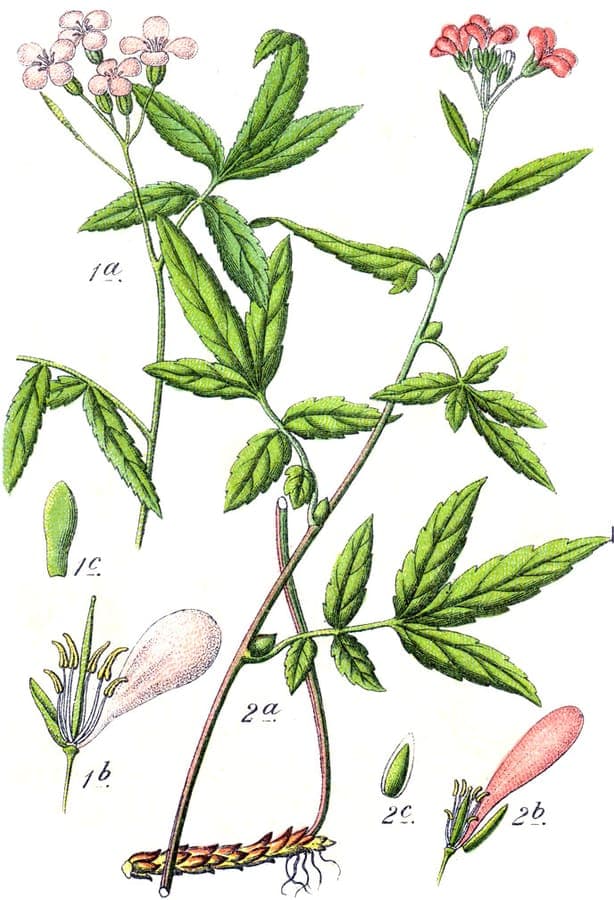
Johann Georg Sturm (Painter: Jacob Sturm) / Public domain, via Wikimedia Commons
Coralroot bittercress: complete guide
Cardamine bulbifera
Want to see Coralroot bittercress: complete guide in your garden?
1 minute, no credit card
Overview
Coralroot bittercress (Cardamine bulbifera) is a modest yet fascinating herbaceous perennial that brings quiet charm to shaded corners in early spring. Native to woodlands across Central and Eastern Europe, it thrives in cool, moist environments and spreads gently through bulbils - small, aerial bulblets that form along the upper stems. If you're aiming for a naturalistic garden design, this plant fits right in. On gardenworld.app, you can create a planting plan that highlights seasonal rhythm and understory layering, perfect for species like Coralroot bittercress.
Typically reaching 30–50 cm in height, it forms loose colonies over time, especially in rich, humus-filled soil. It's not aggressive, but it does self-propagate via those bulbils and seeds, making it a reliable returner year after year. You won't often find it in big-box garden centres, but specialty nurseries or native plant suppliers sometimes carry it. In the UK or US, check independent garden centres that focus on woodland or shade-loving species.
Appearance & bloom cycle
From April into May, Coralroot bittercress produces delicate spikes of small, purple flowers. Each bloom has four petals arranged in a cross - a telltale sign of its Brassicaceae heritage. The flowers are soft in tone, ranging from pale violet to dusky pink, and appear in loose racemes at the stem tips.
After flowering, the plant develops its signature feature: clusters of small, brownish bulbils along the upper leaf axils. These bulbils drop easily and take root, allowing the plant to spread slowly. The leaves are pinnate, with 3–7 narrow leaflets, dark green above and paler beneath. By late summer, the foliage dies back completely, leaving no trace until the following spring.
Ideal location
This plant prefers dappled shade to partial shade - think under deciduous trees or along a north-facing border. A light rating of 3 out of 10 (where 10 is full sun) is ideal. Full sun, especially in warmer climates, will dry out the soil too quickly and stress the plant. Deep shade, on the other hand, delays flowering and reduces bulbil production.
It's perfect for woodland gardens, shaded rockeries, or naturalized areas beneath shrubs. Consider planting it where spring sunlight filters through before the tree canopy closes. On gardenworld.app, you can map light patterns across your garden to pinpoint the best microclimates for this and other shade-tolerant species.
Soil requirements
The soil should be consistently moist, well-drained, and rich in organic matter. A pH between 7.0 and 7.5 is optimal - slightly alkaline to neutral. If your soil is acidic, mix in some composted leaf mold or compost with a bit of lime. Avoid heavy clay unless amended with grit and organic material to improve drainage.
A humus-rich forest loam is the gold standard. Mulch annually with leaf litter or shredded bark to retain moisture and mimic natural conditions. Don't let the soil dry out during active growth - April through June is critical.
Free design
Want to see Coralroot bittercress: complete guide in your garden? Make a free design now.
Watering
Water regularly from March to June, especially if rainfall is below 25 mm per week. Aim for deep, infrequent watering - about 10 litres per square metre once a week during dry spells. Use a watering can with a rose attachment to avoid disturbing the soil surface.
Once the plant dies back in July, stop watering entirely. The underground rhizomes enter dormancy and don't require moisture until the next spring. Overwatering in summer can lead to rot, especially in poorly drained soils.
Pruning
No pruning is needed. Coralroot bittercress has a natural, airy habit that suits informal planting schemes. You can deadhead spent flowers if you want to limit spread, but leaving the stems intact allows the bulbils to mature and drop.
If you want to collect bulbils for propagation, cut the stems in late June when the bulbils are firm and brown. Store them in a cool, moist medium like peat-free compost or damp vermiculite until autumn planting.
Maintenance calendar
- Jan: Dormant. No action needed.
- Feb: Check soil moisture; top up mulch if needed.
- Mar: Watch for emerging shoots; keep soil moist.
- Apr: Active growth; flowering begins; maintain moisture.
- May: Peak bloom; bulbils start forming.
- Jun: Bulbils mature; collect or leave for natural spread.
- Jul: Foliage dies back; stop watering.
- Aug: Dormant; weed control only.
- Sep: Prepare soil; plant collected bulbils at 5 cm depth.
- Oct: Add fresh compost and leaf mulch.
- Nov: Leave fallen leaves in place for insulation.
- Dec: Dormant; no maintenance.
Winter hardiness
Coralroot bittercress is hardy to USDA zone 5 (-20°C). The rhizomes survive freezing temperatures under a protective layer of mulch. In milder zones (6–8), the plant may stay semi-evergreen, especially in sheltered spots.
No extra winter protection is needed, but young plants in their first year benefit from a light covering of leaves. Avoid disturbing the soil in winter - the bulbils and rhizomes are close to the surface.
Companion plants
Pair it with other spring ephemerals like Bloodroot (Sanguinaria), Hellebores, and Wood Anemone (Anemone nemorosa). These share similar soil and light needs and create a layered effect in early spring.
Good partners also include Lungwort (Pulmonaria), False Solomon's Seal (Maianthemum racemosum), and Wild Ginger (Asarum). Avoid competitive perennials that dry out the soil, like Daylilies or large Hostas.
Closing
Coralroot bittercress won't dominate your garden, and that's its strength. It's a subtle performer that adds texture and quiet beauty to shaded areas when little else is in bloom. With minimal care and the right conditions, it becomes a dependable part of your spring display. Plant in groups of 5–7 for a natural look. And remember, on gardenworld.app you can design a planting scheme that integrates this plant seamlessly with companions, bloom times, and seasonal transitions.
Want to see Coralroot bittercress: complete guide in your garden? Make a free design now.
Upload a photo, pick a style, and get a photorealistic design with plant list in under a minute.
No credit card required


Similar plants
Brassica cretica: complete guide
Brassica cretica
Brassica cretica, the Cretan cabbage, grows wild on Aegean cliffs. Discover how to grow this drought-tolerant, yellow-flowered Mediterranean perennial.
Corsican cabbage: complete guide
Brassica insularis
Corsican cabbage is a rare Mediterranean rock cabbage with white flowers and blue-green leaves. Location, soil and winter protection.
Prostrate cabbage: complete guide
Brassica procumbens
Prostrate cabbage is a creeping North African cliff plant with yellow flowers. Discover location, soil type and winter protection.