
Leo Michels / Public domain, via Wikimedia Commons
Large bittercress: complete guide
Cardamine amara
Want to see Large bittercress: complete guide in your garden?
1 minute, no credit card
Overview
Cardamine amara, commonly known as large bittercress, is a resilient perennial that thrives in cool, moist environments across central and eastern Europe. As a member of the Brassicaceae family, it shares traits with cresses and mustards, but unlike its edible relatives, this species is primarily valued for its ornamental and ecological role in the garden. It's not flashy, but it brings a quiet elegance to the late spring border, particularly in spots where few other plants succeed.
This species is a reliable indicator of fertile, consistently damp soil. If you see it growing wild, you can bet the ground is rich in organic matter and rarely dries out. That makes it a smart choice for poorly drained areas, low-lying gardens, or shaded corners near ponds. On gardenworld.app, you can design a moisture-loving planting scheme that integrates large bittercress seamlessly with other shade-tolerant perennials.
Appearance & bloom cycle
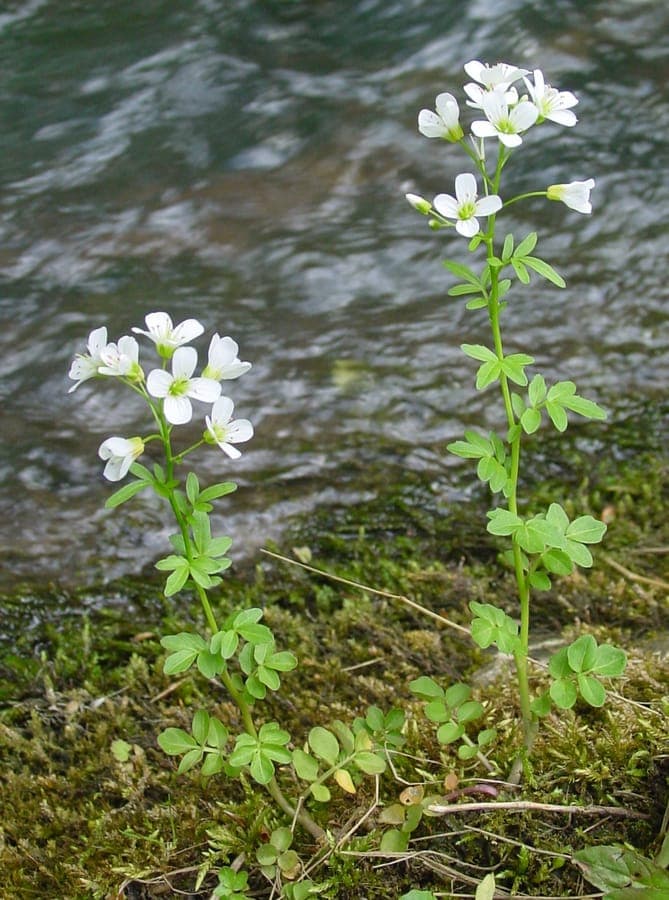
Large bittercress grows 30 to 60 cm tall, with upright, slightly branched stems and pinnate leaves composed of 5 to 9 oval to lance-shaped leaflets. The lower leaves form a basal rosette on long petioles, while upper leaves are shorter-stemmed and clasp the stem more closely. The foliage has a slightly ruffled texture and a fresh green hue that stands out in shaded areas.
Flowering occurs from April through June, peaking in May. The small, white flowers have four petals arranged in a cross-typical of the cabbage family-and are borne in loose racemes at the stem tips. Each flower is about 1 cm across, delicate but numerous, creating a soft cloud-like effect when massed. After blooming, slender seed pods (siliques) develop and split open to disperse seeds, allowing modest self-seeding in suitable conditions.
Though not aggressive, it can establish small colonies over time, especially in undisturbed, moist areas. Deadheading spent blooms can help control spread if desired.
Ideal location
Large bittercress prefers partial to full shade, scoring a 4 on the light scale (10 being full sun). It performs best under deciduous trees, along stream banks, or in shaded damp borders. Avoid full sun, especially in southern exposures-intense afternoon light will scorch the leaves and dry out the soil too quickly.
An east- or north-facing site is ideal, where morning light is gentle and the rest of the day remains cool and shaded. It also works well in rain gardens or near downspouts where water naturally collects.
Free design
Want to see Large bittercress: complete guide in your garden? Make a free design now.
Soil requirements
This plant demands consistently moist, humus-rich soil with a pH between 6.5 and 7.0. It tolerates clay and loamy soils well but struggles in sandy or fast-draining types. The key is moisture retention without waterlogging.
Before planting, amend the soil with well-rotted compost or leaf mould to boost organic content. Avoid high-nitrogen fertilisers, which encourage weak, floppy growth. A thin layer of organic mulch helps maintain moisture and suppress weeds.
Watering
Consistent moisture is non-negotiable. The soil should never dry out completely, especially during dry spells in late spring or early summer. Young plants are particularly vulnerable and need regular watering until established.
Use rainwater when possible-large bittercress is sensitive to chlorine and lime in tap water. Mulching with composted bark or leaf litter helps retain moisture and keeps roots cool.
Pruning
Pruning isn't essential, but cutting back spent flower stalks in early summer keeps the plant looking tidy and reduces self-seeding. If foliage begins to yellow or die back in midsummer, you can cut the plant down to ground level. It may produce a fresh flush of growth in early autumn, especially after rain.
Maintenance calendar
- Jan: Dormant; no action needed
- Feb: Check for early growth
- Mar: Prepare soil, add compost if needed
- Apr: Begin flowering; monitor moisture
- May: Peak bloom; watch for slugs
- Jun: Deadhead spent flowers
- Jul: Check for drought stress
- Aug: Water during dry periods
- Sep: Divide or transplant if desired
- Oct: Leave cut foliage as light mulch
- Nov: Dormancy begins
- Dec: Fully dormant
Winter hardiness
Large bittercress is hardy in USDA zones 5 to 8. In most of the UK and northern Europe, it survives winter without protection. The top growth dies back in autumn, but the root system remains viable and resprouts in spring. In harsher zones, a light mulch layer can prevent frost heave.
Companion plants
Pair large bittercress with other moisture-loving plants such as Carex elata 'Aurea', Filipendula ulmaria, Caltha palustris, or Ligularia. Early spring companions like Pulmonaria or Primula add colour contrast. Avoid drought-tolerant species like lavender or sedum.
Use gardenworld.app to visualise planting combinations that mimic natural damp woodland edges, blending texture and bloom time for year-round interest.
Closing
Large bittercress won't win any beauty contests, but for gardeners dealing with shady, wet areas, it's a dependable and graceful solution. It asks for little-just consistent moisture and cool roots-and repays with reliable spring blooms and natural charm. Find it at local garden centres or specialty nurseries. With the right conditions, it'll return year after year, quietly doing its job where other plants fail.
Want to see Large bittercress: complete guide in your garden? Make a free design now.
Upload a photo, pick a style, and get a photorealistic design with plant list in under a minute.
No credit card required


Similar plants
Brassica cretica: complete guide
Brassica cretica
Brassica cretica, the Cretan cabbage, grows wild on Aegean cliffs. Discover how to grow this drought-tolerant, yellow-flowered Mediterranean perennial.
Corsican cabbage: complete guide
Brassica insularis
Corsican cabbage is a rare Mediterranean rock cabbage with white flowers and blue-green leaves. Location, soil and winter protection.
Prostrate cabbage: complete guide
Brassica procumbens
Prostrate cabbage is a creeping North African cliff plant with yellow flowers. Discover location, soil type and winter protection.