
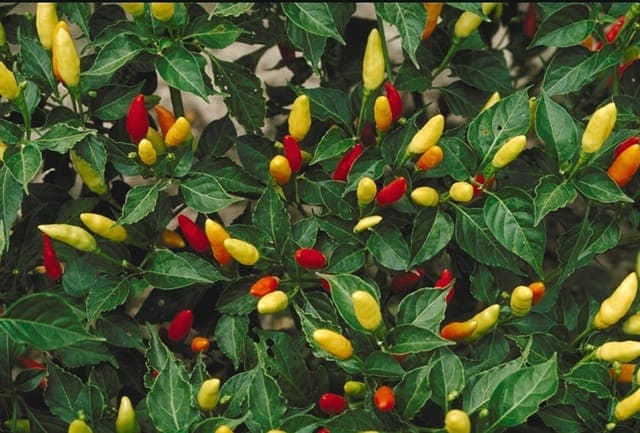
Unknown authorUnknown author / Public domain, via Wikimedia Commons
Capsicum frutescens: complete guide
Capsicum frutescens
Want to see Capsicum frutescens: complete guide in your garden?
1 minute, no credit card
Overview
Capsicum frutescens, known as bird pepper or tabasco pepper, is a productive perennial shrub native to Bolivia and Brazil. This plant is celebrated for its small yet intensely hot red fruits that register much higher on the Scoville scale than common bell peppers. The plant reaches 60-90 cm in height and produces hundreds of small, pointed peppers throughout the growing season.
Bird pepper is popular in hot cuisines worldwide and forms the basis of many traditional sauces and condiments. Gardenworld.app recommends this plant for gardeners who enjoy spicy flavors and want to grow their own chilies. With proper climate and care, bird pepper grows as a robust, highly productive plant.
Appearance and Bloom
Bird pepper forms a compact shrub with elongated, lance-shaped leaves. The plant typically reaches 60-90 cm in height, sometimes up to 120 cm. The stems are green to purple-tinted, especially in older growth.
Small, cream-colored flowers appear from May through September in successive waves. Each flower develops into a small green fruit that ripens to intense red. The fruits grow vertically upward and reach 4-5 cm in length. The Scoville scale rating for bird pepper is 50,000-100,000 units, much higher than jalapenos.
Ideal Location
Capsicum frutescens grows best in full sun with at least 8-10 hours of direct sunlight daily. The plant requires abundant light for maximum fruit production. Even slight light reduction from cloud cover can diminish fruit output.
Plant bird pepper in a sheltered location where the plant is protected from strong winds. The plant blooms and fruits better with warm nighttime temperatures (minimum 15 C). In temperate climates, both greenhouse and outdoor summer cultivation are possible, depending on local weather.
Soil and Nutrition
Capsicum frutescens grows best in nutrient-rich, well-draining soil. A mixture of 60% compost, 20% potting soil, and 20% perlite works well. The plant requires regular feeding for optimal growth and production.
The plant prefers acidic to neutral water (pH 6.0-6.8). In containers, nutrient-rich soil mix is essential; in open ground, 2-3 cm of compost can be added several times per season.
Feeding: during active growth, apply monthly potassium-rich fertilizer (for more fruits). Gardenworld.app recommends organic fertilizer for superior flavor.
Free design
Want to see Capsicum frutescens: complete guide in your garden? Make a free design now.
Watering and Moisture
Capsicum frutescens requires regular watering during the growing season but tolerates short dry periods. The plant signals water need when the top 2-3 cm of soil feels dry. In hot periods, daily watering may be necessary.
Avoid waterlogging, which can cause root rot. During rainy periods, drainage becomes important. In container cultivation, attention to drainage is essential; ensure bottom drainage holes are clear.
Water temperature: lukewarm water (15-20 C) is better than cold tap water.
Pruning and Training
Bird pepper naturally forms a compact shrub. Light pruning in May encourages branching and increased fruiting. Remove the top 10-15 cm of the stem; this stimulates two new side shoots.
With intensive fruit production, carefully remove some upper leaves to allow light to penetrate the center. This improves fruit ripening. Regularly remove yellow or diseased leaves.
Maintenance Calendar
May: Planting and light pruning June-September: Active growth; regular watering and feeding June-October: Flowering and fruit set; adjust feeding toward potassium August-October: Harvest ripe red fruits September-October: Fruit set declines November-April: Plant dies back or is removed (annual crop)
Winter Hardiness
Capsicum frutescens is not frost-hardy. The plant dies when temperatures drop below 10 C. In temperate climates (Northern Europe), the plant is an annual crop that perishes after the first frost.
In warm climates, the plant can live several years. In temperate regions, the plant can overwinter in a warm location (minimum 15 C) and regrow the following year, though productivity subsequently declines.
Harvesting and Storage
Fruits can be harvested while green, but ripening to red provides better flavor and heat intensity. Fruits are ready for harvest when fully red and slightly yielding to pressure. Pick gently to avoid damaging the plant.
Fresh fruits keep 1-2 weeks refrigerated. For longer storage, fruits can be dried, pickled, or frozen.
Companion Plants
Bird pepper pairs well with:
- Basil (promotes growth and flavor)
- Parsley (attracts pollinators)
- Tomatoes (similar climate requirements)
- Marigolds (repels pests)
- Bean plants (nitrogen fixation)
Final Thoughts
Capsicum frutescens is an exciting plant for gardeners who enjoy hot flavors. With proper care and warmth, bird pepper yields a rich harvest of intense, flavorful peppers. Gardenworld.app recommends: start in May, ensure full sun, provide regular watering and feeding, and enjoy your own harvest.
Growing chilies yourself provides great satisfaction. Use freshly harvested fruits in cooking or dry them for winter sauces. Source seeds or seedlings from garden centers; many suppliers offer special chili selections.
Want to see Capsicum frutescens: complete guide in your garden? Make a free design now.
Upload a photo, pick a style, and get a photorealistic design with plant list in under a minute.
No credit card required


Similar plants
Solanum dolichosepalum: complete guide
Solanum dolichosepalum
Discover Solanum dolichosepalum, an Andean nightshade with striking long sepals. Growing tips, hardiness, and companion planting for your patio.
Solanum ripense: complete guide
Solanum ripense
Discover Solanum ripense, a moisture-loving Andean nightshade for pond edges and conservatories. Growing tips, hardiness, and companions.
Solanum tomentosum: complete guide
Solanum tomentosum
Discover Solanum tomentosum, a thorny South African nightshade with felted leaves. Growing tips, hardiness, and companion planting ideas.