
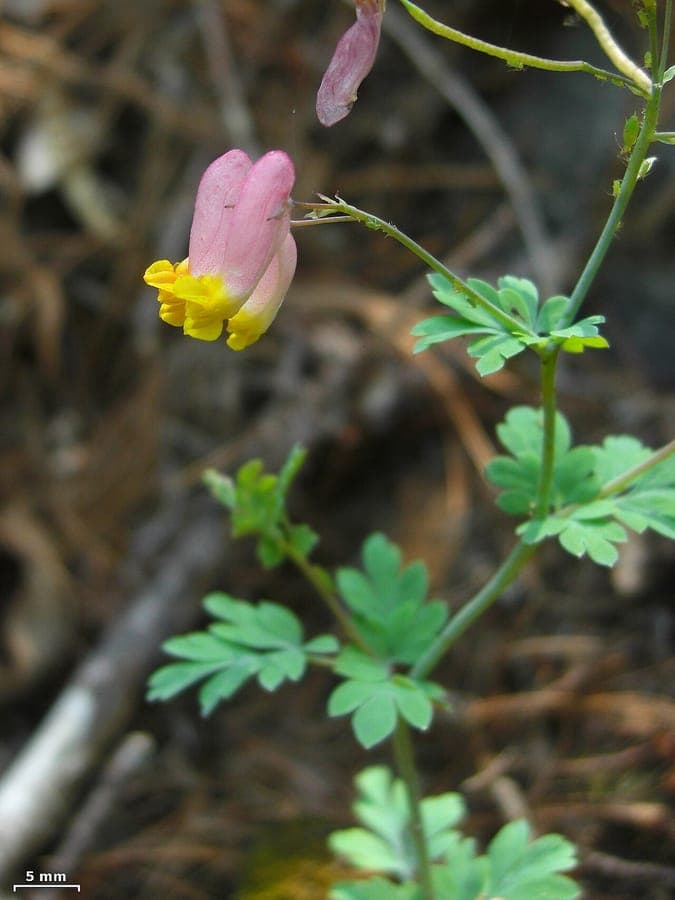
Jason Hollinger / CC BY 2.0, via Wikimedia Commons
Capnoides sempervirens: complete guide
Capnoides sempervirens
Want to see Capnoides sempervirens: complete guide in your garden?
1 minute, no credit card
Overview
Capnoides sempervirens, also known as Rock Harlequin, Pale Corydalis, or Pink Corydalis, is an elegant North American wildflower native to mountainous regions from Alaska to North Carolina. This delicate, evergreen plant is renowned for its graceful pink and yellow flowers and its ability to grow in challenging mountainous habitats where many other plants cannot flourish.
Appearance and bloom
Capnoides sempervirens is a small to medium herbaceous plant with finely divided, fern-like foliage that remains green year-round. The leaves are delicate and highly refined. The characteristic bicolored flowers appear in spring and early summer, usually in shades of pink, white, and yellow. The flowers are small but elegantly formed, resembling miniature harlequins. They grow in low dense clusters offering much interest.
Ideal location
This plant grows best in half-shaded to shaded locations, especially under deciduous trees or on shaded mountainsides. In cold, mountainous areas, some additional sun may be acceptable. Capnoides sempervirens is ideal for alpine gardens, shaded borders, rock gardens, and under large trees. The plant truly thrives in steep, challenging mountain locations with rock and gravel.
Soil
This plant thrives in well-draining, rocky soils. Rock gardens, gravelly soils, and soils with plenty of stones are ideal. The plant tolerates poor soils but prefers well-draining conditions. An acidic to neutral pH (5.5-7.0) is suitable. Heavy clay soil must be well amended with gravel and sand.
Watering
After establishment, Capnoides sempervirens needs regular watering, especially during the growing season. Once established, the plant is moderately drought-tolerant. Water regularly when the top layer feels dry. In mountainous areas with natural mountain streams, the plant functions well. Avoid waterlogging in winter months.
Free design
Want to see Capnoides sempervirens: complete guide in your garden? Make a free design now.
Pruning
Minimal pruning is needed. Dead leaves can be removed. After flowering, seed pods can be left for natural seeding and next generation. The plant maintains itself well in natural alpine environments. Unnecessary pruning can damage the delicate form.
Maintenance calendar
- Spring: Careful watering if it stays dry, remove debris
- Summer: Regular watering in dry periods, monitor for pests
- Autumn: Minimal watering as the plant goes dormant
- Winter: Very minimal watering, protection in very cold areas
Winter hardiness
Capnoides sempervirens is very winter-hardy and thrives in most North American mountainous regions. The plant undergoes dormancy in winter and thus adapts to very cold conditions. This makes it suitable for alpine gardens. No special protection is needed in most climates.
Companion plants
Capnoides sempervirens combines well with other alpine/mountain plants like various Dianthus species, Aquilegia, Geranium species, and other gravel-tolerant alpine flora. Other rock plants can grow nearby. Low-growing Sedum species work well as companions.
Closing
Capnoides sempervirens is an enchanting choice for designers with steep, mountainous, or challenging draining spaces. The delicate pink-yellow flowers and evergreen foliage offer year-round interest. This is a very frost-hardy, low-maintenance plant perfect for alpine and rockery gardens. For those seeking an elegant wildflower, Capnoides sempervirens is a beauty.
Seeds and young plants can be found at alpine plant nurseries and specialized wildflower suppliers.
Want to see Capnoides sempervirens: complete guide in your garden? Make a free design now.
Upload a photo, pick a style, and get a photorealistic design with plant list in under a minute.
No credit card required


Similar plants
Papaver gorodkovii: complete guide
Papaver gorodkovii
Papaver gorodkovii, the arctic poppy, thrives from Alaska to Russia's Far East. Discover how to grow this rare, extremely cold-hardy rock garden treasure.
Papaver setiferum: complete guide
Papaver setiferum
Papaver setiferum is a hardy giant Caucasian poppy with fiery red blooms. Discover siting, soil, deadheading and winter hardiness.
Pale Poppy: complete guide
Papaver alboroseum
Discover pale poppy (Papaver alboroseum) - rare alpine poppy with white-pink flowers. Precious beauty from Kamchatka. Cultivation in alpine and rock gardens.