
Unknown authorUnknown author / Public domain, via Wikimedia Commons
Campanula wilkinsiana: complete guide
Campanula wilkinsiana
Want to see Campanula wilkinsiana: complete guide in your garden?
1 minute, no credit card
Overview
Campanula wilkinsiana, commonly known as Wilkins's harebell or Wilkins' bellflower, is a graceful and delicate alpine plant from North America. Belonging to the Campanulaceae family, the same family as other bellflowers, this plant stands out with its fine, delicate blooms in soft blue and its neat growth habit. It makes an important accent in alpine and rock gardens.
This plant is known for its distinctive characteristics - compact growth, fine foliage, and long blooming period. While its exact natural distribution is uncertain, it likely grows in mountain regions of the western United States. This makes it a valued addition to collections of alpine flowers.
Appearance and Bloom
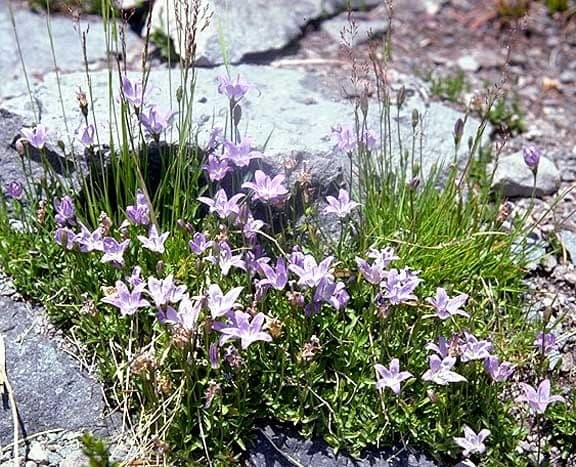
Campanula wilkinsiana grows as a compact, densely-formed plant with fine, narrow foliage. The plant reaches only 10-20 centimeters in height, making it a perfect accent for rock gardens and alpine troughs. The growth is graceful and cohesive.
The flowers are where this plant truly shines. These are soft blue to lavender-blue, bell-shaped with five petals that elegantly recurve. The flowers are small to medium, approximately 1-1.5 centimeters in diameter, and appear during the summer from June through September in wonderful profusion.
Flowers grow in loose racemes above the fine foliage, creating a charming, airy effect. They attract numerous pollinators, particularly bees and butterflies.
Ideal Location
Campanula wilkinsiana thrives in full sun to half-shade. While it tolerates full sun in cool climates, it appreciates some shelter from extreme heat. This is a very cool-loving plant.
The ideal growing spot contains:
- Full sun in temperate climates
- Half-shade in warm regions
- Good ventilation for disease prevention
- No stagnant water
- Elevation above ground level for excellent drainage
In the UK and northern Europe, best cultivate this plant in a rock bed or alpine trough with good light.
Soil
Campanula wilkinsiana requires very well-drained soil, especially grit and sand. This is a plant that naturally grows in rocky, poor soils.
Ideal soil composition for containers:
- 45% coarse sand or stone chips (2-5mm)
- 25% general purpose potting soil
- 20% orchid bark or expanded clay pellets
- 10% perlite for extra drainage
Avoid rich, nutrient-laden soils. This plant thrives in lean, dry soils. In gardens, you can grow seedlings in very well-drained pots.
Free design
Want to see Campanula wilkinsiana: complete guide in your garden? Make a free design now.
Watering
Campanula wilkinsiana requires moderate watering. During the growing period (April-October), water regularly but ensure soil never becomes waterlogged. In winter, watering can be drastically reduced - just enough to prevent complete desiccation.
Watering guidelines:
- Water at the base, not over foliage
- Allow soil to dry slightly between waterings
- Ensure perfect drainage from containers
- In winter: minimal watering
- Prefer rainwater or soft water
Pruning
Campanula wilkinsiana requires virtually no pruning. The plant grows naturally compact. The only maintenance consists of removing spent flower stems after blooming and cutting dead leaves.
Minimal maintenance:
- Remove faded flowers after blooming
- Cut dead leaves in spring
- Carefully remove damaged stems with disinfected pruners
- Avoid heavy pruning
Maintenance Calendar
March-April: Growth begins. Gradually increase watering. May-August: Bloom reaches peak. Regular watering and careful tending. September-October: Bloom ends gradually. Reduce watering gradually. November-February: Winter dormancy. Only minimal watering. Ensure soil doesn't dry completely.
Winter Hardiness
Campanula wilkinsiana is very cold-hardy. The plant can survive temperatures far below freezing. In the UK and northern Europe, this plant can overwinter outdoors in alpine troughs, as long as drainage is perfect. Snow cover is not a problem.
Winter protection is unnecessary, but protection from waterlogging during wet winters is essential.
Companion Plants
Campanula wilkinsiana combines beautifully with other alpine plants:
- Saxifraga - various saxifraga species
- Sempervivum - succulent varieties
- Androsace - small rosette-forming alpines
- Silene acaulis (moss campion) - pink miniature flowers
- Achillea clavennae - dwarf white yarrow
These combinations create interesting alpine displays with seasonal interest.
Closing
Campanula wilkinsiana is an elegant and valued plant for alpine enthusiasts. The soft blue flowers and compact growth make it an absolute treasure. While it requires careful watering, it is absolutely worthwhile for its long blooming period and lovely color.
Specimens may be available from specialized alpine nurseries. GardenWorld.app offers design advice for alpine gardens.
With proper drainage, careful watering, and a location in full sun, you'll enjoy this elegant alpine bellflower for many seasons.
Want to see Campanula wilkinsiana: complete guide in your garden? Make a free design now.
Upload a photo, pick a style, and get a photorealistic design with plant list in under a minute.
No credit card required


Similar plants
Campanula alaskana: complete guide
Campanula alaskana
Discover Campanula alaskana, the delicate alpine bellflower from Alaska. Growing tips, hardy requirements, and design ideas for rock gardens and alpine troughs.
Campanula scouleri: complete guide
Campanula scouleri
Discover Campanula scouleri, the refined Pacific bellflower. Growing tips, care requirements, and design ideas for woodland and mountain gardens.
Doublehorn calicoflower: complete guide
Downingia bicornuta
All about Downingia bicornuta - the doublehorn calicoflower: sowing, location, bloom and care for this rare annual in your garden.