
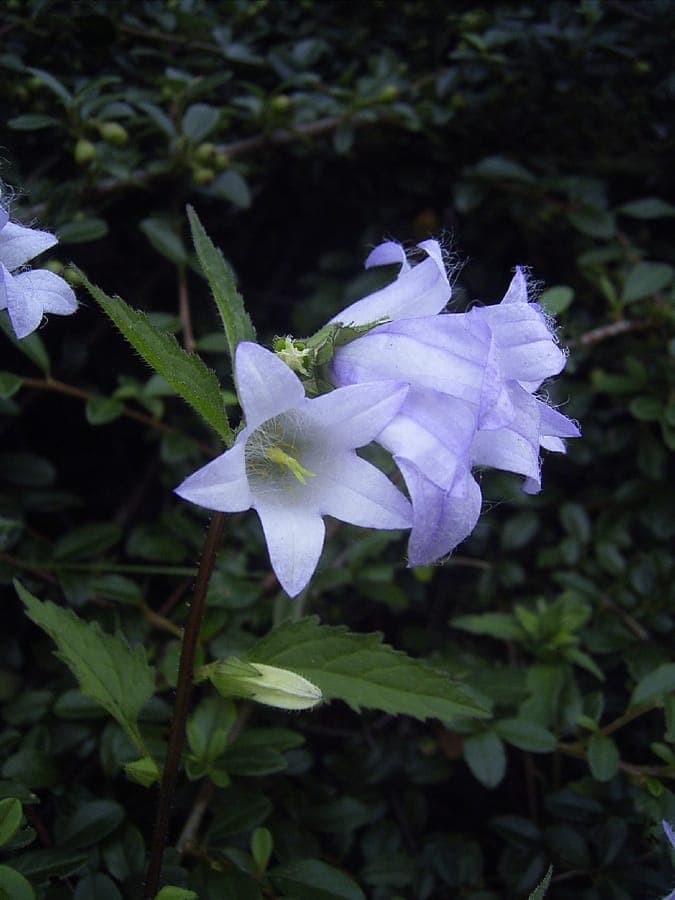
No machine-readable author provided. Denis Barthel assumed (based on copyright claims). / CC BY-SA 3.0, via Wikimedia Commons
Bats-in-the-belfry: complete guide
Campanula trachelium
Want to see Bats-in-the-belfry: complete guide in your garden?
1 minute, no credit card
Overview
Campanula trachelium, commonly known as Bats-in-the-belfry, is a bold and upright perennial that brings vertical interest to the garden from early summer through autumn. Native to central and eastern Europe, it grows naturally along woodland margins, hedgerows, and in open, moist clearings. Reaching heights of 50–80 cm, it's an excellent choice for the middle to back of a border, especially in areas with dappled or partial shade.
Despite its somewhat wild appearance, it's well-behaved in cultivation and doesn't spread aggressively. The common name 'Bats-in-the-belfry' refers to the clustered, drooping blue flowers that resemble tiny bats hanging in a bell tower - a whimsical nod to its floral structure. It belongs to the Campanulaceae family and is closely related to other bellflowers, though it's less commonly grown in UK and US gardens than species like Campanula carpatica or Campanula lactiflora.
On gardenworld.app, you can design a planting scheme that highlights Bats-in-the-belfry's architectural form in shaded borders.
Appearance & bloom cycle
The plant forms sturdy, erect stems with opposite, rough-textured leaves that are broadly ovate and coarsely toothed, 5–10 cm long. The foliage resembles stinging nettle but doesn't irritate the skin - a useful distinction when identifying it in the wild.
From June to September, loose panicles of nodding, bell-shaped flowers appear at the stem tips. Each flower is about 2–3 cm long, vivid blue, and flares slightly at the mouth. The bloom peak is in July, and the long flowering period makes it a reliable performer. After blooming, seed capsules form and split open, allowing seeds to disperse naturally - often resulting in gentle self-seeding in suitable spots.
Ideal location
Bats-in-the-belfry thrives in light to partial shade (around light level 5 out of 10). It performs best under open canopy trees, on the north or east side of structures, or in borders shaded by taller perennials. Full sun is tolerable only if the soil remains consistently moist, but in hot, dry summers, leaf scorch and stem flop are common.
It's ideal for cottage gardens, wildlife borders, and naturalistic plantings. It combines well with ferns, foxgloves, and tall grasses. Try visualising your layout on gardenworld.app to see how it fits into a layered planting design.
Free design
Want to see Bats-in-the-belfry: complete guide in your garden? Make a free design now.
Soil requirements
This plant prefers alkaline to neutral soil with a pH of 7.5–8.0. It grows well in loamy or clay-loam soils that retain moisture but drain adequately. Avoid acidic or waterlogged soils - amend with ground limestone if the pH is too low. A little organic matter, like well-rotted compost, improves structure without encouraging excessive leaf growth.
Heavy clay soils are acceptable as long as they don't stay soggy. Sandy soils need regular mulching to retain moisture.
Watering
During dry spells, especially in May through August, water deeply once a week. Avoid frequent light sprinklings - they encourage shallow roots. Water at the base to prevent foliar diseases like powdery mildew. In average UK or Pacific Northwest conditions, supplemental watering may not be needed outside prolonged droughts.
Morning watering is best to allow foliage to dry before nightfall.
Pruning
Pruning is minimal. After the main July flush, you can cut stems back by half to encourage a second, lighter bloom in late summer. If you prefer a natural look and want to support wildlife, leave the seed heads intact over winter - they provide food for finches and add structure to the dormant garden.
In early spring, remove any dead stems before new growth emerges.
Maintenance calendar
- Jan: clear away old foliage if not done in autumn
- Feb: check soil pH; add lime if needed
- Mar: divide mature clumps if desired
- Apr: apply light mulch; watch for slugs
- May: water during dry periods; inspect for aphids
- Jun: flowering begins; stake if needed
- Jul: deadhead or cut back for rebloom
- Aug: maintain moisture; observe seed development
- Sep: allow some seed heads to persist
- Oct: leave standing stems for winter interest
- Nov: mulch lightly with leaf mould
- Dec: no action required
Winter hardiness
Hardy in USDA zones 5–8. In zone 8 and milder, the plant dies back to ground level and re-emerges in spring. No winter protection is needed, though a light mulch in colder zones helps insulate the crown.
Companion plants
Pair with shade-tolerant perennials like Geranium macrorrhizum, Alchemilla mollis, Digitalis purpurea, or Astrantia major. It also works well with tall sedges (Carex spp.) and ferns such as Dryopteris filix-mas. Avoid overcrowding with vigorous spreaders like mint or goldenrod.
Closing
Bats-in-the-belfry is an underrated perennial that adds height, colour, and wildlife value to shaded areas. With its long bloom time and minimal care needs, it's perfect for low-maintenance gardens. Let it self-seed gently and it will form soft colonies over time.
Available at garden centres across the UK and US. Before planting, use gardenworld.app to plan its placement in your garden design for maximum impact.
Want to see Bats-in-the-belfry: complete guide in your garden? Make a free design now.
Upload a photo, pick a style, and get a photorealistic design with plant list in under a minute.
No credit card required


Similar plants
Campanula alaskana: complete guide
Campanula alaskana
Discover Campanula alaskana, the delicate alpine bellflower from Alaska. Growing tips, hardy requirements, and design ideas for rock gardens and alpine troughs.
Campanula scouleri: complete guide
Campanula scouleri
Discover Campanula scouleri, the refined Pacific bellflower. Growing tips, care requirements, and design ideas for woodland and mountain gardens.
Doublehorn calicoflower: complete guide
Downingia bicornuta
All about Downingia bicornuta - the doublehorn calicoflower: sowing, location, bloom and care for this rare annual in your garden.