
Wikimedia Commons / CC BY-SA 3.0, via Wikimedia Commons
Meadowbell: complete guide
Campanula rotundifolia
Want to see Meadowbell: complete guide in your garden?
1 minute, no credit card
Overview
Meadowbell, or Campanula rotundifolia, is a dainty yet resilient perennial that brings a soft, wild charm to gardens across temperate zones. Native to much of Europe and parts of Asia, it thrives in open grasslands, rocky slopes, and woodland edges. As a member of the Campanulaceae family, it grows as a forb or herbaceous plant, meaning it lacks woody stems and dies back in winter. It's not flashy, but its delicate presence and long bloom season make it a quiet standout in cottage gardens, rockeries, and meadow-style plantings.
This plant spreads gently by seed and short rhizomes, forming loose colonies over time. It's perfect for gardeners who appreciate naturalistic design. On gardenworld.app, you can create a border layout that mimics its wild habitat, blending it seamlessly with grasses and low-growing perennials.
Appearance & bloom cycle
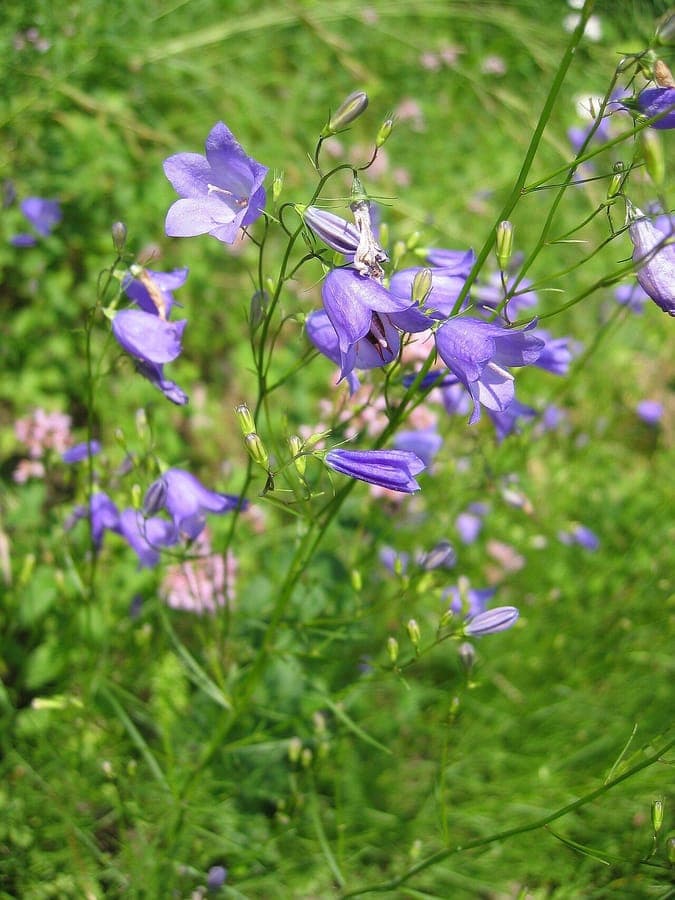
Meadowbell grows 15–40 cm tall, with slender, wiry stems that branch lightly. The basal leaves are round and slightly toothed - hence the species name rotundifolia. These often disappear by flowering time. Upper leaves are narrow, lance-shaped, and clasp the stem closely. The real show begins in early summer: from June to late August, nodding, bell-shaped flowers in soft violet-blue dangle from fine stalks. Each flower measures 1.5 to 2.5 cm long and lasts two to three days, but new buds open steadily, ensuring a long display.
You might catch a faint second flush in September if you trim spent stems in mid-August. The flowers attract bees, especially long-tongued bumblebees, and small butterflies. Seed capsules form in autumn, releasing tiny seeds that may germinate nearby the following spring.
Ideal location
Meadowbell prefers partial shade, scoring a 5 out of 10 on the light scale. That means dappled sunlight, morning sun with afternoon shade, or a spot under open-canopy trees. It tolerates full sun if the soil is well-drained, but in hot climates, full exposure may shorten the bloom period. In deep shade, it becomes leggy and blooms poorly.
It does best in airy, open settings - think rock gardens, dry stone walls, or between stepping stones. Avoid overcrowding. It pairs well with plants that don't compete aggressively for light or moisture. To visualise spacing and light conditions, use the planning tool on gardenworld.app to map out where Meadowbell will thrive alongside companions like yarrow or thyme.
Soil requirements
The ideal soil is well-drained, slightly acidic to neutral (pH 5.0–5.5), and lean to moderately fertile. Sandy or loamy soils work best. Heavy clay or waterlogged ground is a no-go - roots will rot. If your garden has poor drainage, raise the bed slightly or mix in grit or perlite to improve flow.
Meadowbell doesn't need rich soil. In fact, overly fertile conditions lead to floppy stems and fewer flowers. Avoid high-nitrogen fertilisers. A light mulch of grit in spring helps keep the crown dry and prevents fungal issues.
Free design
Want to see Meadowbell: complete guide in your garden? Make a free design now.
Watering
Once established, Meadowbell is drought-tolerant. During the first few weeks after planting, water deeply twice a week - about 1 litre per plant - to help roots settle. After that, rely on rainfall. Even in dry summers, mature plants rarely need supplemental watering.
If you're experiencing a prolonged drought (three weeks or more without rain), a weekly soak at the base can prevent stress. Use rainwater if possible. Never wet the foliage - it increases the risk of mildew. Water early in the morning to let excess moisture evaporate.
Pruning
Pruning is minimal. For a neater look or to encourage a second bloom, cut back flowering stems by half in mid-August. This won't guarantee rebloom, but it often results in fresh growth and a few late flowers.
In late autumn, leave the dead stems in place. They provide shelter for overwintering insects and add texture to the winter garden. Cut everything back to 5 cm in late winter or early spring, just before new growth emerges.
Maintenance calendar
- January: check for persistent debris; remove only if unsightly
- February: cut back old stems to 5 cm; clear space for new shoots
- March: monitor for emerging seedlings; thin if overcrowded
- April: ensure soil is free-draining; no feeding needed
- May: watch for bud formation; check for slug damage
- June: main bloom starts; deadhead optional
- July: peak flowering; keep an eye on pollinators
- August: trim stems for potential rebloom; collect seeds if desired
- September: light late bloom possible; allow self-seeding
- October: reduce watering; let plant go dormant
- November: no action required
- December: dormant; protect from waterlogged soil
Winter hardiness
Meadowbell is hardy in USDA zones 4–8, surviving temperatures down to -34°C. In the UK (zone 8), it's fully winter-hardy. The root system survives frost easily, and the plant reliably returns each spring. No mulch is needed unless your soil is exceptionally wet.
The main winter threat is soggy soil, not cold. Ensure good drainage to prevent crown rot. In areas with heavy winter rain, a light gravel mulch helps keep the base dry.
Companion plants
Choose companions with similar needs: well-drained soil and moderate moisture. Meadowbell blends well with yarrow (Achillea millefolium), wild thyme (Thymus serpyllum), and catmint (Nepeta). In rock gardens, pair it with sedums, houseleeks, or dwarf iris. For a meadow effect, combine with grasses like Deschampsia or Festuca.
Avoid invasive spreaders like mint or aggressive groundcovers. Meadowbell is subtle - it needs space to breathe.
Closing
Meadowbell is a low-fuss perennial that rewards with months of delicate blooms and ecological value. It's perfect for natural gardens, low-maintenance borders, or filling gaps in dry, tricky spots. You can find it at garden centres across the UK and North America, often in 9 cm pots.
If you're unsure where to place it, sketch a test layout on gardenworld.app. See how it interacts with light, soil, and neighbouring plants before you buy.
Want to see Meadowbell: complete guide in your garden? Make a free design now.
Upload a photo, pick a style, and get a photorealistic design with plant list in under a minute.
No credit card required


Similar plants
Campanula alaskana: complete guide
Campanula alaskana
Discover Campanula alaskana, the delicate alpine bellflower from Alaska. Growing tips, hardy requirements, and design ideas for rock gardens and alpine troughs.
Campanula scouleri: complete guide
Campanula scouleri
Discover Campanula scouleri, the refined Pacific bellflower. Growing tips, care requirements, and design ideas for woodland and mountain gardens.
Doublehorn calicoflower: complete guide
Downingia bicornuta
All about Downingia bicornuta - the doublehorn calicoflower: sowing, location, bloom and care for this rare annual in your garden.