
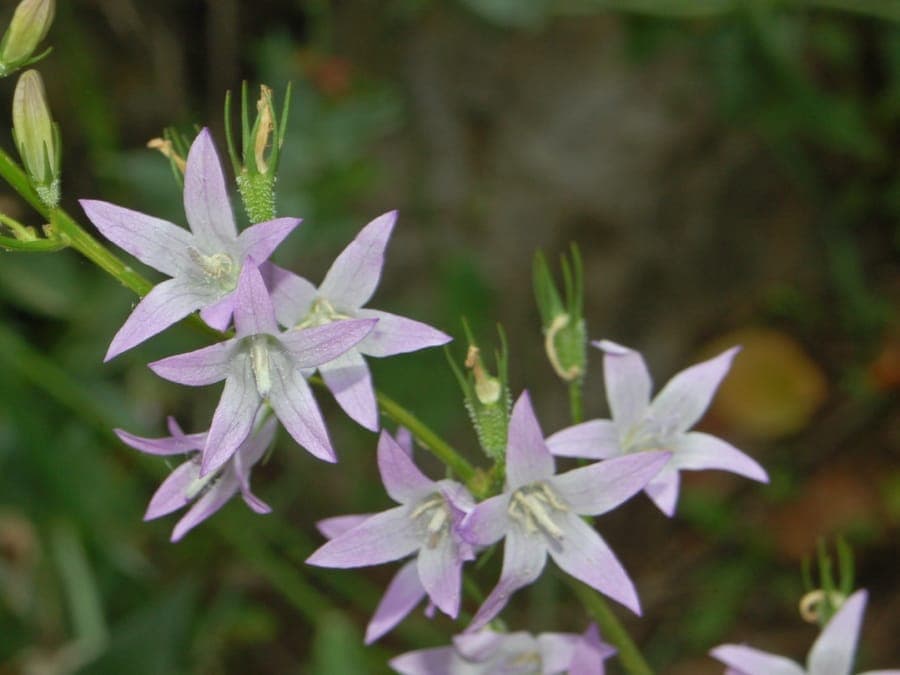
Hectonichus / CC BY-SA 3.0, via Wikimedia Commons
Rampion: complete guide
Campanula rapunculus
Want to see Rampion: complete guide in your garden?
1 minute, no credit card
Overview
Rampion, or Campanula rapunculus, is a graceful herbaceous perennial that brings both beauty and utility to the garden. Native to much of central and southern Europe, it thrives in open woodlands, grassy slopes, and forest edges from France to Bulgaria. Though rare in the wild in the UK, it's gaining popularity in cottage gardens and permaculture designs for its delicate blooms and edible roots.
Unlike many ornamental campanulas, rampion has a dual purpose: its young leaves are tender and mild, perfect for salads, while its taproot develops into a crisp, radish-like tuber in the second year. Historically, this root was a common vegetable in pre-modern European diets-before being overshadowed by the potato. Today, it's a rediscovered gem for gardeners who value heritage edibles.
On gardenworld.app, you can design a planting scheme that highlights rampion's dual role-both as a floral accent and a food source.
Appearance & bloom cycle
Rampion grows 30–60 cm tall, with upright, slender stems and narrow, lance-shaped leaves. The true show begins in late spring, when soft blue, bell-shaped flowers appear in loose racemes. Blooming runs from May through August, peaking in June and July. Each flower is 2–3 cm long, nodding slightly, and attracts bees and hoverflies.
The plant is biennial or short-lived perennial. In year one, it forms a rosette and builds its root. In year two, it bolts and flowers. After seeding, the parent plant often dies, but self-seeding can keep it in the garden if conditions allow.
Ideal location
Plant rampion in partial shade to light sun-about 4 to 6 hours of sunlight daily. Full sun works in cooler climates (USDA zones 5–6), but in warmer areas, afternoon shade prevents stress. It performs especially well under open tree canopies, along north-facing borders, or among taller perennials that offer light dappled shade.
Avoid deep shade, as flowering will be sparse. Also, protect from strong winds, which can snap the slender stems.
Soil requirements
Rampion prefers well-drained, loamy soil with moderate fertility. A mix of sand, silt, and organic matter is ideal. The pH should be between 6.0 and 7.0. Heavy clay soils must be amended with grit and compost to improve drainage, as waterlogged roots lead to rot. For container growing, use a mix of potting soil, perlite, and compost in a pot at least 30 cm deep to accommodate root development.
Avoid overly rich soils, which encourage leafy growth at the expense of root quality.
Free design
Want to see Rampion: complete guide in your garden? Make a free design now.
Watering
Keep soil consistently moist, especially during the first growing season. Once established, rampion tolerates short dry spells but performs best with regular watering in summer. Water at the base to prevent fungal issues. Drip irrigation or soaker hoses work well in beds. During prolonged droughts, deep watering once or twice a week is better than frequent shallow sprinkling.
Pruning
Deadhead spent flowers to prolong blooming and prevent excessive self-seeding. Cut stems back to a leaf node after flowering to tidy the plant and encourage bushier growth. In late autumn, cut back dead foliage to ground level. No heavy pruning is required-rampion is naturally tidy.
Maintenance calendar
- January: Check for heaved plants after frost. Replant if needed.
- February: Prepare beds. Add compost or well-rotted manure.
- March: Sow seeds indoors or direct-sow outdoors when soil warms.
- April: Transplant seedlings. Space 30 cm apart. Watch for slugs.
- May: Begin regular watering. Flowers start to appear.
- June: Peak bloom. Deadhead weekly.
- July: Monitor for drought stress. Support tall stems if necessary.
- August: Allow some seed heads to mature for self-sowing.
- September: Harvest roots from second-year plants. Flavor improves after first autumn frost.
- October: Divide clumps if overcrowded. Replant or share.
- November: Cut back dead foliage. Mulch lightly with leaf mould.
- December: Minimal care. Ensure good drainage in wet winters.
Winter hardiness
Rampion is hardy in USDA zones 5–8. In zone 5, a light mulch of straw or leaves helps protect the crown. In containers, wrap pots or move to a sheltered spot to prevent root damage from freeze-thaw cycles.
Companion plants
Pair rampion with plants that share its preference for partial shade and moist, well-drained soil. Good companions include foxglove (Digitalis), lady's mantle (Alchemilla mollis), lungwort (Pulmonaria), and cranesbill (Geranium spp.). It also works well near spring bulbs like grape hyacinth or daffodils, which provide early color.
Avoid aggressive spreaders like mint or ground elder.
On gardenworld.app, you can explore companion planting tools that suggest ideal pairings based on light, soil, and seasonal needs.
Closing
Rampion is an elegant, low-maintenance plant that bridges the gap between ornamental and edible gardening. Its airy blue flowers bring charm to borders, while its roots offer a unique, historic flavor. For gardeners seeking plants with character and utility, rampion is a standout. Available at garden centres across the UK and US in spring, including local independents and chains.
Want to see Rampion: complete guide in your garden? Make a free design now.
Upload a photo, pick a style, and get a photorealistic design with plant list in under a minute.
No credit card required


Similar plants
Campanula alaskana: complete guide
Campanula alaskana
Discover Campanula alaskana, the delicate alpine bellflower from Alaska. Growing tips, hardy requirements, and design ideas for rock gardens and alpine troughs.
Campanula scouleri: complete guide
Campanula scouleri
Discover Campanula scouleri, the refined Pacific bellflower. Growing tips, care requirements, and design ideas for woodland and mountain gardens.
Doublehorn calicoflower: complete guide
Downingia bicornuta
All about Downingia bicornuta - the doublehorn calicoflower: sowing, location, bloom and care for this rare annual in your garden.