
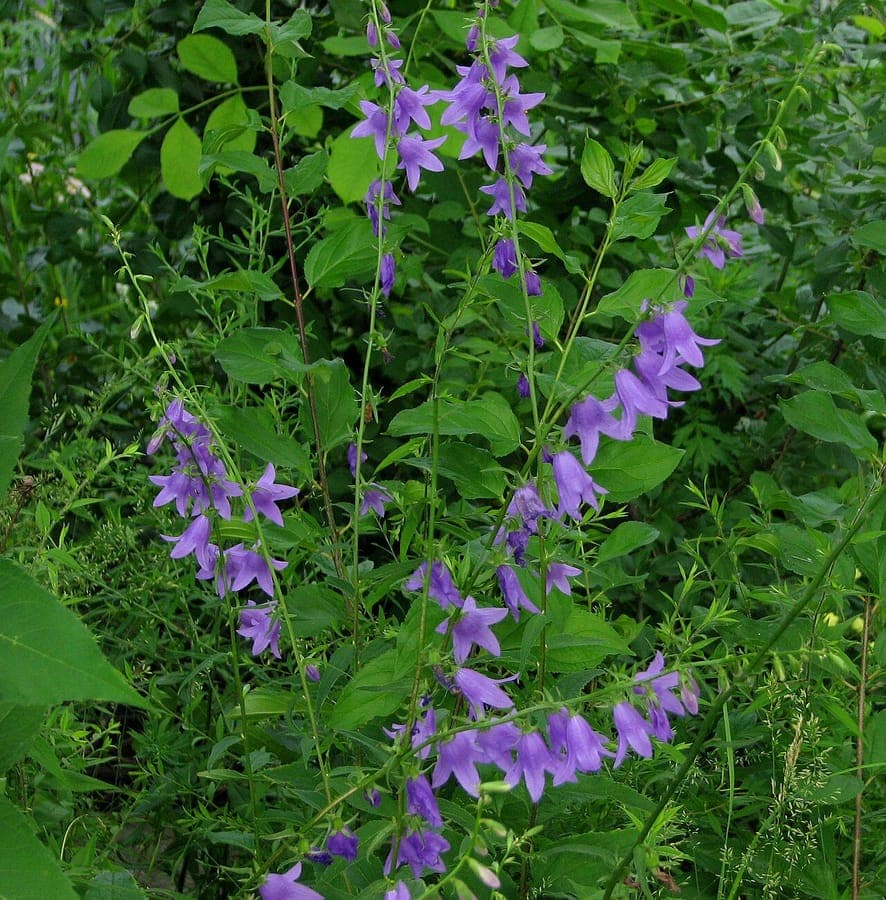
D. Gordon E. Robertson / CC BY-SA 3.0, via Wikimedia Commons
European bellflower: complete guide
Campanula rapunculoides
Want to see European bellflower: complete guide in your garden?
1 minute, no credit card
Overview
Campanula rapunculoides, commonly known as European bellflower, is a tough perennial that looks delicate but behaves like a turf war veteran in the garden. Native to central and eastern Europe - including Belarus, the Baltic States, and Austria - this member of the Campanulaceae family has made itself at home in many temperate regions, often too comfortably. It thrives in USDA hardiness zones 3 to 8 and can reach heights of 100–120 cm, with trailing or climbing stems spreading up to 150 cm via underground rhizomes.
Don't be fooled by the charming, nodding blue bells - this plant spreads aggressively. It's not just a matter of keeping it in check; it's about containment from day one. Once established, removing every bit of root is essential, because even a 2 cm fragment can sprout a new plant.
If you're considering adding it to your garden, think long and hard. On gardenworld.app, you can simulate how Campanula rapunculoides might take over your border within two growing seasons - a sobering but necessary reality check.
Appearance & bloom cycle
European bellflower produces long, slender stems with narrow, slightly hairy leaves, 4–8 cm in length. From late June through August, it bears drooping, bell-shaped flowers in soft lavender-blue, each about 2–3 cm long with five distinct lobes that flare outward like tiny stars. The overall effect is airy and whimsical, especially when lit by late afternoon sun.
Flowering lasts 4–6 weeks, often followed by a light second flush in early September if you deadhead diligently. The flowers are mildly fragrant and attract bumblebees, honeybees, and hoverflies. After blooming, seed capsules form and split open, scattering small, dark seeds - but seed spread is minor compared to the relentless underground creep.
The plant dies back in autumn, leaving behind brittle stems that persist through winter, offering shelter for overwintering insects. New shoots emerge in April, growing quickly once soil temperatures rise.
Ideal location
This plant prefers partial shade to light shade, though it tolerates full sun if soil moisture is consistent. In full sun, growth is more compact but dries out faster. In deep shade, it becomes leggy and blooms poorly.
Best suited for wilder corners of the garden - along fences, at woodland edges, or in naturalized areas where its spread can be monitored. Avoid planting near slow-growing or delicate perennials like primroses or alpines. Consider using root barriers - a 60 cm deep plastic or metal edging sunk into the soil - to contain its rhizomes.
It's not garden-center glam. It's more of a 'set it and somewhat forget it - but keep an eye on it' plant. Great for cottage garden backs or informal hedges, as long as you accept its wandering ways.
Free design
Want to see European bellflower: complete guide in your garden? Make a free design now.
Soil requirements
European bellflower isn't fussy. It grows well in loam, clay, or sandy soils, provided drainage is decent. It dislikes waterlogged conditions and extremely dry patches. Ideal pH ranges from 5.5 to 7.0 - slightly acidic to neutral.
No need for rich soil or added fertiliser. In fact, fertile conditions encourage faster spread. Plant it in average to moderately poor ground. If growing in containers - a smart move for control - use standard potting mix without extra nutrients.
Watering
Keep soil evenly moist during spring and early summer, especially for young plants. Established clumps are somewhat drought-tolerant but bloom better with consistent moisture. Water weekly during dry spells, more often in containers.
Avoid overhead watering when possible, as wet foliage in still air can promote fungal issues like powdery mildew. Water at the base, early in the day.
Pruning
Deadhead regularly to reduce seed spread, though this won't stop the real issue - the roots. Cut back flowered stems to the base after blooming. In autumn, leave the bare stems standing until early spring to provide winter habitat for beneficial insects.
If you're trying to limit its reach, remove surface runners by hand and dig out rhizomes carefully. Wear gloves - the sap can irritate sensitive skin. A yearly late-spring inspection helps catch new shoots before they root deeply.
Maintenance calendar
- Jan: Dormant; no action needed
- Feb: Watch for early shoots in mild areas
- Mar: Begin monitoring for new growth
- Apr: Water if dry; remove early runners
- May: Keep soil moist; check for spread
- Jun: Flowers begin; inspect for pests
- Jul: Peak bloom; deadhead to encourage rebloom
- Aug: Monitor seed pods; remove if needed
- Sep: Cut back dead stems; contain runners
- Oct: Leave stems for insects
- Nov: No pruning; allow natural dieback
- Dec: Dormant; protect containers from freeze-thaw
Winter hardiness
Fully hardy in USDA zones 3–8. Top growth dies back completely in fall, but roots survive deep underground. No mulch or winter protection is required, even in harsh climates. Container-grown plants should be kept in a sheltered spot to prevent root ball freeze-thaw cycles.
In milder winters, occasional green shoots may appear, but they rarely survive prolonged cold snaps.
Companion plants
Choose companions wisely. European bellflower will overwhelm anything slow or delicate. Stick to robust, fast-growing perennials that can hold their own:
- Echinacea purpurea
- Verbena bonariensis
- Monarda didyma
- Persicaria amplexicaulis
- Molinia caerulea
Avoid groundcovers like ajuga or thrift, and keep it far from alpine beds. A better approach? Grow it solo in a large pot, where its beauty can be enjoyed without risk.
Closing
European bellflower is a paradox - beautiful but bossy. It's not one to plant near your prized heirloom peonies. If you want it, commit to containment. You can find it at garden centres, but read labels carefully - it's often sold simply as 'Campanula' with no warning.
On gardenworld.app, you can design a virtual garden layout that factors in growth rate and spread, helping you decide whether this plant fits your space - or will take it over.
Want to see European bellflower: complete guide in your garden? Make a free design now.
Upload a photo, pick a style, and get a photorealistic design with plant list in under a minute.
No credit card required


Similar plants
Campanula alaskana: complete guide
Campanula alaskana
Discover Campanula alaskana, the delicate alpine bellflower from Alaska. Growing tips, hardy requirements, and design ideas for rock gardens and alpine troughs.
Campanula scouleri: complete guide
Campanula scouleri
Discover Campanula scouleri, the refined Pacific bellflower. Growing tips, care requirements, and design ideas for woodland and mountain gardens.
Doublehorn calicoflower: complete guide
Downingia bicornuta
All about Downingia bicornuta - the doublehorn calicoflower: sowing, location, bloom and care for this rare annual in your garden.